

Why Your PPC Budget Demands a Strategic Performance Review
A PPC performance review is essential for understanding what’s working, what’s wasting budget, and how to optimize your ad spend for better results. A proper review involves analyzing everything from account-level bidding strategies and campaign structure to ad creative and competitor performance, culminating in a clear action plan.
With brands wasting 40% of digital ad spend annually, a thorough review is critical. Without regular analysis, even strong ads decline as markets shift and competitors adapt. The challenge for many is navigating the sea of metrics to find the data that truly impacts business goals.
I’m Milton Brown, and since 2008, I’ve conducted PPC performance reviews for businesses with marketing budgets from $20,000 to $5 million. I help them find wasted spend and uncover growth opportunities. This guide will walk you through a structured approach to turn raw data into actionable insights.
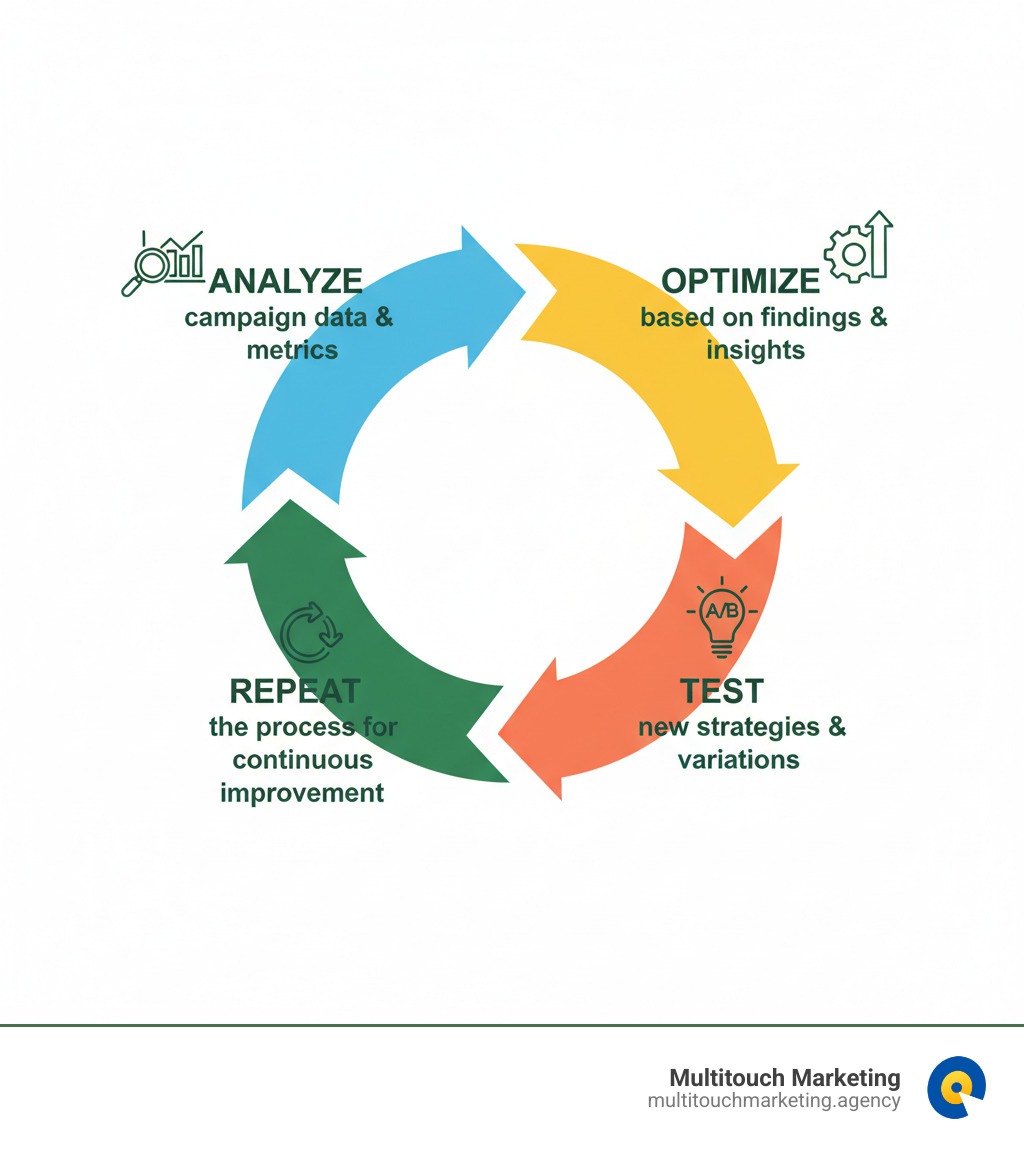
Why a Regular PPC Review is Non-Negotiable for Success
PPC campaigns require constant attention. Without it, resources are wasted and performance withers. A PPC performance review is your systematic check-up to see what’s working and what’s draining your budget. With marketing budgets remaining flat and ad costs rising, every dollar must count. Regular reviews help you catch market shifts and evolving customer behavior before significant budget is wasted. This disciplined approach ensures your advertising aligns with business goals, not just vanity metrics. Learn more about aligning your budget with objectives in our guide on PPC Campaign Budgeting for Small Businesses.
Reducing Wasted Ad Spend
The most immediate benefit of regular reviews is stopping money leaks. A thorough PPC performance review pinpoints where dollars are disappearing. Start with search term reports to find keywords generating clicks but no conversions; add them to your negative keyword list. Track individual ad performance to pause underperformers and redirect budget to winners. Your audience targeting also needs attention. A net cast too wide means you’re paying to reach people who won’t convert. Tightening audience definitions and adjusting bids based on device performance—mobile vs. desktop—are quick ways to improve efficiency. This proactive approach separates campaigns that break even from those that drive profit. Learn more in our article on Google Ads Budget Management.
Staying Ahead of the Competition
Reviews are also your offensive playbook. The digital ad landscape changes fast. Regular reviews help you spot market trends and adjust before competitors do. Competitor analysis reveals their bidding strategies and positioning, exposing gaps you can exploit. Pay close attention to your impression share—the percentage of times your ads appear versus their potential. A low share often means competitors are outbidding you or have better ad quality. This insight prompts strategic adjustments to bids and ads to reclaim lost ground. This forward-thinking strategy keeps you ahead of the curve. For a deeper dive, check out our guide on Best Social Media Analytics Tools for Competitor Analysis.
Decoding Your Data: From Foundational Metrics to Business KPIs
A PPC performance review means navigating a sea of data. The goal is to turn raw numbers—impressions, clicks, costs—into a story that makes sense for your business. A spike in clicks is only exciting if it leads to customers. This is the core of Data Driven Marketing Strategies: asking the right questions to guide decisions. While tools like AI in Marketing Analytics help process data, understanding what it means and how to act on it requires real expertise.
Foundational vs. Advanced Metrics
Not all metrics are equal. A meaningful PPC performance review distinguishes between foundational and advanced metrics. Foundational metrics are a daily health check: impressions, clicks, click-through rate (CTR), and cost per click (CPC). They tell us if people are seeing and engaging with our ads. A sudden drop in CTR, for example, is a red flag that requires investigation. Advanced metrics measure what matters to your business: conversion rate, cost per acquisition (CPA), and return on ad spend (ROAS). These metrics measure profitability and business impact. Foundational metrics tell you if your campaigns are running; advanced metrics tell you if they’re profitable. For more on this, see our guide on Focusing on PPC Marketing.
Key Metrics and What They Tell You
Let’s break down the numbers we watch in every PPC performance review.
Click-through rate (CTR) is the percentage of people who click your ad after seeing it. It’s a primary indicator of message resonance. A lagging CTR suggests your ad isn’t relevant or compelling enough.
Conversion rate is the percentage of clicks that result in a desired action (a sale, a lead). A high CTR with a low conversion rate often points to a landing page problem, like a mismatch between the ad’s promise and the page’s content.
Cost per acquisition (CPA) tells you what you pay for each new customer. This number must be sustainable. If your CPA exceeds the profit from a new customer, your model isn’t working.
Quality Score is Google’s 1-to-10 grade for your ads, based on expected CTR, ad relevance, and landing page experience. A higher Quality Score leads to lower costs and better ad positions.
Return on ad spend (ROAS) measures the revenue generated for every dollar spent. A 4:1 ROAS means $4 in revenue for every $1 spent. However, ROAS measures revenue, not profit. Savvy marketers also track profit on ad spend (POAS) to understand true profitability.
Impression share shows how often your ads appear compared to their potential. A low share means you’re missing visibility, usually due to budget limits or being outbid by competitors.
Each metric tells part of the story. Our job is to read them together to make your campaigns more profitable. For more strategies, explore our article on How to Increase Your ROI Through Scientific SEM.
Your Step-by-Step Guide to a Thorough PPC Performance Review

Now that we understand the metrics, let’s walk through the process of a PPC performance review. This structured approach turns data into actionable insights, helping us spot wasted spend and align ad performance with business outcomes. This process is the foundation for continuous PPC Campaign Optimization that drives growth.
Step 1: Define Goals and Establish Baselines
Before analyzing metrics, we must answer: What are we trying to achieve? We start by setting SMART goals (Specific, Measurable, Achievable, Relevant, Time-bound) that connect directly to your business objectives. For example, instead of “get more leads,” a better goal is “increase qualified leads by 20% next quarter at our current CPA.” Next, we establish your baseline performance. As Senior Growth Marketer Marc Thomas notes, without a baseline, you’re just guessing based on industry benchmarks, which is a poor strategy since every company and situation is different. Your historical data tells us what’s “normal” for your business, allowing us to measure improvement accurately. For more on setting goals, see our resource on PPC Campaign Strategies.
Step 2: Analyze Account Structure and Settings
With clear goals, we examine your account’s foundation. A well-organized structure is vital for budget control and accurate reporting. We review campaign organization to ensure logical segmentation (e.g., by product, service, or geography). We then evaluate ad groups for thematic relevance; each should have a tight keyword set with matching ads to improve relevance and Quality Score. Budget allocation is reviewed to ensure top performers are funded to scale, while underperformers aren’t draining resources. We also verify location targeting to avoid paying for clicks outside your service area and analyze ad scheduling (dayparting) to focus bids during peak conversion times. For guidance on structure, see our guide on Set Up Google Ad Campaign.
Step 3: Dive into Keyword and Audience Performance
This step focuses on your keywords and audiences. The Search Term Report is a goldmine, showing the actual phrases people typed before clicking your ads. As Benjamin Sulka of Cleveland Clinic emphasizes, regular analysis ensures your keywords align with relevant searches. We use this report to find new keyword opportunities and identify irrelevant searches to add as negative keywords. A robust PPC Negative Keyword Strategy is one of the fastest ways to cut wasted spend. We also evaluate keyword match types to balance control and volume, a topic covered in our PPC Keyword Match Types guide. Beyond keywords, we analyze audience segments (demographics, interests, remarketing lists) to see which groups are most responsive. As Jules Foster of Automation Anywhere suggests, reviewing CRM data helps zero in on your target customer, informing both targeting and messaging.
Step 4: Evaluate Ad Creative and Landing Pages
Perfect targeting fails if your creative or landing page is weak. This step reviews the user experience from ad to conversion. We start with A/B testing: are you systematically testing headlines and descriptions? Continuous testing is essential, and you can learn from common A/B Testing on FB Mistakes. Ad relevance is critical; your copy must match the searcher’s intent. For Google Ads, we check your Ad Strength rating, as “excellent” ads perform better. Your call-to-action must be clear and direct, telling users exactly what to do next. Finally, we analyze the landing page. We check technical basics like page speed and mobile-friendliness, then review the content for clarity. A high CTR with a low conversion rate often signals a mismatch between the ad’s promise and the landing page experience.
Step 5: Integrate Competitor Analysis
A PPC performance review isn’t complete without competitor analysis. We use tools like SEMRush and Ahrefs to see what keywords competitors are bidding on and what their ad copy looks like. The Auction Insights report in Google Ads is especially valuable, showing how you stack up against direct competitors in the same auctions. It reveals impression share, overlap rate, and how often you outrank them. We analyze this data to find keyword gaps (terms they target that you don’t) and understand their unique selling propositions. The goal isn’t to copy competitors, but to find an advantageous position by targeting overlooked keywords or crafting more compelling messaging. For more tools, explore our guide on Best Social Media Analytics Tools for Competitor Analysis.
From Analysis to Action: Leveraging Insights and Avoiding Pitfalls

A PPC performance review is meaningless if the analysis doesn’t lead to action. The real value comes from turning insights into strategic decisions that improve ROI. This is where we shift from analysis to action planning, using Advanced PPC Techniques to drive continuous improvement.
How to Leverage Insights for Better ROI
Once we have insights, we put them to work. Budget reallocation is often the fastest path to better ROI. As Ads Specialist Stefan Valentin notes, you give more budget to campaigns with the best return and cut spend on those that aren’t delivering. Bid adjustments follow, increasing bids for high-converting keywords, locations, and devices. Your ad copy should never be static; A/B testing guides us in refining messaging. Landing page optimization is critical when CTR is high but conversions are low. We fix friction points like confusing forms or unclear calls-to-action. A key step many businesses miss is creating a feedback loop with your sales team. HubSpot’s 2024 data shows a quality gap in marketing leads. Your sales team knows what questions prospects ask and what objections they have. This intelligence, as Jules Foster notes, helps refine targeting and messaging for higher-quality leads. Finally, AI Driven Marketing Strategies can accelerate this process by spotting patterns and suggesting optimizations.
Determining Your Review Cadence
How often should you review campaigns? It depends on your ad spend and market, but a consistent schedule is non-negotiable.
- Daily checks: A quick scan for major issues like budget pacing, ad disapprovals, or sudden performance swings.
- Weekly analysis: A deeper dive to review search terms, assess ad tests, and identify wasted spend for quick optimization wins.
- Monthly summaries: A big-picture view comparing month-over-month performance, reviewing budget efficiency, and planning future tests.
- Quarterly strategic audits: The highest-level review to reassess overall strategy, business goals, and the competitive landscape.
This structured cadence ensures you stay aligned with long-term objectives. For more on this, explore our Tips Expert PPC Management.
Common Pitfalls in a PPC Performance Review
Knowing the common pitfalls of a PPC performance review helps you avoid them.
- Ignoring business goals: Don’t get lost in vanity metrics like a low CPC if those clicks don’t convert profitably.
- Over-relying on automation: Automated tools need active monitoring to ensure they align with your strategy and don’t drive up costs.
- Neglecting creative fatigue: Ads get stale over time, so regularly refresh creative to keep campaigns engaging.
- Using short attribution windows: For products with long sales cycles, a short lookback window can lead you to pause campaigns that are actually working.
- Lacking a consistent review cadence: Without a schedule, you’ll always be reacting to problems instead of proactively preventing them.
Avoiding these traps keeps your review process sharp and effective. Learn more in our article on Busting PPC Marketing Myths.
Frequently Asked Questions about PPC Performance Reviews
How often should you conduct a PPC performance review?
The ideal frequency depends on your ad spend, account complexity, and market dynamics. However, a good framework is: daily monitoring for major anomalies, weekly analysis to identify trends and quick wins, and in-depth monthly or quarterly reviews for strategic planning. The key is consistency; stick to your chosen cadence to ensure nothing falls through the cracks.
What tools are essential for a PPC review?
An effective PPC performance review relies on a few key tools.
- Native ad platforms (Google Ads, Meta Ads Manager, etc.) provide the raw data and foundational reports.
- Web analytics platforms like Google Analytics 4 are crucial for understanding post-click behavior, such as bounce rates and on-site conversions.
- Specialized reporting dashboards centralize data from multiple sources, making it easier to spot cross-channel trends and generate insights efficiently.
How do you measure the success of a PPC campaign?
Success is measured by comparing performance against KPIs that align with your business objectives. While health metrics like CTR and CPC are important for diagnostics, true success is defined by bottom-line metrics: Conversion Rate, Cost Per Acquisition (CPA), and Return on Ad Spend (ROAS). The specific KPIs depend on your business model. For lead generation, focus on lead quality and cost per qualified lead. For e-commerce, ROAS and Profit on Ad Spend (POAS) are paramount. A successful campaign is one that contributes meaningfully to your core business goals.
Maximize Your Ad Spend with an Expert Review
A comprehensive PPC performance review is essential for getting the most from your advertising dollars. With flat budgets and rising competition, you must ensure you’re not wasting money. Think of it like checking a business’s books; without consistent analysis, even healthy-looking campaigns can quietly drain your budget.
At Multitouch Marketing, we specialize in navigating the complex world of PPC advertising. Our approach turns raw numbers into clear, actionable strategies that move the needle for your business. A regular PPC performance review is what opens up your campaigns’ true potential, ensuring your budget works as hard as you do.
If you’re ready for an expert evaluation that uncovers hidden growth opportunities, consider scheduling a professional Pay-Per-Click Audit with our team. We’ll help you optimize your PPC performance so every dollar works harder for your bottom line.