
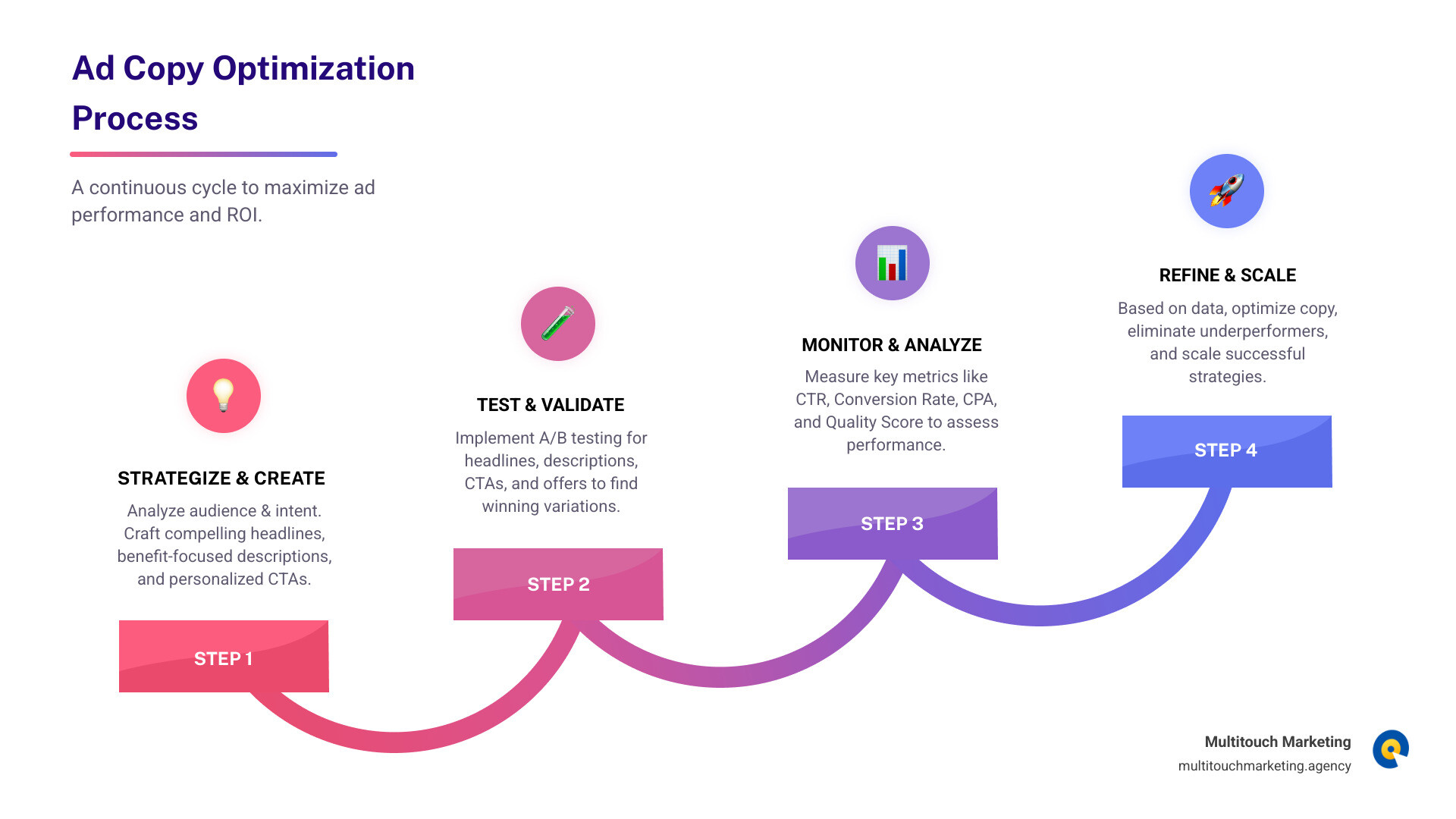
Why Ad Copy Optimization Is Your Secret Weapon for Digital Success
Ad copy optimization is the systematic process of refining your advertisement text to maximize clicks, conversions, and return on investment. Here’s what you need to know:
- Test everything – Headlines, descriptions, CTAs, and offers through A/B testing
- Match user intent – Align your copy with what people are actually searching for
- Focus on benefits – Tell customers what’s in it for them, not just product features
- Use psychological triggers – Urgency, social proof, and emotional appeals drive action
- Optimize continuously – Regular testing and refinement based on performance data
The stakes are high. The average person sees up to 5,000 ads daily, yet 39% of people believe ads aren’t relevant to them. Poor ad copy wastes budget on clicks that don’t convert, while optimized copy can reduce advertising costs by as much as 75%. Even small improvements matter—advertisers who improve their Ad Strength from ‘Poor’ to ‘Excellent’ see 12% more conversions on average.
The challenge for small business owners is real. You’re competing against companies with massive marketing budgets and dedicated teams. You need every advantage you can get. The good news? Knowing the most effective ways to craft ad copy at the best price can be the difference between effective advertising and a money pit.
Ad copy optimization isn’t just about clever wordplay. It’s about understanding your target audience, leveraging data-driven insights, and creating persuasive messaging that compels action. It’s the bridge between your brand and your audience—the difference between ads that get scrolled past and ads that drive real business growth.
Strategic Ad copy optimization can transform underperforming campaigns into revenue-generating machines. The most effective approach combines data-driven methodologies with psychological principles that drive conversions, a strategy proven across industries like e-commerce, healthcare, and higher education.
This guide will walk you through every aspect of creating high-converting ad copy—from understanding the core components of effective ads to platform-specific strategies, testing frameworks, and common pitfalls to avoid.
The Anatomy of High-Converting Ad Copy
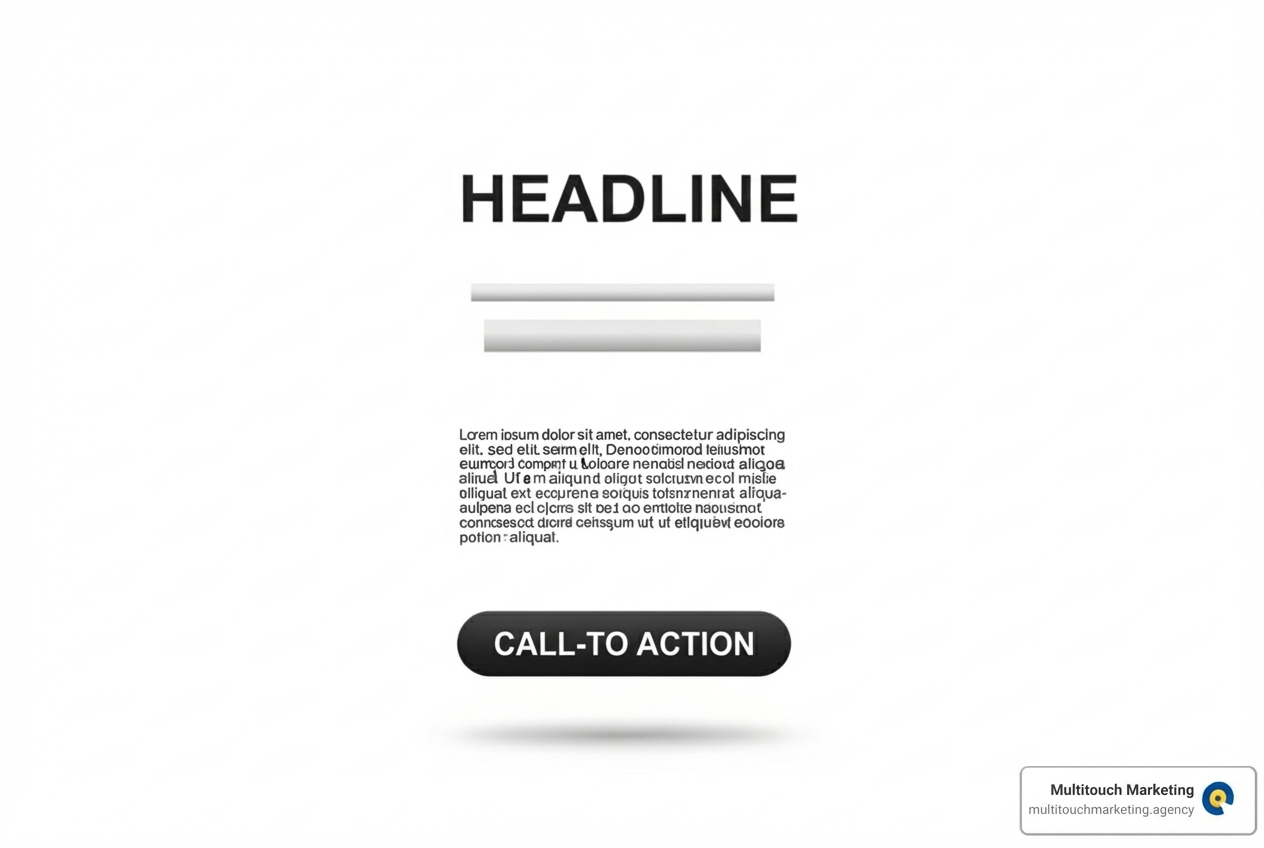
At its heart, every successful ad is a carefully constructed message designed to grab attention and prompt action. Think of it like a finely tuned machine, where each component plays a vital role. When we talk about ad copy optimization, we’re dissecting this machine to make every part as efficient and compelling as possible.
Crafting Irresistible Headlines
Your headline is your ad’s first impression, and often its only chance to stop a scrolling thumb or scanning eye. With the average person seeing thousands of ads daily, we need to make those precious few characters count!
We focus on:
- Keywords: Incorporating relevant keywords isn’t just for search engine optimization; it tells users immediately that your ad is relevant to their needs. For example, if someone in Raleigh, NC, is searching for “emergency plumber,” a headline like “Raleigh Emergency Plumber – 24/7 Service” will clearly resonate. Using a varied PPC Keyword Match Types strategy helps us capture specific intent.
- User intent: Beyond just keywords, we consider the underlying intent. Are they looking for information, a comparison, or ready to buy? Our headlines should speak directly to that intent. Instead of just “Shoes,” we might use “Performance Running Shoes for Marathoners.”
- Specificity: Vague headlines get ignored. Specificity creates curiosity and trust. “Lose Weight” is okay, but “Lose 10 Pounds in 30 Days with Our Proven Plan” is far more compelling.
- Power words: These are words that trigger emotions and create urgency. Words like “instant,” “exclusive,” “proven,” or “guaranteed” pack a punch. Instead of “Ways to improve conversions,” try “Proven ways to double your conversions overnight.” Feel the difference? We often refer to a List of power words that trigger emotions to improve our headlines.
Writing Descriptions That Convert
Once the headline hooks them, your description reels them in. This is where we expand on the value proposition, address pain points, and build credibility.
- Benefits over features: This is a golden rule. Instead of listing what your product is, explain what it does for the customer. “Our software has AI-powered analytics” (feature) becomes “Save 10 hours per week on reporting, giving you more time for strategy” (benefit). Switching from feature-focused to benefit-driven copy has the potential to significantly cut CPA.
- Social proof: People trust what others say more than what you say about yourself. Incorporating testimonials, reviews, or statistics (“Trusted by 50,000+ local businesses”) can be incredibly powerful. According to statistics published by Brightlocal, around 87% of people use Google to find reviews before making a purchase. For local businesses, this means showcasing positive local reviews prominently.
- Storytelling: A compelling narrative can connect with your audience on an emotional level, especially when addressing pain points and offering solutions. A common strategy is to start with a common struggle and then present a service as the hero.
- Numbers and data: Specific numbers add credibility. “Save a lot of money” is weak compared to “Save up to 75% on your monthly bills.” Exact numbers often outperform rounded ones because precision is interpreted as honesty. Our SEO Search Engine Optimization efforts often involve weaving these data points into compelling narratives.
Creating Powerful Calls-to-Action (CTAs)
Your CTA is the grand finale, the explicit instruction telling your audience what to do next. A weak CTA leaves them hanging; a strong one guides them seamlessly to the next step.
- Action-oriented language: Use verbs that command action. “Learn More” is fine, but “Get Your Free Quote,” “Shop Now,” or “Download the Guide” are much stronger.
- Urgency: Creating a sense of urgency (when genuine!) can prompt immediate action. Phrases like “Limited Time Offer,” “Sale Ends Tonight,” or “Only 3 Spots Left” can be highly effective.
- Personalization: This is a game-changer. Personalized call-to-actions perform 202% better than basic CTAs. Instead of “Download the guide,” try “Get your free marketing guide” or “Start your free trial today.” We often tailor our Social Media Ad Creative with personalized CTAs for maximum impact.
The Psychology of Persuasion: Writing Copy That Connects
Effective ad copy isn’t just about what you say, but how you say it, and crucially, how it resonates with the human mind. We dig into the fascinating world of consumer psychology to craft messages that truly connect.
Tapping into the Subconscious Mind
Here’s something that might surprise you: 90 percent of the decision-making process happens subconsciously. This means our potential customers are often making gut-level decisions about your ad before their logical brain even engages. We leverage this by:
- Emotional triggers: We aim to connect with emotions first. Fear of missing out, aspiration, relief from pain, joy, security – these are powerful motivators. For example, for a client offering home security in Chapel Hill, NC, we might use copy that evokes the feeling of safety and protection for their family.
- Loss aversion: People are often more motivated to avoid a loss than to gain something of equal value. Phrases like “Don’t miss your chance to lock in 30% off” can be highly effective.
- Social proof: As mentioned before, the herd mentality is strong. If others are doing it, it must be good. “Join 25,000+ satisfied customers” or “Rated 5 stars on Google” provides powerful subconscious reassurance. Understanding these deep-seated motivations helps us create more impactful campaigns, often informed by our AI-Driven Customer Insights.
Tailoring Copy to the Marketing Funnel
Our audience isn’t a monolith; they’re at different stages of their buying journey. The ad copy needs to reflect this, guiding them smoothly from initial awareness to final conversion. We consider the marketing funnel at every step:
- Awareness stage: At this top-of-funnel stage, people are just recognizing a problem or need. Our copy here is light, educational, and curiosity-driven. “Struggling with slow internet in Raleigh?” or “Find the benefits of solar power for your Durham home.”
- Consideration stage: Here, people are researching solutions. Our copy focuses on benefits, features, and how our client’s solution stands out. “Compare our high-speed internet plans in Raleigh” or “Engineered for maximum energy efficiency: Our solar solutions in Durham.”
- Conversion stage: At the bottom of the funnel, the audience is ready to buy. Our copy is direct, urgent, and focused on the offer. “Sign up for our fastest internet plan today!” or “Get a free solar consultation for your Chapel Hill business.” This strategic approach is a cornerstone of our Data Driven Marketing Strategies.
The Power of Personalization and Segmentation
One size rarely fits all in advertising. We know that 39% of people believe ads aren’t relevant to them. That’s a massive opportunity for ad copy optimization! We combat this by:
- Audience segmentation: We break down our target market into smaller groups based on demographics, interests, behaviors, and location. For instance, an ad for a roofing contractor in Raleigh might show different copy to homeowners than to commercial property managers.
- Dynamic Keyword Insertion (DKI): For search ads, DKI allows us to automatically insert the user’s search query into the ad copy, making it incredibly relevant. If someone searches for “best Italian restaurant Raleigh,” the ad might dynamically show “Best Italian Restaurant in Raleigh.” This personalization dramatically increases relevance and click-through rates.
- Relevance: When an ad feels like it’s speaking directly to you, you’re far more likely to engage. Whether it’s through DKI or tailoring entire ad sets to specific segments, personalization makes ads feel less like an interruption and more like a helpful suggestion. Our Set Up Dynamic Remarketing Google Ads strategies often use advanced personalization techniques.
Platform-Specific Ad Copy Optimization Strategies
Each advertising platform has its own quirks, audience expectations, and technical limitations. What works brilliantly on Google Search might fall flat on Facebook. As digital marketing experts serving Raleigh, Durham, and Chapel Hill, we understand these nuances and tailor our ad copy optimization strategies accordingly.

Google Ads: Capturing Search Intent
Google Ads is all about intent. People are actively searching for solutions, so your copy should be direct, keyword-rich, and benefit-focused.
- Keyword-rich copy: We ensure headlines and descriptions contain relevant keywords that users are searching for. This boosts relevance and helps improve your Quality Score in Google Ads, which can lead to lower costs and better ad positions.
- Responsive Search Ads (RSAs): Google’s RSAs use machine learning to combine different headlines and descriptions for optimal performance. We provide Google with a variety of headlines (up to 15, 30 chars max) and descriptions (up to 4, 90 chars max), and the system automatically tests combinations to find what resonates best with searchers.
- Ad Strength: Google provides “Ad Strength” feedback, helping us see where we can make copy more effective, from keyword usage to headline uniqueness. Improving Ad Strength from ‘Poor’ to ‘Excellent’ can lead to 12% more conversions on average. We continuously work to improve Quality Score in Google Ads for our clients, which directly benefits from optimized ad copy. Our Google Ads Campaign Management Services are designed to handle these complexities.
Facebook & Instagram Ads: Stopping the Scroll
On social media, ads appear in a feed where users are primarily engaging with friends and content. Our goal here is to stop the scroll and entertain or inform in a more conversational way.
- Visual-first copy: While we’re talking about copy, on Facebook and Instagram, visuals often do the heavy lifting. Our copy needs to complement engaging images or videos. Viewers retain 95% of a message when they watch it in a video compared to 10% when reading it in text.
- Conversational tone: We aim for a friendly, approachable voice that feels natural in a social feed. Emojis can also help convey tone and capture attention.
- Storytelling: Social media is a great place for short, impactful stories that highlight a problem and introduce our client’s solution. Conversational banners, for example, yield an average of 4.6% CTR, accounting for an impressive 1214.29% increase in engagement. We leverage these insights in our How to Advertise on Facebook strategies.
LinkedIn Ads: The Professional Approach
LinkedIn is a professional network, and our ad copy reflects that. It’s about thought leadership, professional development, and B2B solutions.
- B2B focus: Our copy directly addresses business challenges and professional goals. For B2B clients, we focus on how their services can improve efficiency, drive growth, or solve industry-specific problems.
- Value-driven content: LinkedIn users are often looking for valuable insights, tools, or services that can benefit their careers or businesses. Our ads might promote whitepapers, webinars, or case studies.
- Professional tone: We maintain a respectful, authoritative, and informative tone. Jargon is acceptable if it’s common in the target industry. We tailor our SMM Social Media Marketing efforts for LinkedIn to reflect this professional environment.
The Science of Refinement: Testing and Measuring Your Ad Copy
Crafting brilliant ad copy isn’t a one-and-done deal; it’s an ongoing scientific process of testing, measuring, and refining. We don’t just guess what works; we prove it with data.
The Crucial Role of A/B Testing in Ad copy optimization
A/B testing, also known as split testing, is our superpower. It allows us to compare two (or more) versions of an ad to see which performs better. This isn’t just about tweaking words; it’s about making data-driven decisions that directly impact your ROI.
- Statistical significance: We ensure our tests run long enough and gather enough data to determine a statistically significant winner. This means we can be confident that the observed difference isn’t just random chance.
- Isolate variables: The golden rule of A/B testing is to test one thing at a time. If we change the headline and the image, how do we know which change caused the performance difference? We test headlines against headlines, descriptions against descriptions, and so on.
Elements to Test:
- Headlines: Different angles, power words, questions, statements.
- Descriptions: Benefits vs. features, length, tone, inclusion of social proof.
- CTAs: Wording, urgency, personalization.
- Offers: “Free trial” vs. “10% off,” different discount amounts.
- Images/Videos: Different visuals can dramatically impact engagement.
Constantly running A/B tests for clients ensures their ad spend is optimized. Understanding A/B Testing on FB Mistakes helps us avoid common pitfalls and achieve cleaner data.
Key Metrics for Measuring Success
How do we know if our ad copy optimization efforts are paying off? We track and analyze key performance indicators (KPIs):
- Click-Through Rate (CTR): The percentage of people who see your ad and click on it. A higher CTR often indicates more relevant and compelling copy.
- Conversion Rate: The percentage of people who click your ad and complete a desired action (e.g., purchase, form submission). This is the ultimate measure of your copy’s persuasive power.
- Cost Per Acquisition (CPA): How much it costs to get one conversion. Optimized copy can significantly reduce CPA by driving more efficient clicks and conversions.
- Return On Ad Spend (ROAS): The revenue generated for every dollar spent on advertising. Our goal is always to maximize ROAS for our clients.
- Quality Score (Google Ads): Google’s rating of your ad’s relevance and quality. High Quality Scores lead to lower costs and better ad placement.
- Engagement Rate (Social Media): Likes, comments, shares, and other interactions. This shows how well your copy is resonating with the audience.
We use sophisticated tools and our Social Media Marketing Analytics Tools knowledge to carefully track these metrics and make informed decisions.
The Hidden Threat: Ad Fraud’s Impact on Your Ad copy optimization
Even the most perfectly optimized ad copy can be undermined by a silent saboteur: ad fraud. This is a crucial, often overlooked, factor in campaign success.
- Skewed data: Ad fraud, such as bot traffic, can inflate clicks and impressions, making your ad copy appear more successful than it is. This leads to misinformed optimization decisions.
- Wasted budget: Fraudulent clicks drain your ad budget on non-human interactions, meaning your brilliant copy isn’t even reaching real people. Poor ad copy wastes budget on clicks that don’t convert, but ad fraud wastes budget on clicks that were never going to convert in the first place.
- Invalid clicks: These are clicks generated by bots or fraudulent schemes, not genuine users interested in your offering.
- Bot traffic: Sophisticated bots can mimic human behavior, making it difficult to distinguish legitimate engagement from fraud.
We emphasize robust ad fraud protection because it ensures your budget is allocated wisely and your campaign performance metrics are accurate. Without it, your ad copy optimization efforts might be based on false positives, hindering true growth. Our PPC Campaign Optimization includes strategies to mitigate ad fraud.
Common Ad Copy Mistakes to Avoid
We’ve seen it all, and we’ve learned from it all. Here are some common pitfalls we help our clients avoid:
- Vague language: “Great products, great service” tells us nothing. Be specific about your unique selling proposition.
- Focusing on features, not benefits: As we discussed, customers care about what’s in it for them.
- Mismatched landing pages: If your ad promises “50% off all services,” the landing page better deliver that promise prominently. A user landing on a generic homepage after clicking a specific ad is a recipe for a high bounce rate. Nearly half of all users will leave a website if it takes longer than 3 seconds to load, so landing page speed is also critical. Our Responsive Web Design services ensure landing pages are fast and relevant.
- Forgetting the CTA: Don’t assume users know what to do. Always include a clear, compelling call to action.
- Ignoring mobile users: With a significant portion of local searches happening on phones (e.g., 90% of local roofing searches), ads and landing pages must be optimized for mobile. A clunky mobile experience will drive users away, costing you potential leads in Raleigh, Durham, or Chapel Hill.
Frequently Asked Questions about Ad Copy Optimization
How often should I optimize my ad copy?
Ad copy optimization is not a one-time task; it’s a continuous process, much like tending a garden. We recommend keeping a close eye on your ads daily or weekly. You should certainly optimize when you notice performance dips (e.g., CTR dropping, CPA creeping up) or when you launch new offers or promotions. Ongoing A/B tests should be running for active campaigns, refreshing best-performing ads with new variations every few weeks and constantly testing fresh ideas in smaller ad groups.
What’s a good click-through rate (CTR) for ad copy?
Industry benchmarks for CTR vary widely depending on the platform, industry, and ad type. For instance, search ads might average under 2% CTR, while social and display ads often see even lower rates. Rather than chasing an arbitrary benchmark, we focus on continuous improvement. A consistently climbing CTR indicates that your ad copy optimization efforts are working. It’s also important to consider the relationship between CTR and conversion rate; sometimes a lower CTR with a higher conversion rate can be more valuable if it’s attracting more qualified leads.
How does ad copy affect my campaign’s ROI?
Ad copy optimization directly impacts your campaign’s Return on Investment (ROI) in several significant ways:
- Increases CTR: Compelling copy leads to more clicks from interested users.
- Lowers CPC: On platforms like Google Ads, a higher CTR contributes to a better Quality Score, which can reduce your Cost Per Click (CPC).
- Increases conversion rates: Effective copy attracts the right audience and persuades them to take action, leading to more conversions.
- Maximizes ad spend: By attracting more qualified clicks and conversions at a lower cost, optimized copy ensures your ad budget is spent more efficiently, ultimately driving a higher ROI.
Conclusion
From the busy streets of Raleigh to the vibrant communities of Durham and Chapel Hill, we understand that standing out in the digital crowd requires more than just showing up. It demands precision, psychology, and persistent refinement. Ad copy optimization is your secret weapon, changing bland messages into brilliant calls to action that drive real business growth.
We’ve explored the core components of effective ad copy, digd into the psychological triggers that motivate action, and outlined platform-specific strategies to ensure your message resonates where it matters most. The journey doesn’t end with a perfectly crafted ad; it’s a continuous cycle of testing, measuring, and refining to stay ahead.
At Multitouch Marketing, we combine data-driven methodologies with a deep understanding of human behavior to craft ad copy that not only captures attention but converts. We’re here to help you turn your ad spend into a powerful engine for growth.
Ready to make your ad copy brilliant? Explore our Expert Social Media Marketing services and let’s optimize your campaigns for success.