
Why Your PPC Clicks Aren’t Converting (And How to Fix It)
Conversion rate optimization PPC is the systematic process of increasing the percentage of your paid ad clicks that turn into customers, leads, or other desired actions. Here’s what it involves:
- Analyzing your data to find where potential customers drop off
- Testing changes to your ads and landing pages
- Improving message match between what your ad promises and what your landing page delivers
- Reducing friction in forms, checkout, and user experience
- Continuously monitoring performance to maximize return on ad spend (ROAS)
Let’s be real—you’re spending hundreds or thousands of dollars driving traffic to your site through PPC campaigns. But when visitors arrive? Most of them just leave. No conversion. No sale. No email signup. Nothing.
This is the frustrating reality for most businesses running pay-per-click advertising. You’re not alone if your conversion rates are disappointing. The average PPC conversion rate across all industries sits at just 2.35%—meaning nearly 98 out of every 100 people who click your ad don’t take action.
But here’s the good news: even small improvements compound dramatically. If you improve from 2% to 3% conversion, that’s 50% more results without spending another dollar on ads. Getting more value from the traffic you already pay for is the fastest path to better ROI.
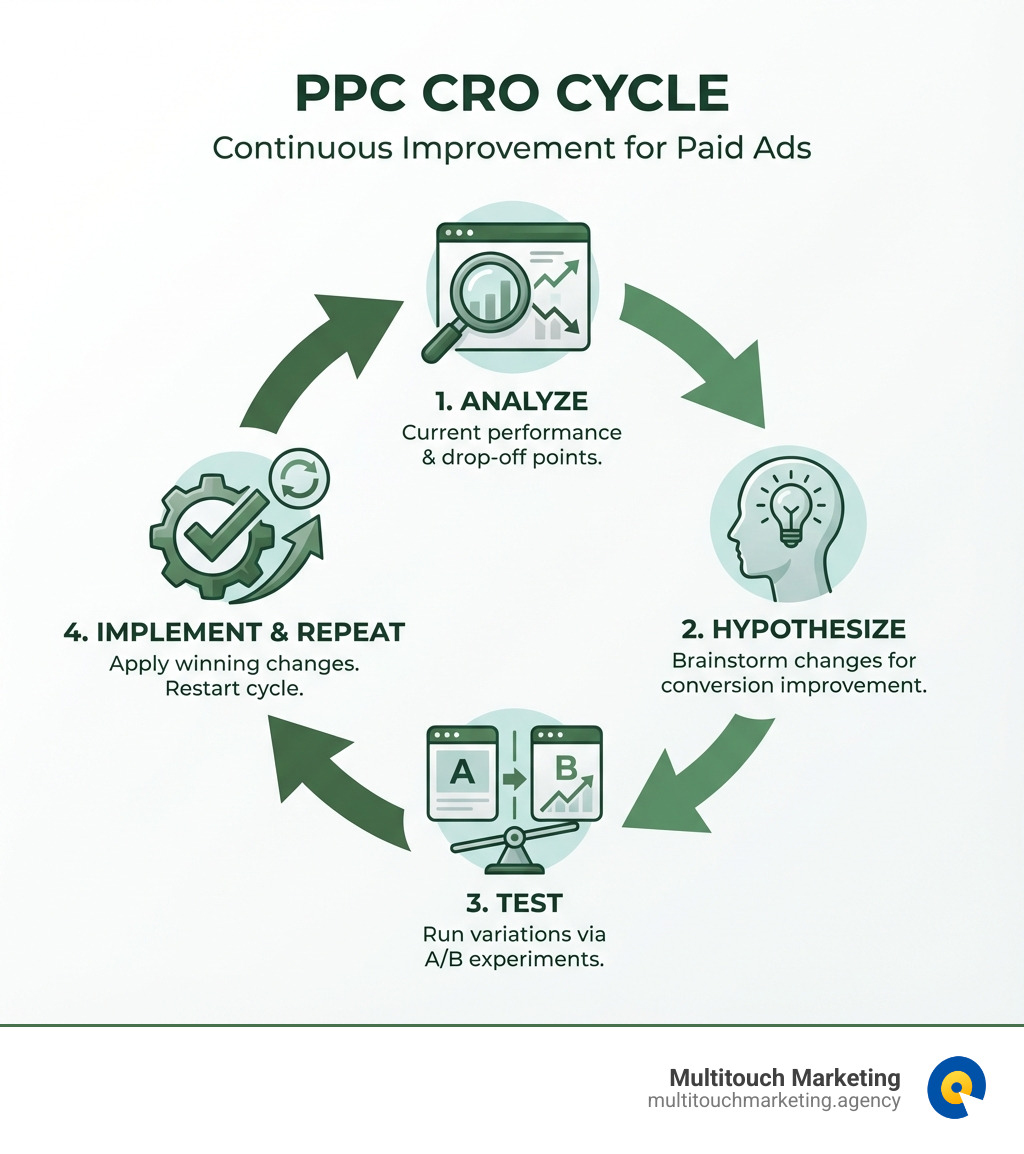
Conversion rate optimization for PPC isn’t a one-time fix. It’s an ongoing cycle of analysis, hypothesis, testing, and implementation. You’ll examine every touchpoint—from your ad copy and targeting to your landing page design and checkout flow—looking for friction points that cause visitors to bounce.
I’m Milton Brown, and since 2008 I’ve managed PPC accounts ranging from $20,000 to $5 million in ad spend across industries like healthcare, e-commerce, and education. Throughout my career, Conversion rate optimization PPC has consistently been the multiplier that transforms mediocre campaigns into highly profitable ones. In this guide, I’ll walk you through the exact strategies that have helped my clients turn more clicks into customers.
Conversion rate optimization PPC further reading:
Measuring Success: Calculating and Benchmarking Your PPC Conversion Rate
Before we can optimize, we need to understand what we’re optimizing for. What is a conversion, and how do we measure it?
A conversion is any desired action a visitor takes on our website or landing page after clicking a paid ad. These actions can be categorized into:
- Macro conversions: The big goals, like a purchase, a contact form submission, or a trial signup. These are usually the ultimate objectives of our PPC campaigns.
- Micro conversions: Smaller steps that indicate user engagement and move them closer to a macro conversion, such as an email newsletter signup, a content download, or viewing a key product page. Tracking these helps us understand user behavior even if they don’t convert immediately.
The formula for calculating our PPC conversion rate is straightforward:
Conversion Rate = (Number of Conversions / Number of Clicks) x 100%
For example, if our ad receives 500 clicks and results in 25 conversions, our conversion rate would be (25 / 500) x 100 = 5%. This percentage tells us that 5% of the people who clicked our ad completed the desired action.
Accurate tracking is paramount here. We need to know which ads, keywords, and landing pages are driving conversions to make informed optimization decisions. Without reliable data, we’re just guessing, and in PPC, guessing is expensive.
What is a ‘Good’ PPC Conversion Rate?
“What’s a good conversion rate?” is one of the most common questions we hear. The honest answer is: it depends! A conversion rate between 2% to 5% is typical across industries. However, exceptionally awesome PPC campaigns may achieve rates above 10%. We’ve seen top-performing advertisers achieve conversion rates of 11.45% or higher, proving that significant performance is possible with proper Conversion rate optimization PPC.
Industry benchmarks provide context, but they’re not a definitive target. Our ultimate goal isn’t just to match an average, but to continuously improve our own performance. A 2% conversion rate for a high-value B2B service might be excellent, while a 5% rate for a low-cost e-commerce product might be just average.
Based on analysis of conversion data across many industry studies, here are some average PPC conversion rates by industry:
| Industry | Average PPC Conversion Rate |
|---|---|
| Media & Entertainment | 18.1% |
| Animals & Pets | 16.3% |
| Physicians & Surgeons | 16.1% |
| Events & Leisure | 12.9% |
| Automotive Repair & Service | 12.6% |
| Dentists & Dental Services | 10.4% |
| Health & Fitness | 11.0% |
| Home & Home Improvement | 10.2% |
| Restaurants & Food | 10.1% |
| Software as a Service (SaaS) | 9.5% |
| Beauty & Personal Care | 7.9% |
| Travel | 7.5% |
| Business Services | 6.8% |
| Finance & Insurance | 6.5% |
| Healthcare | 6.5% |
| Agency Services | 6.1% |
| Sports & Recreation | 5.9% |
| Automotive Sales | 5.7% |
| Real Estate | 4.4% |
| Arts & Entertainment | 4.5% |
| Furniture | 2.9% |
| Apparel & Fashion | 2.6% |
| Cosmetics | 2.3% |
| B2B Technology | 1.7% |
Notice how service-based industries often outperform product-based sectors. This is typically due to the immediacy of service needs driving faster decision-making. For us, whether working with a local business in Raleigh, NC, or a regional service provider across North Carolina, understanding these nuances is key to setting realistic expectations and optimizing effectively.
How Conversion Rates Differ Across PPC Platforms
Every PPC platform is like its own little universe, with a unique crowd and quirky ad dynamics that can totally shake up our conversion rates. User intent is a major factor here. People on Google Search are actively looking for something, often with high commercial intent, while those on social media might be browsing for entertainment or connection.
Here’s a snapshot of average conversion rates across various PPC platforms:
| Platform | Average Conversion Rate |
|---|---|
| Amazon Ads | 9.89% |
| Facebook/Instagram Ads | 9.21% |
| LinkedIn Ads | 6.1% (can range 5%-15%) |
| Google Ads (Search Network) | 4.4% |
| Microsoft Ads (Bing) | 2.94% |
| Google Shopping Ads | 1.91% |
| Pinterest Ads | 1.5% |
| TikTok Ads | 1.1% |
| 1.08% | |
| X (formerly Twitter) | 0.77% |
| Google Display Network | 0.57% |
Google Ads (Search Network) typically performs best because users are actively searching for solutions. For businesses in Durham, NC, targeting highly specific keywords on Google Search can yield strong conversion rates. However, the Google Display Network has a much lower average conversion rate as it’s more for brand awareness.
Facebook/Instagram Ads boast surprisingly high conversion rates, often ranging from 9% to 10%. This is because of their powerful targeting capabilities, allowing us to reach highly specific audiences with personalized messages.
Microsoft Ads (Bing) often boasts a slightly higher average conversion rate than Google Ads in some sectors. Bing’s audience isn’t just a carbon copy of Google’s—they’re a whole different crowd with unique search habits, often older and with higher disposable income, which can be a goldmine for certain businesses in Chapel Hill, NC.
Amazon Ads are a goldmine for e-commerce, with an average conversion rate of 9.89%. This makes sense: people on Amazon are usually ready to buy.
LinkedIn Ads might seem a bit expensive, but they’re like a secret weapon for awesome conversion rates (5% to 15%) if we play our cards right, especially for B2B services.
For specialized campaigns, like PPC for Travel Industry, we know that the average travel and hospitality conversion rate for search is 3.55%. Our strategy always aligns with the platform’s audience and intent to maximize results.
The Core Components of Conversion Rate Optimization PPC
Conversion rate optimization PPC isn’t magic; it’s a structured approach that tackles every part of the user’s journey, from the moment they see our ad to the moment they convert. We break this down into two main areas: the pre-click experience (our ads and targeting) and the post-click experience (our landing pages and website).
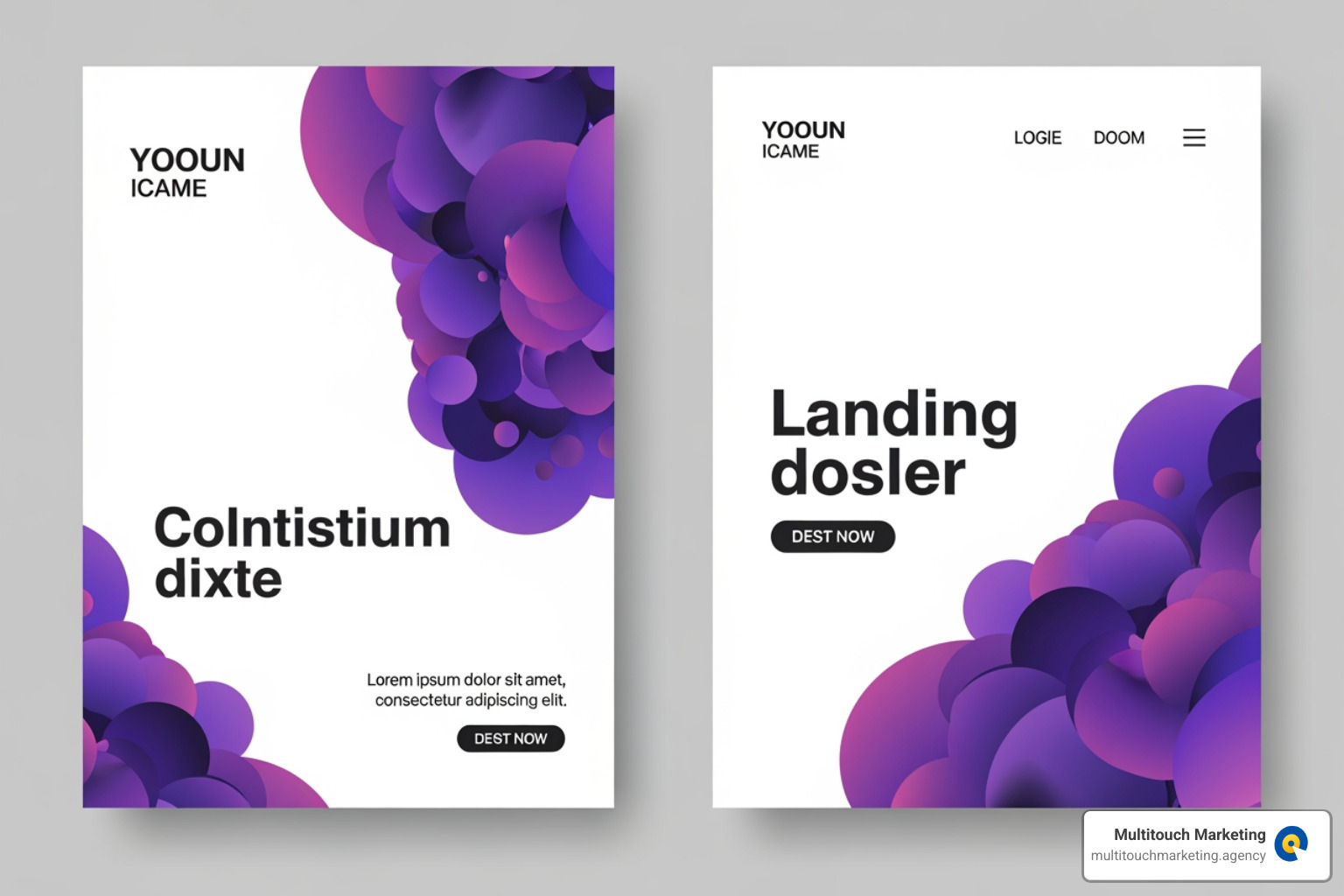
The alignment between these two experiences is paramount. Imagine clicking an ad for “Best Pizza in Raleigh” only to land on a page about Italian restaurants in general. We’d probably bounce faster than a perfectly cooked pizza crust! That’s why message match, reducing friction, and ensuring a seamless user journey are at the heart of our strategy.
Optimizing the Pre-Click Experience: Ads and Targeting
Our ads are the first impression, the digital handshake. Optimizing them means attracting the right clicks—those most likely to convert.
- Compelling Ad Copy: Our ad copy needs to be clear, concise, and persuasive. It should highlight our unique selling proposition and solve a problem for the searcher. We always focus on crafting headlines that grab attention and ad descriptions that build anticipation.
- Strong Value Proposition: What makes us different? What problem do we solve? Our ads must clearly communicate our value proposition to attract qualified leads.
- Keyword Relevance: This is fundamental. We need to bid on keywords that accurately reflect what we offer and what our potential customers are searching for. Utilizing precise PPC Keyword Match Types ensures our ads show for relevant queries.
- Negative Keywords: Just as important as positive keywords! Negative keywords prevent our ads from showing for irrelevant searches, saving us money on wasted clicks. For example, if we sell new cars in Durham, NC, we’d add “used” as a negative keyword.
- Audience Segmentation: We don’t just target broadly. We segment our audience based on demographics, interests, behaviors, and intent. This ensures our ads reach the most receptive individuals in North Carolina.
- Ad Quality Score: This is Google’s rating of the quality and relevance of our keywords, ads, and landing pages. A higher Quality Score means lower costs and better ad positions. Our pre-click optimization efforts directly impact this.
- Increasing Click-Through Rate (CTR): While CTR isn’t conversion, a higher CTR means more people are interested enough to click. We achieve this with compelling ad copy, strong calls-to-action, and relevant ad extensions.
- Ad Extensions: These are snippets of additional information that appear with our ads, like phone numbers, site links, structured snippets, and callouts. They provide more value to the user and take up more real estate on the search results page, boosting visibility and often CTR.
Why Landing Pages are Crucial for PPC Conversion Rate Optimization
Our ads do the hard work of getting the click, but our landing pages close the deal. A landing page’s sole purpose is to convert, not to explore.

- Single Objective: A dedicated landing page should have one, and only one, primary conversion goal. For a business in Chapel Hill, NC, promoting a free consultation, the landing page shouldn’t distract with links to career pages or blog posts. It should guide the user directly to the consultation request form.
- Message Match: This is non-negotiable. The headline, offer, and visuals on our landing page must directly match the ad that brought the user there. If the ad promises “20% off all services,” the landing page must immediately confirm that offer. Discrepancy is a massive conversion killer.
- Page Load Speed: Every extra second a page takes to load increases the chance users will bounce by 17%. Walmart found that for every 1-second improvement in load time, conversions increased by around 2%. We aim for landing page loading speeds under 2 seconds by compressing images, lazy loading videos, and minimizing scripts.
- Mobile-First Design: With mobile devices accounting for almost 60% of web page views worldwide in January 2024, optimizing for mobile is no longer optional. Our landing pages must be responsive, load fast on mobile, and offer a “thumb-friendly” experience with large, easy-to-tap buttons and simplified forms.
- Clear Call-to-Action (CTA): This is the heart of our landing page. Our CTAs need to be direct, bold, and specific. They should stand out visually with contrasting colors and use action-oriented language. Fun fact: rounded CTA buttons receive anywhere from 17 to 55% more clicks than buttons with sharp angles!
- Social Proof and Trust Signals: Nearly 90% of consumers trust word-of-mouth recommendations, and 80% will typically read five or more reviews before committing to a purchase. We leverage testimonials, customer reviews, security badges, and guarantees to build trust and credibility.
- Common ‘Conversion Killers’: We rigorously identify and fix these. They include:
- Lack of message match: As discussed, this immediately erodes trust.
- Slow loading times: Frustrates users and increases bounce rates.
- Cluttered design/too many distractions: Users get overwhelmed and leave.
- Unclear value proposition: Visitors don’t understand what’s being offered or why they need it.
- Too many form fields: One company increased conversions by 120% just by reducing a form from 11 fields to four. We simplify forms, asking only for essential information.
- Lack of mobile optimization: A huge turn-off for a majority of users.
- Weak or missing CTA: Users don’t know what to do next.
- Lack of social proof/trust: Visitors are hesitant to engage with an unknown entity.
We know how to make great landing pages that achieve crazy-high conversion rates, ensuring every click has the best possible chance to turn into a customer.
The Continuous Improvement Cycle: Testing, Tracking, and Tools
Conversion rate optimization PPC isn’t a “set it and forget it” strategy. It’s an ongoing, iterative process driven by data. We constantly analyze, hypothesize, test, and implement changes. This continuous improvement cycle is what allows us to adapt to changing market conditions, user behaviors, and competitive landscapes.
Developing clear hypotheses is crucial. Instead of guessing, we form educated predictions based on our data: “If we simplify the checkout form by removing optional fields, we hypothesize that cart abandonment will decrease by 5%.” Then, we test it.
Statistical significance is our guiding star. We run tests long enough to ensure our results aren’t just random chance. This scientific approach means every change we make is backed by solid data. Our PPC Campaign Optimization process is built on this foundation.
How to Use A/B Testing to Improve Conversions
A/B testing (or split testing) is our go-to method for validating hypotheses. It involves creating two (or more) versions of a web page or ad element and showing them to different segments of our audience simultaneously. The goal is to see which version performs better against our conversion goals.
The golden rule of A/B testing is to test one variable at a time. This allows us to isolate the impact of each change. What can we test? Almost anything!
- Headlines: Different angles, benefits, or pain points.
- Images/Videos: Different visuals can evoke different emotions or clarify offers.
- Form Length: Fewer fields vs. more detailed information.
- CTA Copy and Design: “Get Started” vs. “Claim Your Free Audit,” or a blue button vs. an orange one. Rounded buttons, for instance, often outperform sharp-angled ones.
- Layout and Structure: Single-column vs. multi-column, placement of elements.
- Offer: A free ebook vs. a checklist.
After running our tests, we use an A/B test significance calculator to determine if our results are statistically significant. If a variation wins, we implement it and continue the cycle of testing new hypotheses.
Key Metrics and Tools for Measuring PPC Conversion Rate Optimization
To effectively measure and improve our Conversion rate optimization PPC efforts, we carefully track several key metrics:
- Conversion Rate (CR): Our primary metric, as discussed, indicates the percentage of clicks that convert.
- Cost Per Acquisition (CPA): The total cost of our ad spend divided by the number of conversions. A lower CPA is always better.
- Return On Ad Spend (ROAS): The revenue generated from our ads divided by the cost of those ads. This tells us how much revenue we’re getting back for every dollar spent.
- Click-Through Rate (CTR): The percentage of people who clicked our ad after seeing it. While not a conversion metric, a high CTR signals ad relevance.
- Bounce Rate: The percentage of visitors who leave our landing page after viewing only one page. A high bounce rate often indicates a mismatch between the ad and landing page, or poor landing page experience.
For deep dives into performance, we leverage advanced analytics. Our AI in Marketing Analytics helps us uncover patterns and insights that might otherwise be missed. Beyond standard analytics platforms, we use specialized tools for user behavior analysis, such as:
- Heatmaps: These visually show where users click, move their mouse, and scroll on our pages. If users consistently leave a form unfinished, for example, simplifying it can increase conversions.
- Session Recordings: These allow us to watch anonymized recordings of actual user sessions, revealing exactly how visitors interact with our content, where they get stuck, and why they might abandon a page.
At Multitouch Marketing, we use a suite of essential CRO tools and analytics approaches to ensure we’re always making data-driven decisions for our clients in Raleigh, Durham, and Chapel Hill, NC. These include robust analytics platforms for tracking and attribution, user behavior analytics for qualitative insights, and A/B testing platforms for rigorous experimentation.
Advanced Strategies to Maximize PPC ROI
Once we’ve mastered the basics of Conversion rate optimization PPC, we can implement more advanced strategies to further maximize our ROI, scale our campaigns, and ensure long-term profitability. Our Data Driven Marketing Strategies are constantly evolving to incorporate the latest techniques.
How CRO Reduces Your Average Cost Per Acquisition (CPA)
One of the most profound benefits of Conversion rate optimization PPC is its direct impact on our Average Cost Per Acquisition (CPA). When we improve our conversion rate, we get more conversions from the same number of clicks (and thus, the same ad spend). This naturally drives down our CPA.
Let’s illustrate: If we spend $100 and get 100 clicks, and our conversion rate is 2%, we get 2 conversions, meaning a CPA of $50. If we optimize our landing page and increase our conversion rate to 4% with the same spend and clicks, we now get 4 conversions, dropping our CPA to $25! This means we’re making better use of the money spent on marketing.
By focusing on CRO, we improve budget efficiency significantly. We’re not just throwing more money at ads; we’re making every dollar work harder. This directly impacts profitability, allowing us to acquire more customers at a lower cost, which is crucial for sustainable growth for any business in North Carolina. Our Google Ads Budget Management strategies heavily rely on this principle.
Leveraging Mobile Optimization and Lead Magnets
The mobile experience is no longer an afterthought; it’s a priority. Mobile devices accounted for almost 60% of web page views worldwide in January 2024. Our mobile optimization strategies include:
- Responsive Design: Ensuring our pages adapt seamlessly to any screen size.
- Page Speed: Mobile users are even less patient than desktop users. We prioritize lightning-fast load times.
- Thumb-Friendly Navigation: Easy-to-tap buttons and simplified menus designed for touchscreens.
- Click-to-Call Buttons: Especially important for local businesses in Raleigh, NC, allowing immediate contact.
- Simplified Forms: Minimal fields and autofill options to reduce mobile typing friction.
Lead magnets play a crucial role in complementing PPC traffic and driving conversions, especially for longer sales cycles. A lead magnet is a valuable piece of content or an offer (e.g., an ebook, webinar, discount code, free trial, checklist) that we give away in exchange for contact information.
- Gated vs. Ungated Content: We strategically decide when to “gate” content behind a form (for lead generation) and when to offer it freely (for brand awareness or nurturing).
- Nurturing Leads from PPC Traffic: Not every click is ready to buy immediately. Lead magnets allow us to capture interest, build a relationship through email nurturing sequences, and guide potential customers through our sales funnel. This is a powerful component of our AI Driven Lead Generation approach, ensuring no valuable click goes to waste.
Conclusion
Mastering Conversion rate optimization PPC is about changing our PPC campaigns from mere click-generators into powerful customer-acquisition machines. It’s a journey of continuous improvement, driven by data, testing, and a deep understanding of our audience. We’ve seen how crucial it is to measure accurately, benchmark intelligently, and optimize every aspect of the user’s journey—from the initial ad to the final conversion.
The power of incremental improvements cannot be overstated. Small, consistent gains in our conversion rate can lead to significant increases in leads, sales, and overall profitability without necessarily increasing our ad spend. This means more revenue for your business in Raleigh, Durham, or Chapel Hill, NC.
At Multitouch Marketing, we specialize in navigating the complex and dynamic nature of PPC marketing. Our expertise ensures that your ad spend is not just driving traffic, but converting that traffic into tangible revenue.
Are you ready to stop wasting ad dollars on clicks that don’t convert? Take the next step in optimizing your campaigns. Let us help you open up the full potential of your PPC advertising.
Get a Free PPC Audit today and let’s turn those clicks into customers!