
Why Understanding PPC Advertising Matters for Your Business
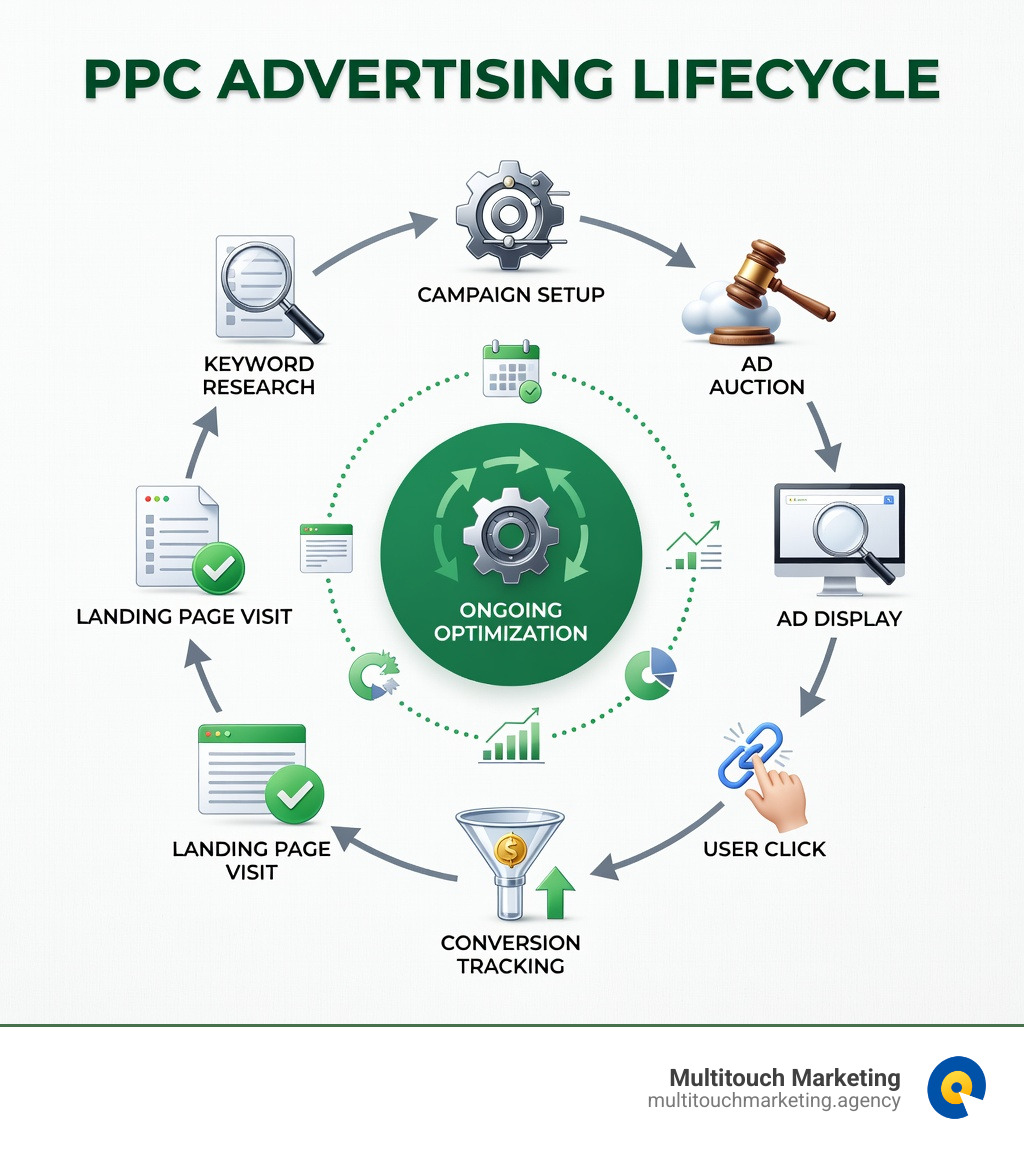
What is PPC advertising? PPC (pay-per-click) advertising is an online advertising model where you pay a fee each time someone clicks on your ad. Instead of earning visits organically, you’re essentially buying visits to your website, landing page, or app.
Quick Answer:
- Definition: PPC is a digital marketing model where advertisers bid on keywords and pay publishers only when users click their ads
- How it works: You create ads, bid on relevant search terms, and your ads appear in search results or on websites when people search for those terms
- Cost: You only pay when someone actually clicks your ad (average CPC is $1.16 across industries)
- Results: In 2022, PPC brought in an average of $2 for every $1 spent
- Main platforms: Google Ads, Microsoft Ads, Facebook Ads, Instagram, LinkedIn, and other search engines and social networks
PPC advertising has become one of the most powerful tools for businesses that need immediate visibility and measurable results. Unlike SEO, which can take months to show results, PPC puts your business at the top of search results within hours.
The appeal is simple: you control your budget, target your exact audience, and track every dollar spent. Whether you’re a local bakery targeting “NYC wedding cake bakeries” or a service provider bidding on “leaking chimney repair services near me,” PPC lets you reach people actively searching for what you offer.
But here’s the challenge: Google processes over 99,000 search queries per second, and 40% of all ad spend goes to search advertising. Competition is fierce, costs are rising, and without the right strategy, you can burn through your budget quickly. That’s why understanding how PPC works—from keyword selection to Quality Score to bidding strategies—is essential before you spend a single dollar.
I’m Milton Brown, and I’ve been managing PPC campaigns since 2008, handling accounts from $20,000 to $5 million across industries like e-commerce, healthcare, and education. Throughout this guide, I’ll break down what is PPC advertising in simple terms and show you exactly how to use it to grow your business without wasting money on clicks that don’t convert.
Discover more about what is ppc advertising:
What is PPC Advertising and How Does It Work?
To truly grasp what is ppc advertising, we have to look under the hood of the digital auction house. At its core, pay-per-click is a way for us to secure prime real estate on search engine results pages (SERPs) and social media feeds. But unlike a traditional billboard where you pay a flat fee regardless of who looks at it, PPC only requires payment when a user takes action by clicking.
The process is governed by a complex, lightning-fast algorithmic auction. Every time someone performs a search, an auction takes place. Advertisers identify keywords they want to bid on and state how much they are willing to spend for a click. However, the winner isn’t always the person with the deepest pockets. Search engines use a metric called Ad Rank to determine which ads appear and in what order.
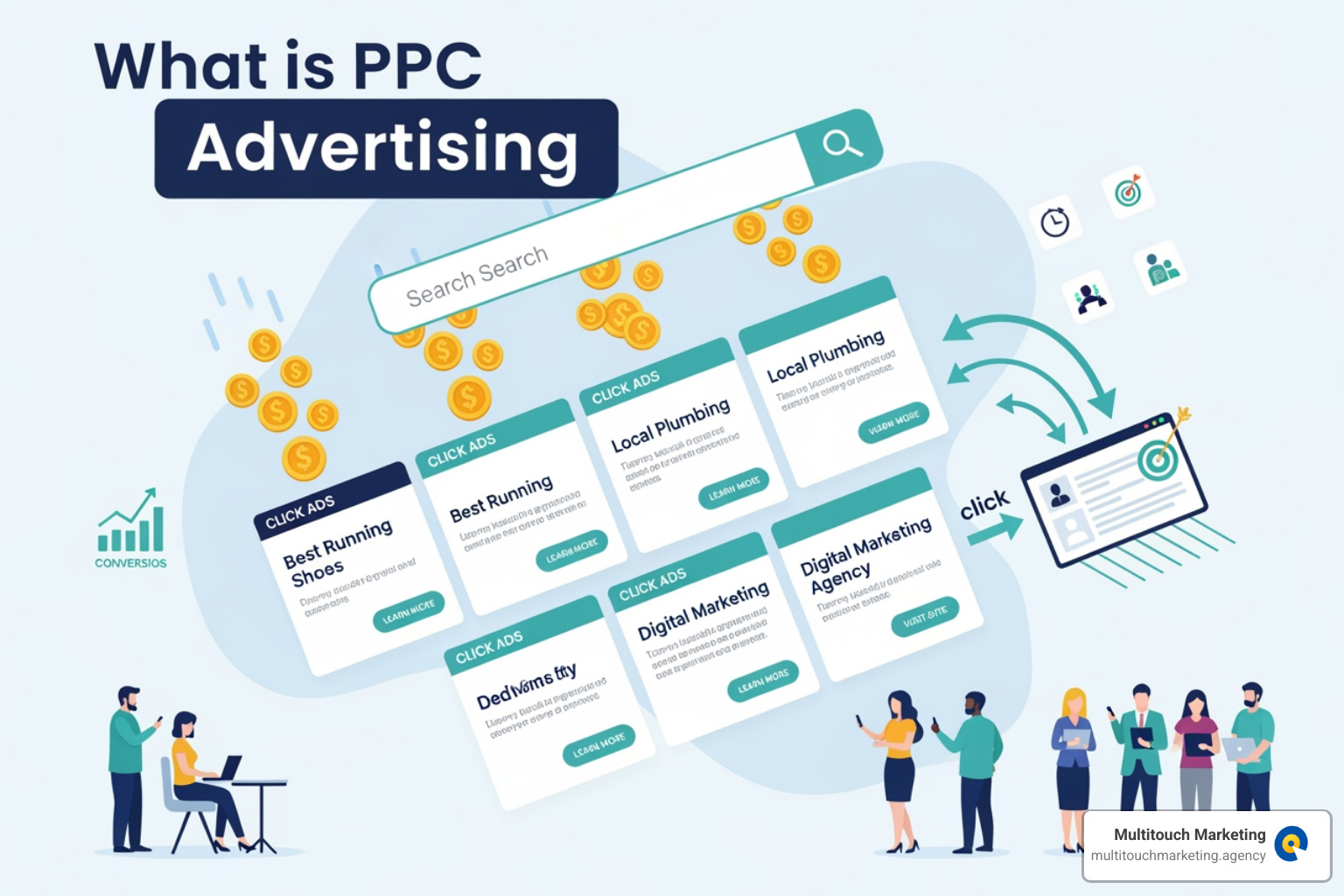
Ad Rank is typically calculated by multiplying your maximum bid by your Quality Score. This means a highly relevant ad with a lower bid can actually outrank a poorly constructed ad with a massive budget. This system ensures that users see ads that actually help them, which is why PPC campaigns require a blend of financial strategy and creative relevance.
The Role of Keywords in What is PPC Advertising
Keywords are the bridge between a customer’s problem and your solution. When we talk about what is ppc advertising, we are essentially talking about intent-based marketing. We target specific words or phrases that indicate a user is ready to buy or learn.
- Search Intent: Are they looking for information (“how to fix a sink”) or ready to buy (“plumber in Raleigh NC”)?
- Long-tail Keywords: These are longer, more specific phrases. While they have lower search volume, they often have less competition and higher conversion rates because they target specific needs.
- Negative Keywords: This is a secret weapon in our PPC negative keyword strategy. By telling Google what terms not to show our ads for (like “free” or “jobs”), we prevent wasting money on irrelevant clicks.
Understanding keyword matching options is also vital. You can choose “Exact Match” to show ads only for that specific phrase, or “Broad Match” to reach a wider (but potentially less qualified) audience.
Understanding Ad Rank and Quality Score
If the bid is the “quantity” of your effort, the Quality Score is the “quality.” Google rates your ads on a scale of 1 to 10 based on three main factors:
- Expected Click-Through Rate (CTR): How likely is it that someone will click your ad?
- Ad Relevance: Does the ad text actually match the search query?
- Landing Page Experience: Is the page you’re sending people to fast, mobile-friendly, and relevant to what the ad promised?
Learning how to improve your quality score is the most effective way to lower your costs. A high Quality Score acts like a discount coupon in the auction, allowing you to pay less than your competitors for the same top position.
The Core Benefits of Using PPC for Your Business
Why do so many businesses in North Carolina—from Durham to Chapel Hill—invest so heavily in PPC? Because the return on investment (ROI) is often undeniable. Research shows that for every $1 spent, businesses earn an average of $2 in revenue.
The benefits go beyond just immediate sales. Why PPC advertising is beneficial in business includes:
- Instant Traffic: Unlike SEO, which can take months to gain traction, PPC starts driving visitors the moment your campaign goes live.
- Hyper-Targeted Reach: We can target users by age, gender, location, interests, and even the type of device they are using.
- Measurability: Every click, call, and sale is tracked. You never have to wonder if your marketing is working.
- Brand Awareness: Even if users don’t click, seeing your name at the top of search results builds familiarity. A study on social media brand awareness confirms that digital ads can lift brand recognition exponentially when they tap into user emotions.
Comparing PPC, SEM, and SEO
It is common to hear these terms used interchangeably, but they serve different purposes in your marketing toolkit. At Multitouch Marketing, we believe the best strategy often involves a combination of all three.
| Feature | PPC (Pay-Per-Click) | SEO (Search Engine Optimization) | SEM (Search Engine Marketing) |
|---|---|---|---|
| Speed | Instant results | Long-term (months) | Combined speed |
| Cost | Pay per click | “Free” (requires time/labor) | Total marketing spend |
| Placement | Top/Bottom of SERP (Ads) | Middle of SERP (Organic) | Covers the whole page |
| Sustainability | Stops when budget ends | Lasts long-term | Integrated approach |
While busting PPC marketing myths, we often explain that SEO and PPC are not enemies. In fact, PPC data can tell us which keywords convert best, allowing us to focus our SEO efforts on the terms that actually drive profit.
Different Types of PPC Ads and Platforms
When most people ask what is ppc advertising, they think of the text ads at the top of Google. But paid traffic is much larger.
- Search Ads: These are standard text ads that appear when you search for something.
- Display Network: These are image-based ads that follow you on other websites (like news sites or blogs). They are fantastic for brand awareness.
- Social Media Ads: Platforms like Facebook and Instagram allow us to show ads in user feeds based on their interests and behaviors.
- Video Ads: YouTube is the second largest search engine in the world. Video ads can appear before or during a video.
- Remarketing: Have you ever looked at a pair of shoes online and then seen an ad for those same shoes everywhere you go? That’s remarketing, one of many advanced PPC techniques used to bring back visitors who didn’t buy the first time.
Top Platforms for What is PPC Advertising
While Google Ads is the undisputed king—processing over 99,000 inquiries per second—it isn’t the only player. Depending on your business, other platforms might offer a better cost-per-click.
- Google Ads: The most popular for search and shopping.
- Microsoft Ads: Often reaches an older, more affluent demographic and usually has a lower CPC.
- Meta Ads (Facebook/Instagram): Unbeatable for interest-based and visual targeting.
- LinkedIn: The go-to for B2B companies looking to reach professionals by job title or industry.
- Amazon: Essential for e-commerce brands wanting to show up when people are in “buying mode.”
For PPC for small business, we often recommend starting with one platform and mastering it before expanding.
Measuring Success: Key Metrics and Bidding Strategies
You can’t manage what you can’t measure. In PPC, we use a specific set of metrics to determine if a campaign is a “win.”
- Cost Per Click (CPC): The actual price you pay for each click.
- Cost Per Mille (CPM): The cost per 1,000 impressions (used mostly in brand awareness campaigns).
- Click-Through Rate (CTR): The percentage of people who see your ad and actually click it. A high CTR usually signals a healthy Quality Score.
- Return on Ad Spend (ROAS): How much revenue do you make for every dollar spent?
- Customer Lifetime Value (CLV): It’s important to track why customer lifetime value matters. A $50 click might seem expensive, but if that customer spends $5,000 with you over five years, it’s a bargain.
We also utilize various keyword bid strategies to optimize performance. This can range from manual bidding, where we have total control, to automated “Smart Bidding” that uses AI to maximize conversions.
Frequently Asked Questions about PPC
What is the difference between CPC and CPM?
The difference lies in what you are paying for. CPC (Cost-Per-Click) is engagement-based; you only pay when someone interacts with your ad. This is best for driving sales and leads. CPM (Cost-Per-Mille) is awareness-based; you pay for every 1,000 times your ad is shown, regardless of clicks. This is ideal for getting your name out there and building brand recognition.
Is PPC advertising suitable for small businesses?
Absolutely. One of the best things about what is ppc advertising for a small business is the level of control. You can set a daily budget as low as $5 or $10. You can also use local targeting to ensure your ads only show to people in specific Raleigh or Durham neighborhoods, preventing you from paying for clicks from people who aren’t in your service area.
What is click fraud and how can I prevent it?
Click fraud occurs when bots or competitors click on your ads to drain your budget. It’s a serious issue—click bots and fake traffic cost advertisers an estimated $35 billion globally.
According to research on click fraud, platforms like Google have sophisticated automated filters to detect and refund you for “invalid activity.” To protect yourself further, we monitor IP addresses and use negative targeting to exclude suspicious traffic sources.
Conclusion
Understanding what is ppc advertising is the first step toward transforming your business’s digital presence. When done correctly, PPC is a high-precision tool that connects you with customers at the exact moment they need you. It provides a level of scalability and measurability that traditional advertising simply can’t match.
However, as we’ve seen, the complexity of ad auctions, Quality Scores, and rising competition means that “setting and forgetting” your ads is a recipe for a drained bank account. Success requires constant campaign optimization and a deep understanding of user intent.
At Multitouch Marketing, we specialize in navigating these complexities for businesses across North Carolina. Whether you’re looking for PPC expert tips or a full-scale management partner, we’re here to help you turn clicks into customers.
Ready to see what paid search can do for your bottom line? Get started with professional PPC services today and let’s build a campaign that actually moves the needle.