

Why Your Website is the Foundation of Your Business
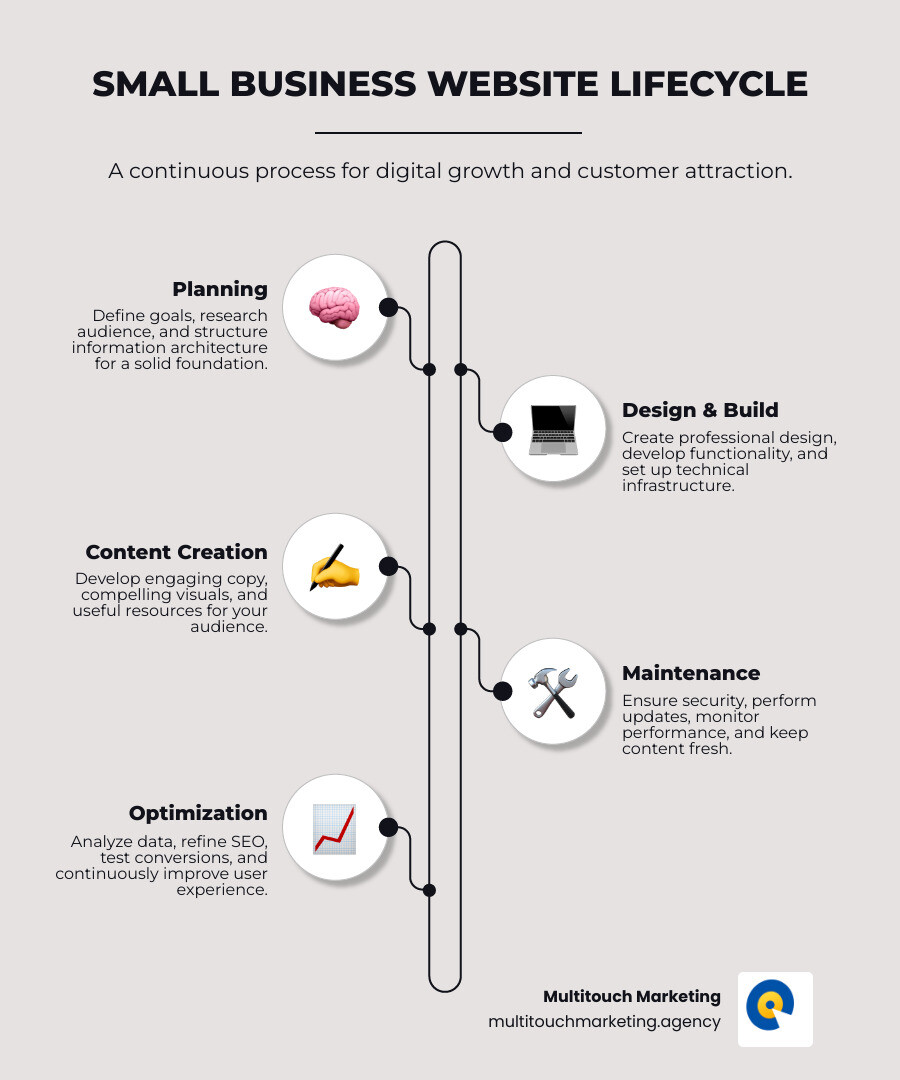
Small business website design and management is the complete process of creating, maintaining, and optimizing your business’s online presence to attract customers, build credibility, and drive sales. Here’s what effective website management involves:
- Design & Setup: Creating a professional, mobile-responsive website with clear navigation and strong branding
- Content Management: Regularly updating pages, blog posts, and product information to keep content fresh and relevant
- Technical Maintenance: Performing software updates, security scans, backups, and performance monitoring
- SEO Optimization: Implementing keyword strategies, meta tags, and local SEO to improve search rankings
- Analytics & Improvement: Tracking user behavior, conversion rates, and traffic sources to make data-driven decisions
If four customers walk into your store, you wouldn’t turn three of them away. Yet that’s exactly what happens when small businesses lack a professional, optimized website. Without one, you’re essentially invisible to the 99% of consumers who search online for local businesses.
Your website isn’t just a digital brochure—it’s your 24/7 employee working to build trust, generate leads, and close sales while you sleep. In 2025, 73% of U.S. small businesses will have websites, but simply having one isn’t enough. The difference between a website that sits idle and one that drives real business growth lies in how it’s designed and managed.
The reality is stark: 94% of people judge your business based on how your website performs on their device. A slow, confusing, or outdated site doesn’t just frustrate visitors—it sends them straight to your competitors. Meanwhile, businesses with well-managed websites see measurable results in traffic, leads, and revenue.
This presents a real challenge for small business owners. You’re already juggling operations, customers, finances, and a dozen other priorities. How do you create and maintain a website that actually works for your business without becoming a full-time web developer?
The good news: you don’t need to be a technical expert. What you need is a clear understanding of what matters, what doesn’t, and where to focus your limited time and resources. Whether you choose to build it yourself using modern tools or work with professionals, the key is knowing the fundamentals that separate websites that convert from those that collect digital dust.
I’m Milton Brown, and I’ve spent years managing paid media campaigns and digital strategies for businesses across industries, where small business website design and management forms the critical foundation for all successful marketing efforts. In this guide, I’ll walk you through everything you need to build and maintain a website that serves as a genuine business asset—not just another expense.
Small business website design and management terms to learn:
Why a Professional Website is Your Greatest Business Asset
For small businesses, a professional website isn’t just an option; it’s a necessity. It’s the digital storefront that never closes, the always-on salesperson, and the hub for all your marketing efforts. The benefits extend far beyond simply having an online presence, impacting everything from first impressions to long-term profitability.
Consider this: 99% of consumers have used the internet in the last year to get information about a local business. If your business isn’t there, or if your online presence is subpar, you’re missing out on a massive audience. Moreover, 59% of people now prefer shopping online, a trend that continues to grow. A well-designed and managed website taps into this consumer behavior, serving as a powerful tool for lead generation, customer trust, and brand building. It gives us a competitive advantage, allowing us to showcase our expertise and connect with customers in Raleigh, Durham, Chapel Hill, and beyond, 24/7.
Build Credibility and Attract Customers
First impressions are everything, and often, your website is the very first interaction a potential customer has with your business. A professional website design signals reliability and trustworthiness. It’s where we tell our story, showcase our products or services, and demonstrate our value. With clear messaging and a polished appearance, we can effectively showcase our expertise. Customer testimonials and case studies integrated into the site act as powerful social proof, building confidence even before a customer walks through our physical doors or makes a call. This credibility is key to attracting new customers and gaining a competitive edge in our local market.
Increase Leads and Sales
Beyond showcasing our brand, a professional website is a direct driver of leads and sales. For businesses selling products, an online storefront with e-commerce functionality can turn website visitors into paying customers around the clock. For service-based businesses, strategically placed contact forms and clear calls-to-action (CTAs) make it easy for potential clients to get in touch. Whether it’s “Request a Quote,” “Book an Appointment,” or “Learn More,” these CTAs guide visitors toward conversion, directly generating revenue. A well-optimized website is a constant source of new business. If you’re considering a website refresh to boost these metrics, explore our insights on website redesign goals.
The Blueprint: Planning Your Website for Success
Every successful building starts with a solid blueprint, and your website is no different. The planning phase for small business website design and management is crucial, laying the foundation for a site that not only looks great but also performs effectively. Skipping this step can lead to a beautiful but ultimately ineffective website.

During planning, we define our target audience, creating detailed user personas to understand who we’re trying to reach and what their needs are. This informs our information architecture, which is essentially the roadmap of our website, ensuring logical navigation and an intuitive user experience (UX). We also solidify our branding, making sure the website’s design, tone, and visuals are consistent with our overall brand identity. Finally, we establish clear website goals, ensuring every element of the site contributes to our business objectives.
Defining Your Audience and Goals
Before we even think about colors or fonts, we need to know who we’re talking to and what we want them to do. This involves defining our audience through market research and developing detailed buyer personas. Who are our ideal customers in Raleigh, Durham, or Chapel Hill? What are their demographics, pain points, and online behaviors? By mapping out user journeys, we can anticipate their needs and design a website that guides them effortlessly towards our desired actions. Setting SMART (Specific, Measurable, Achievable, Relevant, Time-bound) goals for our website—whether it’s generating X leads per month or increasing online sales by Y%—gives us a clear target to aim for. Understanding our audience is paramount; for more on this, check out identifying your target audience.
Ensuring a User-Friendly and Mobile-First Experience
In today’s mobile-dominated world, a user-friendly and mobile-first experience isn’t just a bonus; it’s a requirement. With 57% of all web traffic coming from mobile phones, and more than two-thirds of all traffic from mobile visitors, our website must perform flawlessly on small screens. A staggering 94% of people judge a website based on its responsiveness. If a site is slow, clunky, or hard to steer on a phone, visitors will leave.
We prioritize responsive design, which ensures our website adapts seamlessly to any device size. This includes optimizing page load speed (aiming for under three seconds), ensuring clear and readable text, and having an intuitive navigation structure. Accessibility is also key; we adhere to Web Content Accessibility Guidelines (WCAG) to ensure our site is usable by everyone, including individuals with disabilities. A great mobile experience isn’t just good for users; it’s also a significant factor in search engine rankings. Find why responsive website design matters for SEO.
Choosing Your Path: DIY or Professional Services?
When it comes to small business website design and management, one of the biggest decisions we face is whether to tackle it ourselves or bring in the professionals. Both approaches have their merits, and the best choice often depends on our budget, technical expertise, project scope, and long-term goals.
| Feature | DIY Website Builders | Professional Website Services (e.g., Multitouch Marketing) |
|---|---|---|
| Cost | Low upfront, recurring monthly fees | Higher initial investment, ongoing service fees |
| Time | Significant time investment from business owner | Less time investment from business owner |
| Customization | Limited by templates and platform features | Fully customized design and functionality |
| Technical Maint. | Business owner responsible or limited platform support | Handled by professionals |
| Expertise | Requires some learning, basic design skills | Leverages specialized design, SEO, and marketing expertise |
| Scalability | Can be limited as business grows | Designed for future growth and complex needs |
The DIY Approach: Website Builders
For many small businesses, especially those just starting out or with very limited budgets, DIY website builders offer an attractive solution. Platforms like WordPress (with its user-friendly builders), Wix, Squarespace, and Shopify provide template-based designs and drag-and-drop editors that allow us to get a website up and running quickly. The pros are clear: low cost, fast launch, and a relatively user-friendly interface that doesn’t require coding knowledge.
However, there are cons. Customization can be limited, making it challenging to stand out from competitors using similar templates. We might encounter performance issues, and our branding could be constrained by the builder’s features. While these tools are great for basic brochure sites or simple e-commerce, they can become restrictive as our business grows or if we need more advanced, unique functionalities.
Hiring Professionals: Website Management Services
When we’re looking for a truly unique online presence, robust functionality, and expert guidance, hiring professionals for our small business website design and management needs is often the superior choice. Professional services offer custom design that perfectly aligns with our brand, ensuring our website is distinct and memorable. This is especially vital in competitive markets like Raleigh, Durham, and Chapel Hill.
A key benefit is integrated SEO expertise from the outset, meaning our website is built with search engine visibility in mind, not as an afterthought. Professionals can also ensure scalability, designing a site that can grow and evolve with our business without requiring a complete overhaul every few years. While the initial investment is higher, the long-term benefits in terms of performance, lead generation, and peace of mind can far outweigh the costs. When vetting providers, we always look for a strong portfolio, client testimonials, and a clear understanding of our business goals. For guidance on finding website management companies, we recommend thorough research.
Effective Small Business Website Design and Management for Growth
Launching a website is just the beginning; the real work of small business website design and management is an ongoing process. Think of it like a garden: we don’t just plant seeds and walk away. We need to nurture it, weed it, and ensure it continues to flourish. Continuous improvement is the name of the game, driven by performance tracking and robust security protocols.

A well-managed website acts as a 24/7 employee, constantly working to attract, engage, and convert visitors. This requires a steady rhythm of technical check-ups, fresh content, and strategic tweaks. Neglecting these aspects can turn our powerful digital asset into a liability, leading to security vulnerabilities, outdated information, and dwindling traffic. By prioritizing ongoing management, we ensure our website remains a dynamic tool for business growth.
The Role of SEO in Small Business Website Design and Management
Search Engine Optimization (SEO) is not a one-time task; it’s an integral part of continuous small business website design and management. Our goal is to make our website findable by potential customers searching for our products or services in Raleigh, Durham, Chapel Hill, and beyond. This starts with thorough keyword research to identify the terms our target audience uses.
Once we have our keywords, we implement them through on-page SEO: crafting compelling title tags and meta descriptions, incorporating keywords naturally into our content, and optimizing our URL structures. Local SEO is particularly crucial for small businesses, involving optimizing our Google Business Profile, ensuring consistent Name, Address, and Phone (NAP) information across all online directories, and generating local citations. Building high-quality backlinks also signals authority to search engines. For a deeper dive into how design impacts search visibility, explore responsive web design SEO.
Critical Aspects of Website Security and Maintenance
Just like a physical storefront, our website needs regular upkeep and protection. Critical aspects of website security and maintenance for small business website design and management include:
- Regular Backups: Automating daily or weekly backups of our entire site (files and database) and storing them off-site is non-negotiable. A server crash or hack could otherwise wipe out years of work.
- Software Updates: Keeping our Content Management System (CMS), themes, and plugins updated promptly closes security vulnerabilities and ensures compatibility. Hosted website builders often handle these for us, which is a huge time-saver.
- SSL Certificates: An SSL certificate encrypts data between our site and visitors, indicated by “https://” in the URL. This builds trust and is a ranking factor for search engines.
- Security Scans: Regularly scanning our site for malware and suspicious activity helps us detect and address threats before they cause significant damage. Tools like Wordfence can be invaluable here.
- Uptime Monitoring: Ensuring our website is always accessible is paramount. Uptime monitoring services alert us immediately if our site goes down, allowing for quick resolution.
- Performance Checks: Monitoring page load times and overall site speed is crucial for user experience and SEO. Slow sites frustrate visitors and deter search engines.
Neglecting these maintenance tasks is like leaving our front door open uped. It invites trouble, compromises our data, and ultimately harms our business. For more detailed guidance, refer to our website maintenance best practices.
Measuring Success and Driving Improvement
How do we know if our small business website design and management efforts are actually working? By measuring success and continuously driving improvement. This involves leveraging analytics tools like Google Analytics to track key performance indicators (KPIs). We look at metrics such as:
- Traffic Sources: Where are our visitors coming from (organic search, social media, direct, referrals)?
- Page Views & Time on Page: Which content resonates most with our audience?
- Bounce Rate: Are visitors leaving quickly, or are they engaging with our site?
- Conversion Rates: How many visitors are completing our desired actions (filling a form, making a purchase)?
These insights allow us to make data-driven decisions. We can implement Conversion Rate Optimization (CRO) strategies, focusing on improving the percentage of visitors who convert. This might involve A/B testing different headlines, calls-to-action, or page layouts. User behavior analysis through heatmaps and click maps can show us exactly where visitors are engaging (or getting stuck) on our pages, providing invaluable information for tweaks and improvements. Running PPC campaigns without proper tracking is like driving blindfolded; we need to track not just clicks, but actual conversions, customer lifetime value (CLV), and return on ad spend (ROAS). This continuous cycle of analysis and optimization ensures our website is always evolving to meet our business goals.
Common Mistakes to Avoid with Your Business Website
Even with the best intentions, it’s easy for small businesses to stumble when it comes to small business website design and management. Avoiding common pitfalls can save us time, money, and missed opportunities.
Some of the most frequent mistakes include forgetting the mobile user, implementing weak calls-to-action, designing confusing navigation, neglecting ongoing maintenance, and ignoring SEO. These issues don’t just create minor inconveniences; they actively push potential customers away and prevent our website from performing its essential role as a business asset.
Forgetting the Mobile User
This is perhaps one of the most critical mistakes in today’s digital landscape. Despite the fact that more than two-thirds of all web traffic comes from mobile devices, many small business owners still focus primarily on the desktop experience. An unresponsive design leads to slow mobile speed, difficult-to-click elements, and the dreaded pinch-and-zoom frustration. This isn’t just annoying; it sends a clear message that our business isn’t modern or user-focused. 94% of people judge a website based on its responsiveness. If our site isn’t mobile-friendly, we’re effectively turning away a huge segment of our potential customer base. For a comprehensive understanding, explore more on responsive web design.
Missing or Unclear Calls-to-Action (CTAs)
Imagine walking into a store, finding exactly what you need, but there’s no price tag, no cashier, and no sign telling you how to buy it. Frustrating, right? That’s what a website with missing or unclear calls-to-action feels like. Vague language like “Click Here” or “Submit” doesn’t inspire action. Poor placement (hidden at the bottom of a long page) or a lack of visual emphasis means visitors won’t even see them. Every page on our website should have a clear next step, an action-oriented text that tells visitors exactly what we want them to do, whether it’s “Get a Free Quote,” “Book a Consultation,” or “Shop Now.” Without clear CTAs, we’re leaving conversions to chance.
Neglecting Ongoing Maintenance and Security
This is a silent killer for many small business websites. We often launch a site, breathe a sigh of relief, and then forget about it. However, neglecting ongoing maintenance and security can lead to disastrous consequences:
- Outdated Plugins: These are common entry points for hackers and can cause compatibility issues.
- No Backups: A server crash, a bad update, or a cyber-attack could erase our entire website with no way to recover.
- Broken Links: These create a poor user experience and can harm our SEO.
- Vulnerability to Hacks: Cyber-attacks are a constant threat; 30,000 websites are hacked every single day. Neglecting security makes us an easy target.
- Slow Performance: Unoptimized images, excessive plugins, or outdated software can grind our site to a halt, impacting user experience and search rankings.
These issues erode trust, frustrate visitors, and can even lead to our site being blacklisted by search engines. Proactive maintenance is not an expense; it’s an investment in the health and longevity of our online presence. Understand the full importance of website maintenance and support.
Take Control of Your Digital Presence
A well-designed and managed website is a dynamic tool for business growth, not a static one-time project. By focusing on planning, user experience, and continuous improvement, we can transform our site into a powerful engine for attracting customers and increasing revenue. While building a great website is the first step, driving targeted traffic is the next. Multitouch Marketing specializes in creating effective PPC campaigns that bring qualified visitors to your digital doorstep.
Ready to ensure your website is managed for maximum impact? Explore our website management company services.