
Why Precision Matters in Pay-Per-Click Advertising
Targeted PPC advertising is a digital marketing model where you pay a fee per click, but you control exactly who sees your ad. By defining specific audiences based on demographics, interests, search intent, or location, you ensure your budget is spent on qualified prospects. This precision is what separates effective campaigns from budget-draining ones.
Quick answer for searchers:
- What it is: PPC ads shown only to users matching your criteria (keywords, demographics, interests, location).
- Why it matters: You spend money only on clicks from people likely to become customers.
- Core targeting options: Keywords, audience segments, locations, devices, and remarketing.
- Main platforms: Google Ads, Meta Ads, and Microsoft Ads.
- Key benefit: Higher ROI through focused ad spend.
Unlike SEO, which takes months to build organic rankings, PPC delivers immediate visibility. However, every click costs money. Without precise targeting, you’re paying for clicks from people who will never buy, quickly depleting your budget.
The difference between a profitable campaign and a money pit is who sees your ads. Traditional advertising is like shouting in a crowded mall; Targeted PPC advertising is like having a direct conversation with shoppers who are already looking for what you sell.
I’m Milton Brown, and I’ve managed Targeted PPC advertising campaigns ranging from $20,000 to $5 million across education, e-commerce, healthcare, and non-profit sectors since 2008. Throughout this guide, I’ll show you how to implement the same data-driven targeting strategies that help my clients turn ad spend into measurable revenue.
The Core Components of a Winning PPC Campaign
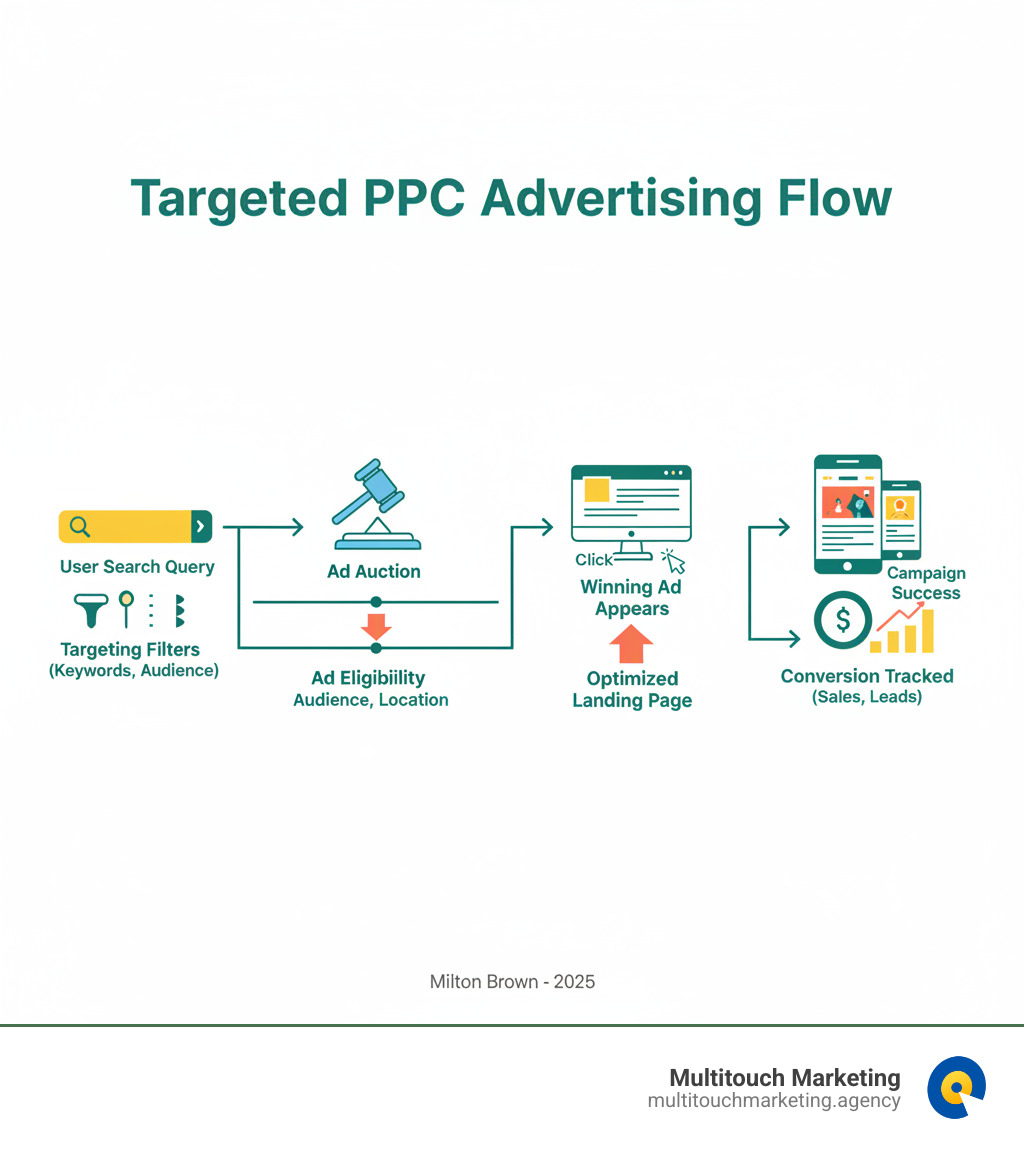
Before exploring targeting methods, we must understand the foundational components of any PPC campaign. The most common form is search engine advertising, where ads appear at the top of Google search results. This system runs on keywords—the phrases you bid on to trigger your ads.
Keywords are the bedrock of search campaigns. The skill lies in choosing keywords that match buying intent, not just casual browsing. For example, someone searching “buy Nike Pegasus 40 size 10” is more ready to purchase than someone searching “best running shoes.”
PPC Keyword Match Types control how closely a search must match your keyword. Broad match casts a wide net, exact match is precise, phrase match is a middle ground, and negative match excludes irrelevant searches. Mastering these is key to avoiding wasted spend.
Your bidding strategy determines how much you’ll pay per click or conversion. You can set bids manually for full control or use automated strategies that let Google’s AI optimize for your goals. Manual bidding is great for new campaigns, while automated bidding excels with sufficient conversion data. We cover this at Keyword Bid Strategies PPC Campaign.
Google doesn’t just award ad space to the highest bidder; it uses Quality Score. This report card for your ads measures your expected click-through rate (CTR), ad relevance, and landing page experience.
A high Quality Score leads to lower costs and better ad positions. Google rewards relevance because it improves the user experience. Your ad’s relevance is crucial; if someone searches “emergency plumber Raleigh NC,” your ad must reflect that specific need. Generic ads like “Professional Plumbing Services” are less effective.
Finally, the landing page experience is where the conversion happens. After a user clicks your ad, your landing page must deliver on the ad’s promise. It should load quickly (under three seconds), have a clear message, and make the next step obvious. A poor landing page experience leads to a high bounce rate and wasted ad spend.
These components are interconnected. Great keywords with a poor landing page waste money. Targeted PPC advertising requires aligning all these elements to work in harmony.
Mastering the Methods of Targeted PPC Advertising
Effective PPC uses a digital laser pointer to highlight exactly who we want to reach. This precision ensures every advertising dollar works hard for your business. We typically combine audience-based targeting (who the user is) and content-based targeting (what the user is seeing) to create highly specific and effective campaigns. For a deeper dive, see The Ultimate Guide to PPC Ad Targeting.
Reaching People: Audience-Based Targeting
This approach finds people based on their characteristics and online behaviors.
- Demographic Targeting: Reach users by Age, Gender, and Household Income. This is useful for products custom to specific groups, like tech for Gen Z or financial services for higher-income brackets.
- Interest Targeting: Connect with users based on their hobbies. Affinity Audiences are broad groups (e.g., “Sports Fans”) great for brand awareness. Custom Segments let you build niche audiences based on specific interests, purchase intentions, or websites they’ve visited.
- Behavioral Targeting: This focuses on what users are actively doing. In-Market Audiences are users currently researching specific products, indicating high purchase intent. Life Events targeting reaches people going through major changes like moving or getting married.
- Remarketing: Re-engage people who have already interacted with your business, such as website visitors or video viewers. These users are more likely to convert. With dynamic remarketing, you can even show them the exact products they viewed. Learn how at Set Up Dynamic Remarketing Google Ads.
- Customer Match: Upload your own customer data (like email lists) to platforms like Google Ads or Meta Ads to target existing customers for retention or to find new lookalike prospects.
Reaching Context: Content-Based Targeting
This method focuses on where users are online and what content they’re consuming.
- Keyword Targeting: In Search Campaigns, keywords match your ads to user search queries. In Display Campaigns, keywords match your ads to the content of webpages, apps, and videos.
- Topic Targeting: Show ads on content related to a specific subject, like placing ads for gourmet coffee on pages about “coffee brewing.”
- Placement Targeting: Choose specific websites, apps, or YouTube channels where you want your ads to appear, giving you precise control over ad location.
- Negative Keywords: A strong PPC Negative Keyword Strategy is vital. It prevents your ads from showing for irrelevant searches, saving money and improving relevance.
- Contextual Advertising: This privacy-friendly method shows ads alongside content that matches your ad’s topic. As the industry moves away from cookies, contextual targeting is becoming increasingly important.
The Power of Automation: Optimized and AI-Driven Targeting
Artificial intelligence (AI) is revolutionizing how we find ideal customers.
- Optimized Targeting: This Google Ads feature goes beyond your manual selections to find new, relevant audiences likely to convert. It uses your existing segments and keywords as Targeting Signals but has the freedom to explore other high-performing traffic sources. Learn more at About optimized targeting – Google Ads Help.
- AI in Google Ads: AI analyzes vast amounts of data in real-time to make bid adjustments and find audience patterns that are impossible for humans to manage manually. Learn more about AI in Google Ads.
- Lookalike Audiences: Platforms like Meta and Google can create “lookalike” or “similar” audiences. You provide a seed audience (like a customer list), and the AI finds new users with similar characteristics, expanding your reach to qualified prospects.
- AI-Driven Customer Insights: Beyond targeting, AI Driven Customer Insights help us understand customer behaviors and preferences, allowing for even more refined messaging and targeting.
Choosing Your Platform and Ad Format
Choosing the right platform and ad format is like picking the perfect stage for your message. Different platforms excel at reaching different audiences, and the right format ensures your ad grabs their attention.
Major PPC Platforms
Each platform has unique strengths, and a multi-platform strategy is often most effective.
- Google Ads: As the largest PPC platform, Google Ads is ideal for capturing high-intent users actively searching for your products or services. Its massive reach makes it perfect for generating leads, driving e-commerce sales, and building brand awareness.
- Meta Ads (Facebook & Instagram): Meta is incredibly powerful for targeting based on detailed demographics, interests, and behaviors. It’s a visual-first platform, making it great for building a community, promoting events, and reaching users as they browse and find new things. Learn more with our guide on How to Advertise on Facebook.
- Microsoft Ads: Often overlooked, the Microsoft network (including Bing and Yahoo) can be a treasure trove. It frequently offers lower costs-per-click (CPCs) and less competition. Its audience tends to be older and more professional, making it a fantastic choice for B2B services.
Types of PPC Ads
The ad format you choose plays a specific role in the customer journey.
- Search Ads: These text ads appear on search engine results pages, targeting users with high purchase intent who are actively searching for solutions.
- Display Ads: These visual ads (images, banners) appear on websites across networks like the Google Display Network. They are used for building brand awareness and remarketing to past visitors.
- Video Ads: Platforms like YouTube offer powerful video advertising options, excellent for storytelling, grabbing attention, and engaging audiences with dynamic content.
- Shopping Ads: A must for e-commerce, these ads (also known as Product Listing Ads) show your product image, price, and store name directly in search results, providing key information upfront.
- Social Media Ads: These ads blend into feeds on platforms like Facebook, Instagram, and LinkedIn. Using various formats like images, videos, and carousels, they are brilliant for building brand interest and driving conversions with detailed targeting. Explore options at Social Media Ad Formats.
We carefully select the platform and ad format to match your campaign goals and your audience’s stage in the customer journey, ensuring your ad spend works smarter.
From Strategy to Conversion: Advanced Tactics & Best Practices
Even with perfect targeting, campaigns need a solid strategy to turn clicks into business results. Targeted PPC advertising gives you a map to your customers, but you still need the right tools to secure the conversion. This is how we achieve measurable ROI and build strong brand awareness.
Creative Approaches to Targeted PPC Advertising
To stand out, we go beyond basic keyword targeting with creative strategies:
- Targeting Problems, Not Just Products: We focus on the problems your product solves. A meal kit service, for example, could target searches like “save time grocery shopping,” connecting with a user’s core need.
- Targeting Product Applications: We highlight how people use your product. A project management tool could target “remote team collaboration,” helping users visualize the tool in their own workflow.
- Targeting Alternatives and Competitors: We position your product against other options. A home workout app might highlight its benefits over “gym memberships,” showcasing its unique value. These are part of the Advanced PPC Techniques we employ.
The Landing Page Connection: Maximizing Conversion
A perfectly targeted ad is wasted if it leads to a poor landing page. The ad sets the expectation, and the landing page must deliver.
- Match Ad Message to Landing Page: If your ad promises a “Free PPC Audit for Raleigh Businesses,” the landing page must deliver exactly that. This consistency is crucial for conversion.
- Design for Skimmers: Research from the Nielsen Norman Group shows 79% of people skim web content. Headlines must grab attention, and information must be easy to digest.
- Reduce Friction: Simplify the conversion path. Use simple forms and minimize clicks. Too much friction causes users to leave.
- Clear Call-to-Action (CTA): Your CTA must be direct and easy to find. HubSpot data shows that well-matched CTAs convert 202% better than generic ones. Use “Get Your Free Quote Now” instead of a vague “Learn More.”
- A/B Testing: We continuously test different landing page elements—headlines, CTAs, layouts—to identify what best resonates with your audience.
- Page Speed Importance: Slow pages kill conversions. Walmart found a 1-second load time improvement could boost conversions by 2%. We ensure your pages are fast, especially on mobile.
Common Mistakes in Targeted PPC Advertising
We help clients in Raleigh, Durham, and Chapel Hill avoid these common pitfalls:
- Overly Broad Keywords: This wastes your budget on irrelevant clicks. We focus on precise keywords with exact and phrase match types to attract users with clear buying intent.
- Neglecting Negative Keywords: Without a strong PPC Negative Keyword Strategy, you’ll pay for unwanted clicks (e.g., from searches for “free” or “jobs”).
- Incorrect Geo-Targeting: Targeting an area that’s too broad or too narrow hurts results. For local businesses, we use precise geo-targeting, down to the zip code, as part of our Local Business PPC Management.
- Ignoring Device Targeting: User behavior varies by device. We optimize ads, landing pages, and bids for desktop, tablet, and mobile experiences.
- Poor Audience Segmentation: Generic ads are ineffective. We carefully segment audiences to create personalized ad experiences.
- Failing to Audit Campaigns: PPC is not “set it and forget it.” Regular campaign reviews and a thorough Pay Per Click Audit are essential for uncovering improvement opportunities.
Frequently Asked Questions about Targeted PPC Advertising
Here are answers to some of the most common questions we receive about Targeted PPC advertising.
Is PPC advertising suitable for small businesses with limited budgets?
Yes, absolutely. Targeted PPC advertising is highly efficient and ideal for businesses watching every penny. Here’s why:
- Scalability: You can start with a modest budget (e.g., $200-$500) and scale up as you see positive results. You have complete control over your spending. Our guide on PPC Campaign Budgeting for Small Businesses explains how to maximize your budget.
- Geo-Targeting: For local businesses in areas like Raleigh or Durham, we can ensure ads are shown only to customers within a specific radius, eliminating wasted spend on clicks from outside your service area.
- Long-Tail Keywords: Small businesses can target specific, niche search terms that larger competitors often ignore. These keywords typically have lower competition, cheaper costs, and attract highly qualified leads.
- Trackable ROI: Every click and conversion is trackable, providing a clear view of your Return on Investment (ROI). This allows us to quickly optimize campaigns for profitability. Learn more at Does PPC Work for Small Businesses.
How can PPC advertising complement an SEO strategy?
PPC and SEO are a powerful combination that creates a strong digital marketing synergy.
- Immediate Visibility: PPC provides instant traffic and visibility at the top of search results while your long-term SEO strategy matures.
- Keyword Data Insights: PPC campaigns generate valuable data on which keywords drive conversions. This information can then be used to focus your SEO and content strategy on the most profitable terms.
- Message Testing: You can A/B test ad copy and headlines with PPC to see what resonates with users. The winning variations can be applied to your organic meta descriptions to improve click-through rates.
- SERP Domination: Running both PPC and SEO campaigns allows you to occupy more prime real estate on the Search Engine Results Pages (SERPs), pushing competitors down.
How can I learn PPC and become a specialist?
Becoming a Targeted PPC advertising specialist requires a blend of theoretical knowledge and hands-on experience.
- Online Courses & Certifications: Start with structured training from reputable providers and pursue certifications from major platforms like Google Ads and Microsoft Advertising to validate your expertise.
- Hands-On Experience: The best way to learn is by doing. Start by managing your own small campaigns or volunteering for a non-profit. Practical experience is invaluable.
- Start with a Small Budget: PPC is scalable, so you don’t need a large budget to start learning. Experiment with different strategies and learn from the results.
- Continuous Learning: The digital advertising landscape is always changing. Stay updated by reading industry blogs, attending webinars, and participating in online communities.
- Develop Analytics Skills: Understanding data from tools like Google Analytics is crucial for making data-driven decisions and optimizing campaign performance.
Conclusion: Take the Next Step in Your PPC Journey
We’ve covered the fundamentals of PPC, the critical role of precision targeting, the core components of a winning campaign, and advanced strategies for success. The key takeaway is that Targeted PPC advertising is not just a feature; it’s the essential ingredient for turning ad spend into measurable growth.
By understanding who you want to reach, what they’re looking for, and where they are online, you can create campaigns that resonate deeply. This ensures your ads attract the right clicks—the ones that convert into loyal customers and drive your business forward.
The PPC landscape is dynamic, requiring a strategic approach and continuous optimization to maintain long-term success. It’s like steering a ship; constant adjustments are needed to stay on course.
If you’re ready to transform your ad spending into tangible results, our team at Multitouch Marketing is here to help. We are passionate about navigating the ever-changing world of PPC and helping businesses like yours achieve their goals with professional, hands-on campaign management.
Ready to see how we can help your campaigns soar? Check out our Google Ads Campaign Management Services.