
Why Understanding PPC Ads Management is Essential for Your Business Success
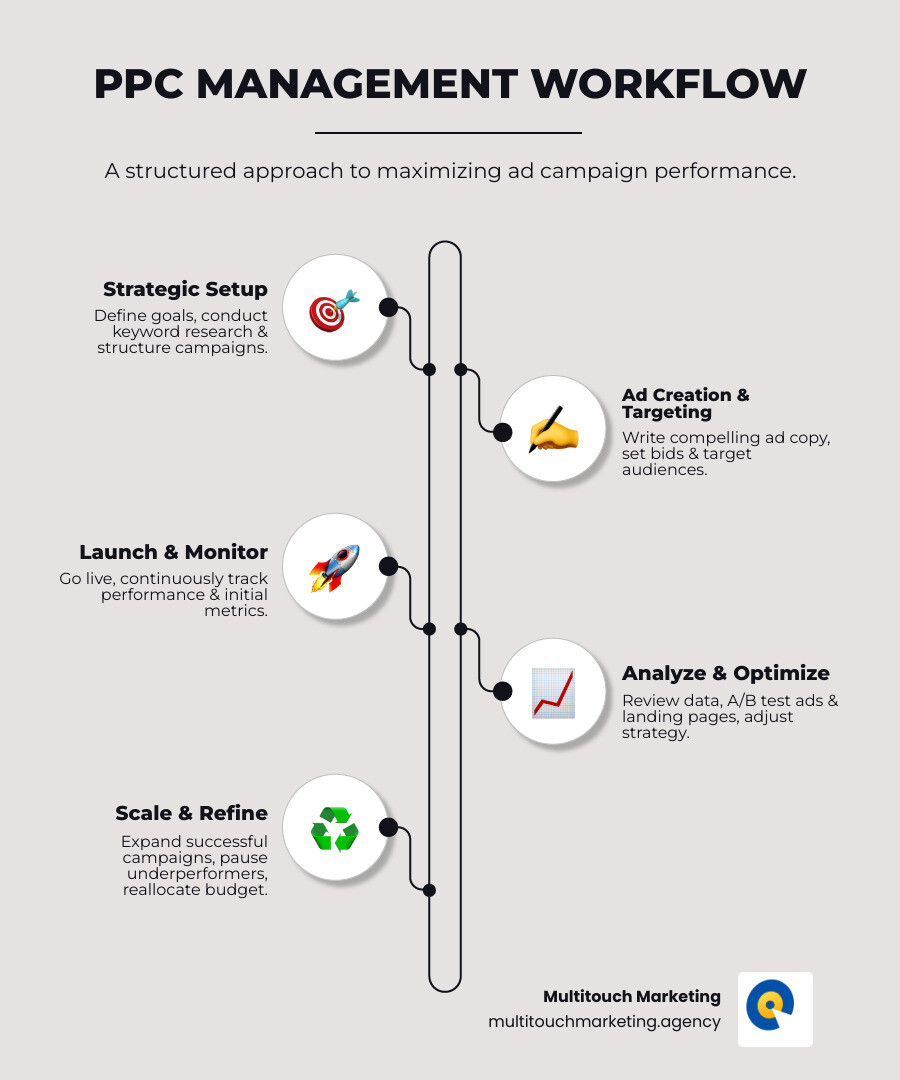
PPC ads management is the process of overseeing and optimizing your pay-per-click advertising campaigns to maximize return on investment while minimizing wasted spend. At its core, it involves:
- Strategic Planning: Setting campaign goals, choosing the right channels, and defining your target audience
- Keyword Research: Finding and targeting search terms that your ideal customers actually use
- Campaign Execution: Creating compelling ads, setting budgets, and managing bids across platforms like Google Ads and social media
- Ongoing Optimization: Monitoring performance metrics, testing ad variations, and adjusting strategy based on data
- ROI Tracking: Measuring conversions and ensuring every dollar spent drives meaningful business results
Most businesses turn to PPC advertising because it delivers what SEO can’t: immediate traffic and results. While organic search strategies take months to show impact, a well-managed PPC campaign can drive qualified visitors to your website within hours of launch.
The numbers tell a compelling story. Paid search ads can boost brand awareness by as much as 80%, and 65% of clicks on keywords with buying intent go to paid ads. In a digital landscape where 8.5 million searches happen on Google every day, businesses that ignore PPC are leaving serious revenue on the table.
But here’s the challenge: launching a campaign is easy, but managing it effectively requires expertise. The average cost per click ranges from $0.20 to $30 or more, and without proper management, budgets disappear quickly with little to show for it. Small mistakes—like targeting the wrong keywords, neglecting negative keywords, or sending traffic to poorly optimized landing pages—can turn a promising campaign into a money pit.
That’s where strategic PPC ads management makes all the difference. It’s not just about spending money on ads. It’s about understanding campaign structure, analyzing performance data, optimizing continuously, and making informed decisions that drive real business growth.
I’m Milton Brown, and I’ve been managing PPC ads management strategies for over 15 years across industries ranging from e-commerce to healthcare, overseeing budgets from $20,000 to $5 million. Throughout this guide, I’ll walk you through the essential components of managing PPC campaigns like a professional, helping you avoid costly mistakes and maximize your advertising investment.
What is PPC Management and Why is it Crucial?
At its heart, PPC ads management is the continuous process of overseeing and refining your pay-per-click advertising campaigns. Think of it as steering a ship through constantly changing waters; you can’t just set a course and walk away. You need to constantly monitor the wind, currents, and destination to ensure you reach your goal efficiently.
Why is this so important for businesses in Raleigh, Durham, Chapel Hill, and throughout North Carolina? Because the digital marketplace is fiercely competitive. Simply putting an ad out there isn’t enough; you need to make sure that ad reaches the right people at the right time, with the right message, and at the right cost.
Consider these compelling reasons why effective PPC ads management is a game-changer:
- Boosts Brand Awareness: Paid search advertisements can significantly amplify your voice. In fact, they can boost brand awareness by as much as 80%. Imagine the impact that kind of visibility can have on your business in Chapel Hill or Durham!
- Provides Immediate Feedback: Unlike some marketing strategies that take months to yield actionable insights, PPC offers immediate feedback. You can quickly see what search terms people are using, which ads they click on, and what happens once they land on your site. This allows for rapid adjustments and optimizations.
- Complements SEO Efforts: While SEO builds long-term organic traffic, it can take time to see results. PPC, however, can drive immediate paid traffic, filling the gap and providing instant data on how your advertising is performing. It’s like having a fast-track lane while your organic efforts are building the superhighway.
- Low-Risk When Done Correctly: Many business owners fear the “cost” of PPC. However, when managed strategically, PPC offers more visibility into ROI than perhaps any other form of marketing. It’s extremely low-risk because you only pay when someone clicks, and every aspect is measurable. This allows us to make data-driven decisions to optimize your ad spend and maximize your returns. We believe in Why PPC Advertising is Beneficial in Business for your growth.
- Reaches Users with High Buying Intent: By virtue of keyword targeting, each person we serve a PPC ad to on Google is demonstrably in the market for your product or service. When someone searches for “emergency plumber Raleigh NC” or “best pizza Durham,” they’re not just browsing; they’re looking to take action. PPC puts your business directly in front of these high-intent customers.
When Google holds the majority of the search engine market share, with tens of thousands of searches taking place every second, neglecting PPC ads management is akin to leaving serious opportunity (and bottom-line revenue) on the table. We believe every business, from small startups to established enterprises in North Carolina, deserves to capitalize on this digital goldmine.
The Core Components of Effective PPC Ads Management
Effective PPC ads management isn’t a one-time setup; it’s an ongoing, multifaceted process involving a strategic blend of planning, execution, and continuous optimization. Let’s explore the essential elements that make up a robust PPC strategy.
The Role of Keyword Research and Targeting
Keyword research is the bedrock of any successful PPC campaign, ensuring you target the specific phrases your potential customers are using.
- Keyword Analysis: We analyze keywords for search volume, competition, and commercial intent to identify high-intent phrases. For instance, “PPC services Raleigh” shows much higher intent to convert than “what is marketing.”
- Long-tail vs. Short-tail: We target both broad keywords (e.g., “shoes”) and specific long-tail phrases (e.g., “men’s running shoes size 10 Durham”). Long-tail keywords often have higher conversion rates and less competition, making them ideal for SMBs.
- Keyword Match Types: Understanding PPC Keyword Match Types is crucial. Selecting the right type (broad, phrase, or exact) ensures your ads show for relevant searches while avoiding irrelevant ones, helping control costs.
- Negative Keywords: Just as important as choosing the right keywords is excluding the wrong ones. A PPC Negative Keyword Strategy involves identifying irrelevant terms (e.g., adding “used” or “free” if you sell new cars) to prevent wasted ad spend on clicks that won’t convert.
- Using Tools: We leverage powerful tools like Google Keyword Planner to uncover keyword opportunities, analyze trends, and estimate bid costs, ensuring our strategy is data-driven.
Ad Creation and Landing Page Optimization
Once we know what people are searching for, the next step in PPC ads management is to craft compelling ads and direct users to optimized landing pages to turn clicks into conversions.
- Writing Compelling Ad Copy: Your ad copy must grab attention, communicate your value proposition, and encourage a click. We focus on writing clear, persuasive copy with relevant keywords and a strong call-to-action.
- A/B Testing: We continuously run A/B tests on multiple ad variations to see which headlines, descriptions, and calls-to-action resonate most with your audience, refining your messaging for maximum impact.
- Ad Extensions: These are crucial for boosting ad visibility. Extensions like phone numbers, site links, and images are free to add and can significantly improve your Ad Rank by enhancing the user experience.
- Creating Relevant and High-Converting Landing Pages: A great ad is wasted if it leads to a poor landing page. The page must be relevant to the ad, fast-loading, mobile-friendly, and guide the user toward conversion. We focus on PPC Campaign Optimization to ensure your landing pages are conversion-focused.
- Quality Score: Google’s Quality Score is influenced by ad relevance, expected click-through rate, and landing page experience. A higher score can lead to better ad positions at lower costs.
Common Pitfalls to Avoid in PPC Management
Avoiding these common mistakes is a critical part of effective PPC ads management.
- Poor Campaign Structure: A disorganized campaign without proper ad group segmentation leads to irrelevant ads and wasted spend. We ensure your campaigns are logically structured with tightly themed keywords.
- Neglecting Keyword Research: Relying on gut feeling instead of data for keyword selection is a major misstep that leads to targeting irrelevant terms or missing high-value opportunities.
- Ignoring Negative Keywords: This is one of the quickest ways to bleed your budget. Not adding negative keywords means your ads show for irrelevant searches, costing you money on clicks that will never convert.
- Using Unengaging Landing Pages: Sending traffic to a generic homepage or a page that doesn’t align with the ad’s message is a conversion killer. Your landing page must directly continue your ad’s promise.
- Not Monitoring Performance: Setting up a campaign and forgetting it is like throwing money away. PPC requires constant monitoring. The first month is about gathering data, with consistent results appearing in two to three months as we fine-tune the campaign.
- Wasting Budget: This can happen by bidding too high on low-converting keywords or not pausing underperforming ads. Effective PPC Campaign Budgeting for Small Businesses involves allocating spend intelligently and being agile.
By actively avoiding these common traps, we can ensure your campaigns are robust, efficient, and geared for success. For more insights, check out our article on Busting PPC Marketing Myths.
Navigating the PPC Landscape: Key Channels
The versatility of PPC ads management allows us to craft a comprehensive strategy that reaches potential customers across a diverse landscape of channels, each with unique strengths.
Search Advertising
Search advertising is the powerhouse channel where you directly tap into user intent.
- Google Ads: As the most widespread PPC platform, Google Ads places your ad directly in search results for high-intent queries like “roof repair in Raleigh.” We specialize in helping businesses Set Up Google Ad Campaign to capture this valuable traffic.
- Microsoft Ads (formerly Bing Ads): While Google dominates, Microsoft’s search engine captures a significant audience, often with a lower cost-per-click due to less competition, providing a valuable opportunity to expand your reach.
- How it Works: Search advertising involves bidding on keywords. When a user’s query matches your keywords, your ad may appear, and you pay only when someone clicks. This model is effective because you’re reaching users actively looking for what you provide.
Social Media Advertising
While search advertising captures active intent, social media advertising excels at reaching users based on their demographics, interests, and behaviors. With 62% of the population using social media, it presents an enormous opportunity.
- Facebook (Meta): Meta’s vast user base and rich demographic data make Facebook and Instagram ideal for targeted advertising. We create visual ads to build brand awareness and drive sales, reaching audiences in Chapel Hill and beyond based on their interests and online activities.
- LinkedIn: For B2B businesses, LinkedIn is an unparalleled platform. We can target professionals by job title, industry, and company size, making it perfect for lead generation.
- X (formerly Twitter): X offers a unique environment for real-time engagement. Promoted ads and vertical video ads can be highly effective for driving brand conversations, with vertical video being the platform’s fastest-growing segment.
- How it Works: Social media advertising uses compelling visual or video ads in users’ feeds. Targeting is based on audience attributes rather than search queries, making it excellent for introducing your brand to new, relevant audiences.
Display and Remarketing Advertising
Display advertising casts a wider net, using visual ads to reach your audience across a network of websites, apps, and videos.
- Google Display Network (GDN): The GDN places your visual ads across millions of websites, apps, and YouTube. It’s excellent for increasing brand visibility and reaching users who have shown interest in related topics but aren’t actively searching. YouTube alone offers immense reach with over 2.4 billion monthly users.
- Visual Ads: Display ads are typically banner, image, or video ads designed to be visually appealing and grab attention. They work well for showcasing products or reinforcing brand messaging.
- Building Customer Lists: Display campaigns, especially when combined with remarketing, are powerful for developing lists of potential customers by driving traffic to lead-capture pages.
- Re-engaging Past Visitors: Remarketing (or retargeting) is a highly effective strategy where we show ads specifically to users who have previously visited your website. If someone browsed your services in Raleigh but didn’t convert, we can Set Up Dynamic Remarketing Google Ads to keep your brand top-of-mind and nudge them back to your site.
Measuring Success and Maximizing ROI
The beauty of PPC ads management lies in its measurability. Unlike traditional advertising, where gauging exact impact can be tricky, every click, impression, and conversion in PPC leaves a digital footprint. This allows us to make data-driven decisions that not only maximize your return on investment (ROI) but also minimize wasted ad spend.
Key Metrics for Successful PPC Ads Management
To truly understand how your campaigns are performing, we need to track the right metrics. These are our compass and speedometer, guiding our optimization efforts:
- Click-Through Rate (CTR): This is the percentage of people who click on your ad after seeing it. A higher CTR indicates that your ad copy and targeting are relevant and compelling.
- Cost Per Click (CPC): The actual cost you pay for each click on your ad. Our goal is always to reduce CPC while maintaining or improving conversion rates. The average cost per click can range anywhere from $0.20 to $30 or more, depending on the industry and competition, making efficient management crucial.
- Conversion Rate: The percentage of people who complete a desired action (e.g., purchase, form submission, call) after clicking your ad. This is a critical indicator of how effectively your ads and landing pages are driving business goals.
- Cost Per Acquisition (CPA): The total cost to acquire one customer or lead through your PPC campaigns. This metric directly ties your ad spend to tangible business results.
- Return On Ad Spend (ROAS): This metric measures the revenue generated for every dollar spent on advertising. It’s a powerful way to assess the profitability of your campaigns.
- Quality Score: As mentioned earlier, Google’s Quality Score (based on ad relevance, CTR, and landing page experience) directly impacts your CPC and ad position. A high Quality Score helps you get more visibility for less money.
Regularly auditing these metrics is part of our routine. We offer Pay Per Click Audit services to uncover opportunities for improvement and ensure your campaigns are always performing at their peak.
Optimizing Ad Spend and Bids
Maximizing ROI is the ultimate goal of PPC ads management. This involves smart budget allocation and strategic bidding.
- Budget Allocation: We continuously monitor which campaigns, ad groups, and keywords are performing best and reallocate your budget accordingly. This means shifting more spend towards high-converting areas and away from underperforming ones. Effective Google Ads Budget Management ensures every dollar is working hard for your business.
- Bidding Strategies: We employ various bidding strategies, both manual and automated, to achieve your specific goals. For instance, if your goal is to maximize conversions within a certain CPA, automated strategies can be highly effective. We determine how much you can pay for each conversion and still make a profit, then use tools like Google Ads’ Bid simulator and First-page bid estimates to optimize your bids.
- Pausing Low-Performing Keywords and Ads: We ruthlessly prune underperforming elements. Keywords that aren’t converting, are too expensive, or have a low Quality Score are paused or removed. Similarly, ad creatives with low CTRs or poor conversion rates are replaced. The first month is really about gathering crucial data—seeing what search terms people actually use, which ads they click on, and what happens once they land on your site. This initial data informs our subsequent optimizations.
- Focusing on Profitable Campaigns: Not all campaigns are created equal. We identify your most profitable campaigns and scale them strategically, ensuring you get the best possible return. This scientific approach to digital marketing is how we Increase Your ROI Through Scientific SEM.
Advanced Strategies: Tools, Trends, and Professional Help
The world of PPC ads management is dynamic, constantly evolving with new tools, technologies, and best practices. Staying ahead requires embracing advanced strategies, leveraging sophisticated platforms, and understanding when to call in the experts.
Latest Trends: AI and Automation in PPC
Artificial intelligence (AI) and automation are no longer futuristic concepts; they are integral to modern PPC.
- AI-Driven Bidding: AI algorithms can analyze vast amounts of data—including user behavior, device, location, time of day, and more—to make real-time bid adjustments far more efficiently than any human. This ensures your bids are always optimized for the best possible outcome.
- Automated Campaign Creation: AI can assist in generating ad copy, headlines, and even entire campaign structures based on your business goals and existing data. Tools like AdCreative.ai use generative AI to create ad copy, imagery, and video content, saving significant time in the design process.
- Performance Max Campaigns: Google’s Performance Max campaigns are a prime example of AI in action. They allow advertisers to access all of Google’s ad inventory (Search, Display, YouTube, Gmail, Find) through a single campaign, with AI optimizing performance across channels to meet your conversion goals. For more on this, explore AI in Google Ads.
- Predictive Analytics: AI can forecast future performance, identify trends, and recommend strategic adjustments before issues even arise, giving us a powerful edge in optimizing campaigns.
- AI Tools for PPC: There’s a growing ecosystem of AI-powered tools designed to streamline and improve various aspects of PPC, from keyword research to creative generation.
In-House vs. Outsourced PPC Ads Management
A crucial decision for any business is whether to manage PPC campaigns internally or to partner with a specialized agency.
- Pros and Cons of DIY:
- Pros: Full control, direct learning, potentially lower initial cost if you have the expertise.
- Cons: Steep learning curve, time-consuming, requires specialized skills and continuous education, often lacks access to premium tools, can lead to costly mistakes and missed opportunities. Many businesses find that trying to run PPC campaigns themselves quickly becomes overwhelming, pulling focus from day-to-day operations.
- When to Hire a Specialist: Good candidates for hiring a PPC management company include anyone new to online advertising, companies lacking an in-house advertising team, small firms without sufficient manpower, and organizations unable to afford the necessary database and software systems for optimal PPC management. If you’re a business owner in Raleigh, Durham, or Chapel Hill and you’re finding that you’re spending more time trying to manage ads than running your actual business, it’s a clear sign to seek professional help.
- Benefits of an Agency:
- Expertise: Agencies like Multitouch Marketing bring years of experience and specialized knowledge across various industries and platforms. We stay abreast of the latest trends and algorithm changes.
- Tools & Technology: We invest in advanced PPC tools and software that may be too expensive or complex for individual businesses, giving you an edge.
- Time-Saving: Outsourcing frees up your valuable time to focus on your core business operations.
- Objectivity: An external agency provides an unbiased perspective, focusing solely on campaign performance and ROI.
- Cost-Effectiveness: While there’s an investment, a good agency’s optimizations and increased ROI often far outweigh their fees. For example, many small businesses find a sweet spot starting between $500 and $1,500 per month for PPC management, which can lead to significant returns.
We consistently provide PPC Expert Tips Businesses Recommendations to help businesses make informed decisions about their PPC strategy.
Conclusion
PPC ads management is more than just buying clicks; it’s a strategic, data-driven discipline essential for any business aiming to thrive in the digital age. From the initial keyword research and crafting compelling ad copy to meticulous budget management and continuous optimization, every step plays a vital role in turning ad spend into tangible business growth. The landscape is complex, with diverse channels, evolving technologies like AI, and a constant need for adaptation.
By understanding the core components, navigating the various advertising channels, relentlessly measuring performance, and embracing advanced strategies, you can transform your PPC campaigns into powerful engines for lead generation, sales, and brand awareness. Perfect optimization is an evolving art, but it is always the objective.
For businesses in Raleigh, Durham, Chapel Hill, and across North Carolina seeking expert guidance to steer the complexities of digital advertising, a dedicated agency like Multitouch Marketing can provide the necessary expertise and tools to maximize ROI. We’re here to help you open up the full potential of your online advertising efforts.
Learn more about our expert PPC management for small businesses