
Why PPC Advertising for Small Businesses Is Your Fast Track to Growth
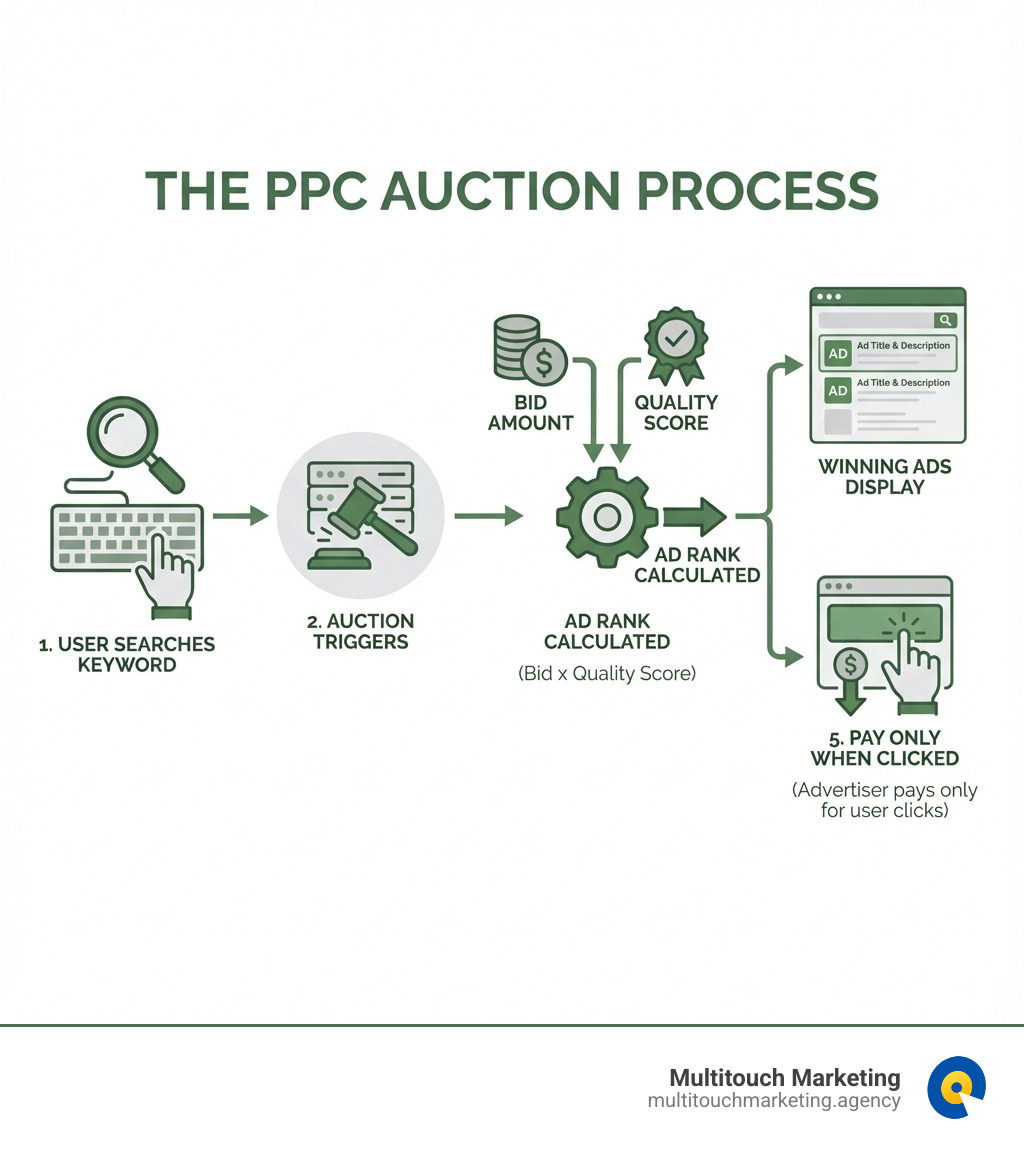
PPC advertising for small businesses is a paid digital marketing strategy where you only pay when someone clicks your ad. Here’s what you need to know:
- What it is: Pay-Per-Click advertising places your business at the top of search results instantly
- How it works: You bid on keywords, create ads, and pay only when users click
- Why it matters: Compete with larger brands, control your budget, and see immediate results
- Best for: Driving targeted traffic, generating leads, and testing new markets quickly
Think of PPC as your express lane to customers. Unlike waiting months for organic search results, your ads can appear at the top of Google within hours. You set your budget, choose who sees your ads, and track every dollar spent.
The challenge? Less than 25% of PPC ads produce conversions. Most small businesses waste hundreds or thousands of dollars on campaigns that don’t work—not because PPC doesn’t work, but because they’re missing key strategies.
The good news: With the right approach, PPC can deliver an average ROI of 200%. Businesses typically make $2 in revenue for every $1 spent on Google Ads, with well-optimized campaigns seeing returns as high as 800%.
This guide walks you through everything: from understanding the basics to launching campaigns that actually convert. You’ll learn how to choose profitable keywords, write ads that get clicks, optimize landing pages, and track results that matter to your bottom line.
I’m Milton Brown, and I’ve been managing PPC campaigns for small businesses since 2008, handling budgets from $20,000 to $5 million across industries like e-commerce, healthcare, and professional services. Throughout this guide, I’ll share proven strategies for PPC advertising for small businesses that work in competitive markets without burning through your budget.
PPC advertising for small businesses basics:
The Core Benefits of PPC for Small Businesses
Feeling like your small business is invisible online? Pay-per-click (PPC) advertising can help us cut through the noise and reach our ideal customers fast—no need to wait months for organic traffic to grow. For small businesses, PPC allows us to compete with bigger brands, even on a tight budget. About 45% of brands consider PPC a valuable strategy, and for good reason!
Here’s why PPC advertising for small businesses is a game-changer:
- Immediate Results: Unlike SEO, which can take months to show significant results, PPC campaigns deliver traffic and visibility almost instantly. As soon as your ads go live, you start getting traffic. This immediate impact is invaluable for small businesses looking for quick wins or needing to promote time-sensitive offers. Studies show PPC has an average ROI of 200%, higher than many other digital outlets.
- Laser-Focused Targeting: We can pinpoint our ideal audience with incredible precision. This includes:
- Geotargeting: For local businesses in Raleigh, Durham, or Chapel Hill, geotargeting is a superpower. We can ensure our ads only show to people searching within a specific radius of our physical location, or even specific zip codes. This is crucial given that 46% of all Google searches are looking for local information, and 72% of local searchers will visit a business within five miles from them. Searches for “near me” or “close by” have grown by more than 900% over recent years, making local PPC an essential tool for reaching customers in our community.
- Demographic Targeting: We can narrow down our audience by age, gender, income, parental status, and more, ensuring our ad spend reaches the most relevant potential customers.
- Interest and Behavior Targeting: We can target users based on their online interests and past behaviors, serving ads to those most likely to be interested in our products or services.
- Budget Control and Flexibility: We have complete control over our spending. We can set daily or monthly budgets, adjust bids in real-time, and pause campaigns whenever we need to. This flexibility is vital for small businesses with limited resources. We can start small, test what works, and then scale our campaigns strategically. Our internal guide on PPC Campaign Budgeting for Small Businesses offers more insights.
- Measurable and Trackable ROI: Every click, impression, and conversion is trackable. This means we can clearly see what’s working and what isn’t, allowing us to make data-driven decisions to optimize our campaigns for maximum return on investment. This transparency helps us understand the true value of our marketing efforts.
- Data-Driven Optimization: With detailed performance metrics at our fingertips, we can continuously refine our campaigns. We can identify high-performing keywords, optimize ad copy, and improve landing pages to boost conversion rates. This constant cycle of analysis and improvement ensures our campaigns become more efficient over time.
- Brand Awareness: Even if a user doesn’t click our ad, seeing our business name and offering repeatedly builds brand recognition and trust. PPC ads appear at the top of search results, giving our brand immediate visibility and helping us stand out in a crowded market.
Crafting Your Winning Strategy: A PPC Plan for Small Businesses
A well-thought-out strategy is the backbone of successful PPC advertising for small businesses. It’s not just about throwing money at ads; it’s about making every dollar count. Here’s how we approach building a robust PPC plan:
First, we need to clearly define our campaign goals. Do we want to drive website traffic, generate phone calls, increase online sales, or build brand awareness? Having clear objectives will guide every decision we make.
Next, we develop detailed audience personas. Who are our ideal customers in Raleigh, Durham, or Chapel Hill? What are their demographics, interests, and pain points? The more we understand our audience, the better we can tailor our keywords and ad copy.
Then, we conduct thorough competitor analysis. We look at what our competitors are doing in PPC, what keywords they’re bidding on, and what their ads and landing pages look like. This helps us find opportunities they might have missed and identify areas where we can differentiate ourselves.
Finally, we allocate our budget wisely. A reasonable starting point for many small businesses is $500 to $2,000 per month. The first 30 days are often a data-gathering mission, not a profit sprint.
Effective Keyword Research for PPC Advertising for Small Businesses
Keywords are the bridge between our business and the people searching for what we offer. Choosing the right keywords will put our ads directly in their path.
- User Intent: This is paramount. Is the searcher looking for information (“how to create invoices”), comparing prices (“invoicing software cost”), or ready to buy (“best invoicing tools”)? We must match our keywords to their intent.
- Long-Tail Keywords vs. Short-Tail Keywords:
- Short-tail keywords (e.g., “sneakers,” “shampoo”) are broad and attract a wide audience. However, they are often too competitive and expensive for small businesses due to higher bids.
- Long-tail keywords (e.g., “sneakers made with renewable fibers,” “purple shampoo without fragrance”) are longer, more specific phrases. While they have lower search volume, they are more likely to convert and have much less competition, resulting in a lower Cost Per Click (CPC). For example, a local coffee shop in Raleigh might target “artisan coffee delivery boxes Raleigh” instead of just “coffee.”
- Keyword Research Tools: Tools like Google’s own Keyword Planner are invaluable. They allow us to enter words and phrases related to our business and find relevant keywords, estimate search volume, and gauge competition.
- Keyword Match Types: Understanding match types (broad, phrase, exact) is crucial for controlling where our ads appear and preventing wasted spend. Our Keyword Bid Strategies PPC Campaign guide digs deeper into this.
- Negative Keywords: These are just as important as our target keywords. Negative keywords tell the ad platform when not to show our ads. For instance, if we sell luxury appliances, we might add “cheap” or “free” as negative keywords to avoid showing our ads to bargain hunters. Regularly reviewing search term reports helps us identify and add new negative keywords, preventing our ads from appearing for irrelevant searches and saving us money.
Setting and Managing Your Budget Effectively
Budget management is where small businesses can truly shine in PPC. We might not have the deep pockets of larger brands, but we can be smarter with our spending.
- Daily vs. Lifetime Budgets: Most platforms allow us to set a daily budget, which helps prevent overspending. We can also set a lifetime budget for a specific campaign duration.
- Average CPC: The average CPC tends to fall between $1 and $2, though it can vary significantly by industry. In 2024, the cost per click (CPC) across all businesses was $4.66. While this might seem high, a focused strategy can make it worthwhile.
- Bidding Strategies: We can choose from various bidding strategies:
- Manual CPC: We set our own bids for keywords, giving us maximum control. This is a good starting point for new campaigns to gather data.
- Automated Bidding: Strategies like “Maximize Conversions” or “Target CPA” leverage machine learning to optimize bids in real-time based on our goals. These can be very effective once we have enough conversion data.
- Starting Small and Scaling: We recommend starting with a modest budget. The first 30 days should be viewed as an investment in data collection. Once we identify what’s working, we can gradually increase spending on high-performing campaigns. Our Google Ads Budget Management resource provides more practical advice.
From Clicks to Customers: Executing a High-Impact Campaign
Effective campaign execution transforms clicks into valuable customer interactions. This involves structuring our campaigns logically, ensuring ad relevance, and continuously optimizing.
Our campaigns should be structured into tightly themed ad groups. For example, if we sell handmade leather wallets, instead of one ad group for “wallets,” we might have separate ad groups for “men’s bifold leather wallet,” “slim front pocket wallet,” and “personalized leather anniversary gift.” This level of organization ensures high ad relevance, which is crucial for Quality Score. Our guide on Adwords Campaign Setup and Optimization offers a detailed walkthrough.
Writing Compelling Ad Copy
Our ad is often the first impression a potential customer has of our business. It needs to grab attention and persuade them to click.
- Strong Headlines: These are our prime real estate. They should include our target keyword, highlight a pain point or desire, and create urgency. We have 15 potential headlines in Responsive Search Ads (RSAs), so we should use them all!
- Clear Value Proposition: What makes us different? Why should they choose us over a competitor? Our ad copy must clearly articulate our unique selling points.
- Highlighting Benefits: Instead of just listing features, we focus on the benefits our product or service provides. For instance, for a plumbing business in Durham, instead of “We offer 24/7 emergency services” (feature), we might say “Leaking pipe at 2 am? We’ll be there fast to fix the problem and save you from a major disaster” (benefit).
- Strong Call-to-Action (CTA): Our ad needs a clear, compelling instruction. “Shop Now,” “Get a Free Quote,” “Call Us Today” – these tell users exactly what to do next.
- Using Ad Extensions: These are free and offer extra space to provide more information and additional reasons for users to click.
- Sitelinks: Links to specific pages on our website (e.g., “Services,” “About Us,” “Contact”).
- Callouts: Highlight specific features or benefits (e.g., “Free Shipping,” “24/7 Support”).
- Structured Snippets: Showcase specific aspects of our products or services (e.g., “Service list: HVAC, Plumbing, Electrical”).
- Location Extensions: Crucial for local businesses in Raleigh or Chapel Hill, displaying our address and phone number directly in the ad.
- Lead Form Extensions: Allow users to fill out their information directly from the search results page.
We must create an ad copy testing strategy and stick with it. Develop themes, pin those assets, and start creating more meaningful ads.
Optimizing Your Landing Page for Conversions
Our ad gets the click, but our landing page seals the deal. A great landing page continues the conversation our ad started and guides the user toward conversion.
- Message Match: The content and offer on our landing page must perfectly align with the ad the user clicked. If our ad promises “20% off all services,” our landing page should immediately confirm that offer.
- Fast Load Times: Page load speed is critical. Walmart found that for every 1-second improvement in load time, conversions increased by around 2%. Slow pages mean lost customers and wasted ad spend.
- Mobile-First Design: More than 50% of internet traffic comes from mobile devices. Our landing pages must be fully responsive, easy to steer, and load quickly on smartphones. This is especially important for local businesses, as many people search for nearby services on their phones while on the go.
- Clear CTA: Just like our ad, our landing page needs a prominent and unambiguous call to action.
- Trust Signals: Include testimonials, reviews, security badges, and clear contact information to build trust and credibility.
Key Landing Page Elements:
- Compelling Headline: Reiterate the ad’s promise.
- Concise Copy: Highlight benefits, not just features.
- Visuals: High-quality images or videos.
- Clear Call-to-Action: Prominent and easy to find.
- Lead Form (if applicable): Simple and minimal fields.
- Trust Signals: Testimonials, reviews, security badges.
- Contact Information: Easy ways to reach us.
- Mobile Responsiveness: Flawless experience on all devices.
- No Distractions: Minimal navigation, focus on conversion.
Maximizing Your ROI: Advanced PPC Advertising for Small Businesses
Once we have our foundational campaigns running, it’s time to fine-tune and scale. This is where advanced strategies for PPC advertising for small businesses come into play, helping us wring every last drop of value from our ad spend.
Improving Your Quality Score
Quality Score is a diagnostic tool that provides a holistic view of the quality of our ads, keywords, and landing pages. A higher Quality Score means lower costs and better ad positions. Search engines evaluate bids along with the quality and relevance of the ads, using pre-determined metrics such as quality scores.
- Ad Relevance: Our keywords, ad copy, and landing page content should all be tightly aligned. If someone searches for “emergency plumber Raleigh,” our ad should mention “emergency plumber Raleigh,” and our landing page should immediately offer emergency plumbing services in Raleigh.
- Expected CTR: This is an estimate of how likely our ad is to be clicked when shown for a given keyword, relative to competitors’ ads. Compelling ad copy and strong CTAs help improve this.
- Landing Page Experience: Our landing page should be relevant, easy to steer, fast-loading, and mobile-friendly. It should provide a positive user experience.
Regularly auditing our campaigns, including a Pay Per Click Audit, helps us identify areas for Quality Score improvement.
Leveraging Automation and Smart Bidding
Automation and smart bidding strategies are no longer just for big brands. They can significantly boost the efficiency of PPC advertising for small businesses.
- Target CPA (Cost Per Acquisition): We tell the system our target cost for each conversion, and it automatically adjusts bids to achieve that goal. This is ideal for businesses focused on lead generation or sales.
- Maximize Conversions: This strategy aims to get us the most conversions possible within our budget.
- Real-time Bidding: These strategies use machine learning to analyze countless signals (device, location, time of day, user behavior) in real-time during every auction to set the optimal bid. This is something no human can do manually.
- AI-powered tools: We can use AI-powered tools or Google’s automatic buying strategies to change bids in real-time. Automation uses signals sent during auctions to improve performance and spending without any help from a person. Our internal guide on AI in Google Ads explores this further.
Tracking, Measuring, and Proving ROI
The beauty of PPC is its measurability. We can track almost everything, allowing us to prove the return on our investment.
- Conversion Tracking Setup: This is non-negotiable. We need to set up conversion tracking on our website to record valuable actions like form submissions, phone calls, purchases, or newsletter sign-ups.
- Google Analytics Integration: Linking our Google Analytics account to our ad platform provides a holistic view of user behavior after the click, offering deeper insights into engagement and pathways to conversion.
- Calculating ROI: Our ROI (Return on Investment) is simple: (Revenue – Cost) / Cost. We aim for a positive ROI, meaning we’re making more money than we spend.
- Cost-Per-Acquisition (CPA): This tells us how much it costs to acquire a single customer or lead through our ads. We divide our total ad spend by the number of conversions. Our goal is to minimize CPA while maximizing conversion volume. Our resource on How to Increase Your ROI Through Scientific SEM provides methods for this.
Retargeting
The cost of acquiring a new customer can be up to 30 times that of keeping an existing one. Retargeting (or remarketing) allows us to show ads to people who have previously interacted with our website or app but didn’t convert. Since only about 2% of website visitors make a purchase on their first visit, retargeting is a highly effective way to bring back warm leads and encourage them to complete a desired action. Our guide on how to Set Up Dynamic Remarketing Google Ads offers a step-by-step approach.
Frequently Asked Questions about PPC for Small Businesses
Should small businesses prioritize PPC or SEO?
This is a classic question, and the answer is usually “both!”
- PPC for Immediate Results: As we’ve discussed, PPC provides instant visibility and traffic. It’s excellent for quick wins, testing new products or services, and capturing demand immediately. If you’re a new business in Raleigh wanting to get noticed now, PPC is your fast lane.
- SEO for Long-Term Growth: SEO builds organic authority and sustainable, free traffic over time. It’s a long-term investment that pays dividends by establishing your business as an authoritative presence online.
- A Combined Strategy: The most effective approach for PPC advertising for small businesses is often a combined strategy. PPC can drive immediate traffic and provide valuable keyword data that can inform our SEO efforts. Meanwhile, a strong organic presence can boost the overall credibility of our paid ads. Our internal comparison of Small business advertising strategies—Google Ads offers more detail.
What are common mistakes in PPC advertising for small businesses?
Even with the best intentions, small businesses can fall into common PPC traps. Here are some to avoid:
- Not Using Negative Keywords: This is a huge budget drain. Failing to add negative keywords means our ads show for irrelevant searches, leading to wasted clicks and poor performance. Our PPC Negative Keyword Strategy guide is essential reading.
- Poor Landing Pages: Sending ad traffic to an unoptimized or irrelevant landing page is like inviting guests to a party and then locking the door. It leads to high bounce rates and low conversion rates.
- Ignoring Mobile Users: With over 50% of internet traffic coming from mobile devices, neglecting mobile optimization for ads and landing pages is a critical error.
- Setting and Forgetting Campaigns: PPC is not a “set it and forget it” strategy. It requires continuous monitoring, testing, and optimization to remain effective.
- Vague Ad Copy: Ads that don’t clearly state their value proposition or include a strong call to action will struggle to attract clicks.
- Broad Keyword Targeting: Bidding on overly broad keywords can lead to irrelevant traffic and quickly deplete our budget.
- No Conversion Tracking: If we don’t track conversions, we have no idea if our campaigns are actually generating business, making it impossible to calculate ROI. Our resource on Busting PPC Marketing Myths addresses more misconceptions.
How can local businesses use PPC effectively?
For local small businesses in areas like Raleigh, Durham, or Chapel Hill, PPC is an absolute powerhouse.
- Geotargeting: This is our best friend. We can set our campaigns to only show ads to users within a specific radius of our business, ensuring we reach local customers actively searching for our services. This is a major theme in local PPC.
- “Near Me” Searches: Capitalize on the explosion of “near me” or “close by” searches, which have grown by more than 900% in recent years. Include these phrases in our keywords and ad copy to capture high-intent local traffic.
- Location Extensions: These free ad extensions display our business address, phone number, and a map link directly in our ad, making it easy for local customers to find and contact us.
- Local Services Ads: For service-based businesses (e.g., plumbers, electricians, locksmiths in Raleigh or Chapel Hill), Local Services Ads appear at the very top of Google search results, often with a “Google Guaranteed” badge, and we only pay when a qualified lead contacts us.
- Local Keyword Specificity: Instead of just “bakery,” we might target “best sourdough bakery Durham NC” or “custom cakes Chapel Hill.”
Conclusion
PPC advertising for small businesses is a powerful, dynamic tool that, when wielded correctly, can level the playing field against larger competitors. We’ve explored how PPC offers immediate visibility, precise targeting, budget control, and measurable results, making it an indispensable part of any modern marketing strategy.
From crafting compelling ad copy and optimizing landing pages to leveraging advanced techniques like Quality Score improvement and smart bidding, the journey to PPC success is one of continuous learning and adaptation. By avoiding common mistakes and focusing on a strategic, data-driven approach, we can transform clicks into tangible business growth.
At Multitouch Marketing, we specialize in guiding businesses through this complex landscape, helping them achieve big wins with their PPC campaigns. Ready to open up the full potential of your online advertising? We’re here to help you get started.