
Why Pay-Per-Click Advertising Matters for Your Business
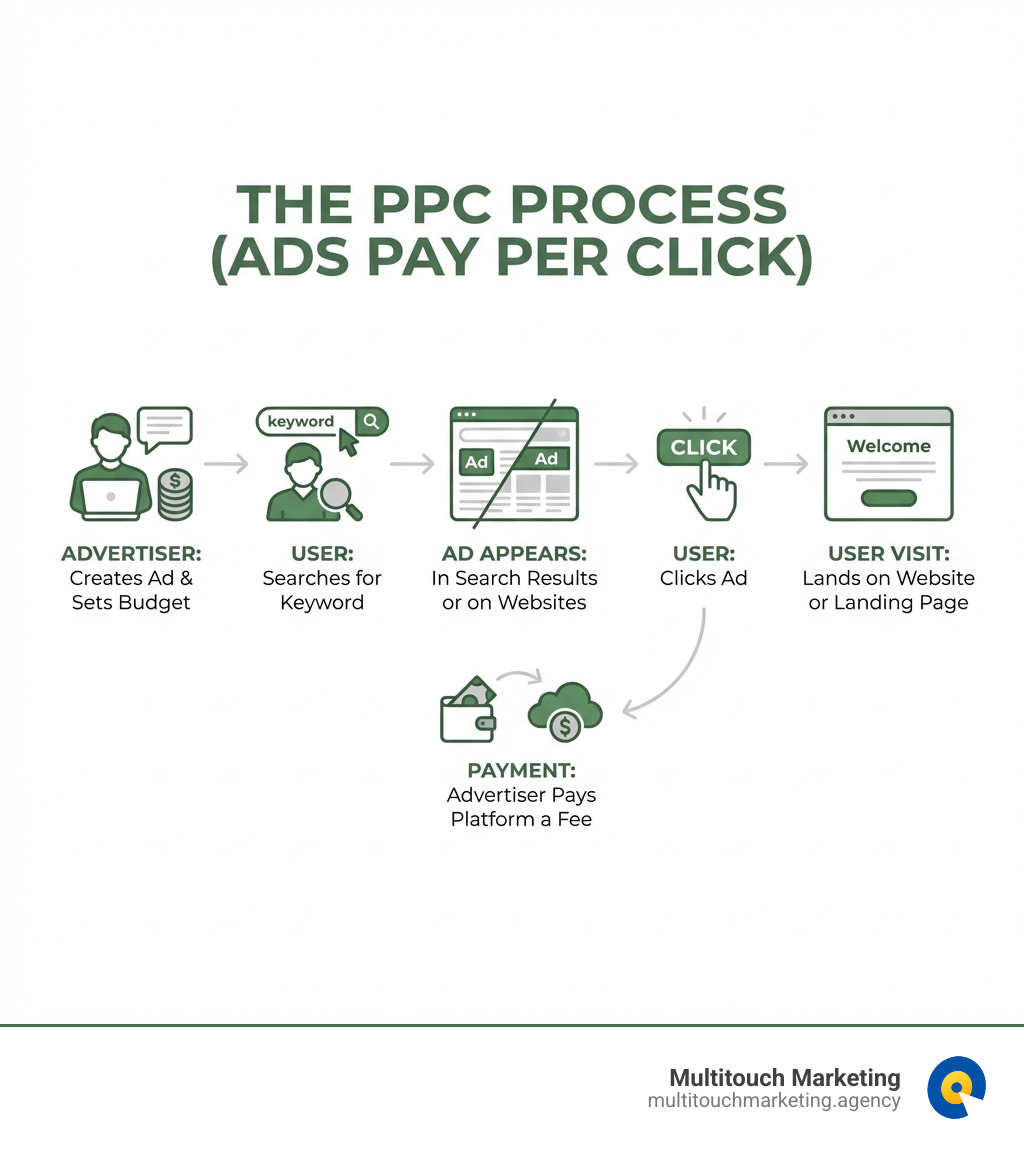
Ads pay per click (PPC) is an online advertising model where you pay a fee each time someone clicks on your ad. Instead of earning visits organically, you’re buying targeted traffic to your website, landing page, or app.
Here’s what you need to know about PPC:
- How it works: You bid on keywords relevant to your business. When someone searches for those terms, your ad may appear at the top of search results or on websites and social media platforms.
- When you pay: You only pay when someone actually clicks your ad—not when they just see it.
- Where ads appear: Search engines (Google, Bing), social media platforms (Facebook, Instagram, LinkedIn), and websites across the internet.
- Main benefit: You get measurable, immediate results and only pay for people who show interest by clicking.
The numbers tell a compelling story. Customers are 50% more likely to purchase after clicking a paid ad. Even better, businesses see an average return of $2 for every $1 spent on PPC. With paid ads capable of improving brand awareness by 80%, it’s no wonder that 79% of brands call PPC a massive driver for their business.
But there’s a catch. Click fraud and fake traffic cost advertisers $35 billion annually. The average cost-per-click sits at $2.59, and many business owners struggle to steer the complexities of bidding, keywords, Quality Scores, and campaign optimization. Without the right approach, PPC can drain your budget faster than it fills your sales pipeline.
I’m Milton Brown, and since 2008, I’ve managed PPC campaigns with budgets from $20,000 to $5 million for diverse organizations. My expertise in ads pay per click combines data-driven strategy with advanced tracking to turn ad spend into measurable growth. In this guide, I’ll walk you through making PPC work for your business, from the basics to avoiding costly mistakes.
How Ads Pay Per Click Work: The Ad Auction Explained
At its core, ads pay per click operates on an auction system. When a user performs a search query on a platform like Google, an instantaneous auction takes place among advertisers who have bid on keywords related to that query. This isn’t a traditional auction where the highest bidder always wins the top spot. Instead, platforms like Google Ads use a complex algorithm to determine ad placement and cost.
Here’s how it generally works:
- Keyword Bidding: Advertisers choose keywords they want their ads to appear for and set a maximum bid—the highest amount they’re willing to pay for a single click.
- Ad Auction: When a search is performed, the system identifies all eligible ads that are bidding on keywords relevant to the search query.
- Ad Rank Calculation: Each eligible ad is assigned an “Ad Rank.” This rank determines your ad’s position on the search results page and whether it shows at all. Ad Rank is primarily influenced by two factors:
- Your Bid: The maximum amount you’re willing to pay per click.
- Quality Score: This is a crucial metric, rated from 1 to 10, that measures the quality and relevance of your ad and keywords to your landing page. A higher Quality Score means your ad is more relevant and useful to users.
- Ad Placement: The ads with the highest Ad Ranks are displayed, usually at the top or bottom of the search results page. Advertisers only pay when someone clicks on their ad.
A high Quality Score significantly impacts your campaign, leading to better ad placement at a lower cost per click. Google’s Quality Score is influenced by three main factors: expected click-through rate (CTR), ad relevance, and landing page experience. Improving your Quality Score can dramatically increase your return on investment. Learn more about how to improve your quality score and explore How to Increase Your ROI Through Scientific SEM for deeper insights into maximizing your ad spend.
The Role of Keywords in PPC

Keywords are the backbone of any successful ads pay per click campaign. They are the words and phrases that users type into search engines, and they directly connect your ads to potential customers. Our approach to keyword strategy focuses on relevance, intent, and continuous refinement.
When we select keywords, we consider:
- Search Intent: Are users looking to buy, research, or simply browse? Understanding their intent helps us tailor ads and landing pages for better conversions. For example, a search for “software for lead management” shows research intent, while “Salesforce pricing” indicates a readiness to buy.
- Keyword Relevance: The chosen keywords must directly relate to your products or services. Google’s Quality Score heavily weighs keyword relevance, so choosing wisely can lower your CPC and improve ad position.
- Match Types: Google Ads offers various match types (Broad, Phrase, Exact) that control how closely a user’s search query must match your keyword for your ad to appear. Using the right match types ensures your ads are shown to the most relevant audience. For instance, “exact match” offers tight control, while “broad match” offers wider reach.
- Long-Tail Keywords: These are longer, more specific keyword phrases (e.g., “best organic coffee beans Raleigh NC”). They typically have lower search volume but often indicate higher purchase intent and are less competitive, leading to lower costs and higher conversion rates.
- Negative Keywords: Just as important as the keywords you target are the ones you exclude. Negative keywords prevent your ads from showing for irrelevant searches. For example, if you sell new cars, you might add “used” or “rental” as negative keywords. This reduces wasted ad spend and improves ad relevance. Find more in our PPC Negative Keyword Strategy and this handy guide on keyword planning.
PPC vs. Other Ad Models
It’s important to understand how PPC compares to other models like Cost Per Mille (CPM), or Cost Per Thousand Impressions. The main distinction is what triggers the payment.
Here’s a quick comparison:
| Feature | Pay-Per-Click (PPC) | Cost Per Mille (CPM) |
|---|---|---|
| Payment Trigger | Advertiser pays each time a user clicks on the ad. | Advertiser pays for every 1,000 times the ad is displayed (impressions). |
| Primary Goal | Driving qualified traffic, leads, or sales directly to a website. | Maximizing brand exposure, awareness, and visibility. |
| Performance | Focus on clicks, conversions, and ROI. Measures direct engagement. | Focus on reach, frequency, and viewability. Measures exposure. |
| Cost Basis | Cost-Per-Click (CPC) – varies by keyword competitiveness and Quality Score. | Cost-Per-Mille (CPM) – varies by audience, placement, and ad format. |
| Best For | Businesses seeking immediate action, conversions, or highly targeted traffic. | Campaigns focused on building brand recognition and broad audience reach. |
As the research suggests, PPC’s advantage over CPM is its ability to convey effectiveness through clicks, directly measuring attention and interest. With CPM, you’re paying for eyeballs, whether they engage or not. With ads pay per click, you’re paying for intent. Both have their place in a comprehensive digital strategy, but our focus is on the direct, measurable results that PPC delivers. For a deeper dive into these models, consider the insights from “Online advertising: Pay-per-view versus pay-per-click — A comment” by Fjell (2009) which provides a historical context to these different payment structures.
Types of PPC Ads and Campaign Strategies

The world of ads pay per click is diverse, offering various ad formats and placements to reach your audience. The type of PPC ad you choose depends heavily on your business goals and where your target audience spends their time online.
Here are the main types of PPC ads we use:
- Search Ads: These are the most common type of PPC ad, appearing at the top or bottom of search engine results pages (SERPs), like Google. They are text-based and highly effective because they target users with high intent—those actively searching for specific products, services, or information. For businesses in Raleigh, Durham, or Chapel Hill, this means capturing local customers looking for what you offer right now.
- Display Ads: These are visual ads (images, animations, videos) that appear on websites, apps, and video content across vast ad networks (like the Google Display Network). They are excellent for brand awareness and retargeting, allowing you to reach users who aren’t actively searching but might be interested in your offerings based on their browsing behavior.
- Social Media Ads: Platforms like Facebook, Instagram, and LinkedIn offer robust PPC advertising options. These ads integrate seamlessly into users’ feeds and are powerful for targeting specific demographics, interests, and behaviors. For instance, an accounting SaaS business might target LinkedIn users due to their higher median age and income, as noted in our research.
- Remarketing/Retargeting Ads: These ads target users who have previously interacted with your website or app. For example, if someone visited your online store but didn’t make a purchase, remarketing ads can show them the products they viewed on other websites or social media, reminding them to complete their purchase. This is crucial for nurturing leads and recovering potential sales. Check out how to Set Up Dynamic Remarketing Google Ads.
- Video Ads: Appearing on platforms like YouTube and other video content sites, these ads leverage the power of visual storytelling. They can be highly engaging and effective for building brand awareness and driving traffic.
- Shopping Ads (Product Listing Ads): Predominantly seen on Google, these ads display product images, prices, and store names directly in search results. They are ideal for e-commerce businesses as they provide immediate product information and drive highly qualified traffic.
Each type of ad serves a different purpose, and a truly effective PPC strategy often involves a combination of these, carefully orchestrated to guide potential customers through their journey. Learn more about crafting a multi-faceted approach in our PPC Campaign Strategies guide.
Aligning Ad Types with Business Goals
The beauty of ads pay per click lies in its versatility to align with diverse business objectives. Whether you’re aiming to fill your sales funnel or paint the town with your brand name, PPC has a strategy for you.
- Lead Generation: For businesses focused on collecting potential customer information (e.g., service providers, B2B companies), search ads are often paramount. By bidding on keywords indicating high intent (e.g., “PPC management Raleigh,” “digital marketing Chapel Hill”), we can capture users actively looking for your services. Social media ads on platforms like LinkedIn can also be highly effective for B2B lead generation due to their professional targeting capabilities.
- Brand Awareness: If your goal is to introduce your brand to a wider audience or keep it top-of-mind, display and video ads are excellent choices. They allow for broad reach and visual impact, making your brand recognizable even to those who aren’t actively searching for your product. Paid ads can improve brand awareness by 80%, a statistic we love to see!
- E-commerce Sales: For online retailers, Shopping Ads are a no-brainer, showcasing products directly in search results. Remarketing ads are also incredibly powerful here, converting browsers into buyers by reminding them of items left in their cart. Our research shows that customers are 50% more likely to purchase after clicking a paid ad, making retargeting a vital component for sales.
- Funnel Stages: We tailor ad types to different stages of the customer journey:
- Awareness: Display and social media ads introduce your brand.
- Consideration: Search ads answer specific queries, and video ads provide deeper insights.
- Conversion: Highly targeted search ads, shopping ads, and remarketing ads drive the final purchase or action.
- Loyalty: Remarketing can even be used to nurture existing customers with special offers, ensuring they return.
For specialized industries, like automotive, PPC can be finely tuned to target specific buyer journeys. Explore our insights on Automotive PPC Campaigns to see how this plays out in practice.
Setting Up a Successful PPC Campaign
Setting up an effective ads pay per click campaign might seem daunting, but by breaking it down into manageable steps, you can build a powerful engine for business growth.
- Establish Your Campaign Goals: Before we even think about keywords or bids, we define what success looks like. Do we want to drive website traffic, generate leads, increase online sales, or boost brand awareness in the Raleigh, Durham, or Chapel Hill area? Clear goals dictate every subsequent decision.
- Budgeting: Decide how much you’re willing to spend. This involves setting a daily or monthly budget. The average cost-per-click is $2.59, but this can vary wildly by industry and keyword. We help businesses determine a realistic budget that aligns with their goals and expected ROI. For small and mid-sized businesses, allocating $15,000 to $20,000 per month is common, but we work with all budget sizes. Learn more about PPC Campaign Budgeting for Small Businesses.
- Audience Targeting: Who are we trying to reach? We define our target audience based on demographics (age, gender, income), interests, location (targeting specific neighborhoods in Raleigh, Durham, or Chapel Hill), devices, and even past interactions with your business. This precision ensures your ads are seen by the right people at the right time.
- Keyword Research and Selection: As discussed, this is critical. We use tools like Google Keyword Planner to identify relevant, high-intent keywords, considering search volume and competitiveness. We also build a robust list of negative keywords to prevent wasted spend.
- Ad Groups: We organize your keywords and ads into tightly themed ad groups. This ensures that the ads shown are highly relevant to the specific search query, improving Quality Score and CTR.
- Ad Copy Creation: Crafting compelling ad copy is an art and a science. Your ad needs to grab attention, highlight your unique selling proposition (USP), and include a clear Call-to-Action (CTA). Creative quality accounts for 49%-70% of an ad’s success, outweighing media placement or targeting.
- Landing Page Optimization: Your ad is only as good as the page it leads to. We ensure your landing pages are highly relevant to the ad copy and keywords, load quickly (Walmart found a 1-second improvement in load time increased conversions by 2%), and have a clear, persuasive CTA. A well-designed landing page should be simple, remove distractions, and guide the user towards conversion.
- Tracking Setup: We implement robust tracking mechanisms to monitor every click, conversion, and dollar spent. This data is vital for understanding performance and making informed optimization decisions.
For a step-by-step guide on launching your first campaign, refer to our resource on how to Set Up Google Ad Campaign.
Best Practices for Managing Your Ads Pay Per Click
Launching a campaign is just the beginning. Effective management and continuous optimization are what truly open up the power of ads pay per click. We believe PPC is not a “set-it-and-forget-it” kind of deal.
Here are our best practices for managing your PPC campaigns:
- A/B Testing: We constantly test different versions of ad copy, headlines, images, and landing page elements to see what resonates best with your audience. Small tweaks can lead to significant improvements in CTR and conversion rates.
- Bid Management: We strategically adjust bids based on keyword performance, competition, and campaign goals. While automation handles much of this, human oversight and strategic adjustments are still crucial. Our goal is to achieve the best possible ad position at the lowest possible cost. Managing your Google Ads Budget Management effectively is key here.
- Regular Monitoring: We keep a close eye on campaign performance daily, weekly, and monthly. This includes tracking impressions, clicks, conversions, and costs. Early detection of issues or opportunities allows for quick adjustments.
- Performance Analysis: Beyond just monitoring, we dig deep into the data to identify trends, understand what’s working (and what’s not), and uncover new opportunities. This might involve analyzing geographic performance (e.g., how ads perform in Raleigh vs. Durham), device performance, or time-of-day performance.
- Keyword Refinement: We continuously add new relevant keywords, identify and add negative keywords, and prune underperforming terms. If a keyword is costing too much without generating conversions, we’re not afraid to turn it off.
- Landing Page Optimization: We regularly review and refine landing pages, ensuring they remain relevant, fast-loading, and conversion-focused.
- Retargeting: We leverage remarketing campaigns to re-engage users who have shown interest but haven’t converted. This keeps your brand front of mind and can significantly boost conversion rates.
- Iterate and Scale: PPC is an iterative process of refining strategies based on successes and failures. What works today may need adjustment tomorrow. Once a strategy is proven, we look for opportunities to scale it profitably.
This rigorous approach to optimization is critical. Explore more about PPC Campaign Optimization and get Tips Expert PPC Management for more in-depth strategies.
Measuring Performance and Overcoming Challenges
The beauty of ads pay per click is its measurability. We track a variety of Key Performance Indicators (KPIs) to ensure your campaigns are on track to meet your business objectives.
Here are the essential metrics we monitor:
- Click-Through Rate (CTR): The percentage of people who see your ad and click on it. A higher CTR often indicates ad relevance and can improve your Quality Score.
- Cost-Per-Click (CPC): The actual amount you pay for each click. While the average CPC is $2.59, our goal is always to optimize for a lower, more efficient cost. As we mentioned earlier, a high Quality Score can lead to lower CPC.
- Conversion Rate: The percentage of clicks that result in a desired action, such as a purchase, form submission, or phone call. This is a critical metric for understanding the effectiveness of your landing pages and overall campaign. For example, the average travel and hospitality conversion rate for search is 3.55%.
- Return on Ad Spend (ROAS): The revenue generated for every dollar spent on advertising. This is a direct measure of profitability, showing us if our ad spend is truly turning into measurable business growth. Our goal is always to exceed the average ROI of $2 for every $1 spent.
- Cost Per Acquisition (CPA) / Cost Per Conversion: The total cost of acquiring a new customer or generating a specific conversion. This helps us understand the true cost-effectiveness of our campaigns.
Regularly auditing your PPC campaigns is essential to ensure these metrics are healthy and improving. Our PPC Audit Services can help uncover opportunities for improvement.
Common Challenges with Ads Pay Per Click
While PPC offers incredible opportunities, it’s not without its problems. We’ve steered these challenges for businesses in Raleigh, Durham, and Chapel Hill, and understand the importance of proactive solutions.
- Click Fraud: This is a significant concern in the PPC world, costing online advertisers an estimated $35 billion due to click bots and fake traffic. Click fraud involves illegitimate clicks on ads, either by competitors trying to deplete your budget or publishers trying to inflate their earnings. Platforms like Google have sophisticated systems to prevent invalid activity, and we also employ vigilant monitoring to detect and mitigate fraudulent clicks. Our research highlights the serious nature of click fraud, with major schemes being dismantled by authorities. Learn more in this Click fraud paper.
- Wasted Ad Spend: This can stem from broad keyword targeting, irrelevant ad copy, poor landing page experiences, or failing to use negative keywords. Without careful management, your budget can quickly be spent on clicks that never convert.
- Rising Costs: Digital advertising costs have been steadily rising. The average customer acquisition cost (CAC) for online retailers is now between $68-$78, double what it was in 2013. This makes optimization and a strong conversion strategy more crucial than ever. For instance, online travel agents (OTAs) bidding on your property’s name can cost around 47% more per click.
- Ad Fatigue: When your target audience sees the same ad too many times, they might start ignoring it or even develop negative feelings toward your brand. This leads to diminishing returns and wasted impressions. Fresh ad creatives and varied messaging are key to combating this.
Overcoming these challenges requires expert knowledge, continuous monitoring, and strategic adjustments. We’re here to help Busting PPC Marketing Myths and ensuring your ad spend is optimized for real results.
When to Hire a PPC Agency
Managing successful ads pay per click campaigns is a full-time job. It demands constant attention, deep expertise, and a commitment to continuous learning and optimization. For many businesses in Raleigh, Durham, and Chapel Hill, knowing when to bring in professional help can be a game-changer.
Consider hiring a PPC agency like Multitouch Marketing when:
- Lack of Time: You’re too busy running your business to dedicate the hours needed for effective campaign management, optimization, and analysis. PPC isn’t a “set it and forget it” task; it requires daily vigilance.
- Lack of Expertise: You’re new to PPC or feel overwhelmed by the complexities of keyword research, bidding strategies, Quality Scores, and analytics. Our team brings years of specialized experience to the table.
- Diminishing Returns: Your current campaigns aren’t performing as well as they used to, or your ROI is flatlining. An agency can provide a fresh perspective, identify hidden opportunities, and implement advanced strategies.
- Scaling Campaigns: You’re ready to grow your business aggressively and need to scale your PPC efforts without sacrificing efficiency. We have the expertise to manage larger budgets and expand into new markets or ad platforms.
- Complex Industries: Your industry is highly competitive, has unique regulatory challenges, or requires highly specialized targeting. We’ve worked across diverse sectors, from e-commerce to healthcare and automotive, tailoring strategies to specific needs.
A good PPC agency handles all aspects of paid advertising: finding keywords, identifying audiences, creating ad components, and tracking campaigns. We act as a growth partner, focusing on your business outcomes, not just clicks. If you’re looking for expert PPC management in the Triangle area, explore our services for PPC Management Raleigh.
Conclusion: Using the Power of PPC for Your Business
Ads pay per click stands as a powerful, dynamic, and indispensable tool in the modern digital marketing landscape. It offers businesses unparalleled control over their advertising spend, delivering targeted traffic and measurable results in real-time. From boosting brand awareness by a staggering 80% to generating an average of $2 for every $1 spent, the benefits are clear and compelling.
We’ve explored the PPC ad auction, the diverse ad types for goals like lead generation, and the process of managing successful campaigns. This includes continuous optimization, A/B testing, and vigilant performance tracking to align with your business goals. While challenges like click fraud and rising costs exist, these are surmountable with expert knowledge and proactive management. This is why a strategic partnership with a dedicated PPC agency can transform your ad spend into significant business growth.
There’s a reason why 79% of brands list pay-per-click advertising as a huge driver for their business. It’s controllable, scalable, and delivers fast results, making it a strategic cornerstone for any business looking to thrive online. If you’re ready to harness the power of ads pay per click and drive tangible results for your business, we’re here to help. Take the next step towards maximizing your online visibility and conversions.
Find how our expertise can benefit your business: PPC Management for Small Business