
Why PPC Advertising for Small Businesses is Your Fast Track to Growth
PPC advertising for small businesses is a digital marketing strategy where you pay only when someone clicks on your ad. It’s the fastest way to get your business in front of potential customers who are actively searching for what you sell.
Quick Overview:
- What it is: Pay-Per-Click advertising on platforms like Google Ads, Bing, and Facebook
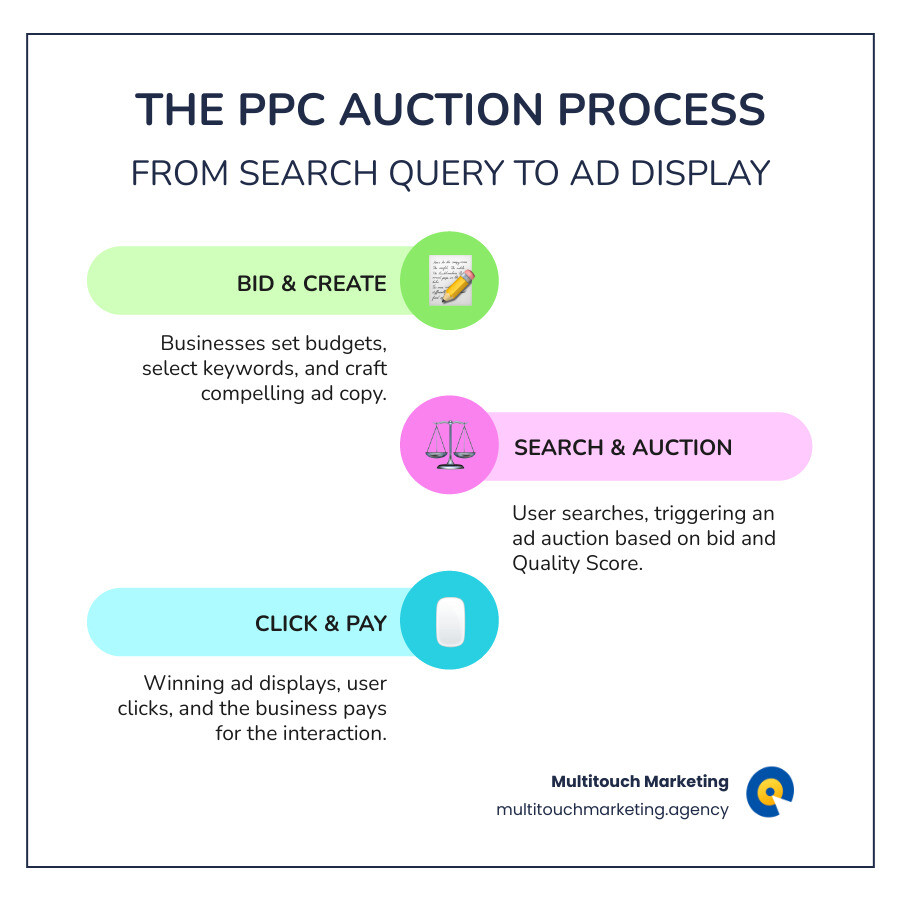
- How it works: You bid on keywords, create ads, and pay only when users click
- Why it matters: Delivers immediate visibility, precise targeting, and measurable ROI
- Average return: $2 revenue for every $1 spent (up to 200% ROI)
- Budget control: Set daily limits, start small (as low as $1-$2 per click), and scale up
- Best for: Businesses needing quick results, testing new markets, or competing with larger brands
If you’ve ever searched for something on Google and noticed ads at the top of the results page, you’ve seen PPC in action. Those businesses aren’t there by accident—they’re strategically positioning themselves exactly where their customers are looking.
Unlike traditional advertising where you pay upfront and hope for results, PPC is different. You only pay when someone actually clicks your ad. This makes it one of the most cost-effective marketing strategies available, especially for small businesses with tight budgets.
The challenge? Many small business owners find PPC overwhelming. The platforms look complex, the terminology feels foreign, and the fear of wasting money is real. But here’s the truth: with the right guidance, PPC can be your secret weapon for growth.
I’m Milton Brown, and since 2008, I’ve managed ppc advertising for small businesses across healthcare, e-commerce, and education, with budgets from $20,000 to $5 million. I’ve helped hundreds of businesses turn clicks into customers.
In this guide, I’ll break down everything you need to know about PPC. We’ll cover setting up your first campaign to advanced strategies that maximize every dollar, with practical advice you can use today.
Ppc advertising for small businesses terms explained:
- local business ppc management
- ppc campaign budgeting for small businesses
- ppc management for small business
The Small Business Advantage: Why PPC is a Game-Changer
Feeling like your small business is invisible online? We understand. It’s tough to cut through the noise, especially when you’re competing with larger brands that have seemingly endless marketing budgets. But here’s where PPC advertising for small businesses shines: it’s a genuine game-changer, allowing you to punch above your weight and get noticed.

PPC offers immediate results, unlike organic methods that can take months to mature. As soon as your ads go live, your business can appear at the top of search results, putting you directly in front of potential customers who are actively looking for what you offer in Raleigh, Durham, or Chapel Hill. This laser-focused targeting means we can reach precisely the right people at the right time, maximizing every dollar of your ad spend. The campaigns are highly measurable, giving us clear data on performance and allowing for continuous optimization. We’ve seen how PPC can significantly boost brand awareness and drive qualified traffic, helping small businesses grow and scale effectively. For more on the strategic advantages, explore Why PPC Advertising is Beneficial in Business.
Why is PPC advertising for small businesses a smart investment?
PPC advertising isn’t just another marketing expense; it’s a strategic investment with impressive returns. Studies show that PPC has an average ROI of 200%, meaning for every dollar you spend, you could see a two-dollar return. That’s a higher return than many other digital marketing channels! This immediate return on investment means you don’t have to wait for your ads to be indexed; traffic starts flowing as soon as your campaigns are active.
One of the biggest advantages is the ability to make data-driven decisions. PPC platforms provide a wealth of data on hits, impressions, cost-per-acquisition (CPA), and conversion rates. This allows us to see exactly what’s working and what isn’t, enabling us to optimize campaigns for maximum efficiency. With an average conversion rate of 4.40% on search networks, the potential to turn clicks into customers is significant. We’ve seen how PPC puts businesses in front of high-intent customers who are just a click away from making a purchase. If you’re still wondering if it’s right for you, our guide Does PPC Work for Small Businesses? offers more insights. It’s no wonder that about 45% of brands consider PPC a valuable strategy for their growth.
The Power of Budget Control and Flexibility
For small businesses, every penny counts. The beauty of PPC advertising for small businesses is the unparalleled control and flexibility it offers over your budget. You can set daily spending limits and adjust bids at the campaign or even ad group level, ensuring you never overspend. This means you can start small, test the waters, and then scale up your investment as you see positive results.
There’s no need to commit to a massive budget upfront. You can begin with a modest daily spend, monitor performance closely, and gradually increase your investment in campaigns that are generating a strong ROI. This iterative approach is perfect for small businesses looking to maximize their ad spend. While the cost per click (CPC) across all businesses was $4.66 in 2024, the average CPC for many small businesses tends to fall between $1 and $2, making it an accessible option. This precise control over your advertising spend is a unique advantage that, when managed wisely, can yield a significant return on your investment. Learn more about strategic spending in our article on PPC Campaign Budgeting for Small Businesses.
Your Step-by-Step Guide to PPC Advertising for Small Businesses
Starting a PPC campaign can feel like navigating a complex maze, but we’re here to provide a clear roadmap. For small businesses in Raleigh, Durham, or Chapel Hill, a structured approach is key to ensuring your advertising efforts are efficient and effective.

Before we even touch a keyboard, we need to define clear campaign objectives. Do we want to drive phone calls to your plumbing service, generate form submissions for your salon, or boost online sales for your boutique? Knowing your “North Star” guides every decision. Next, we’ll build detailed audience personas. Who are your ideal customers in our local North Carolina market? What are their demographics, interests, and pain points? This helps us craft messages that truly resonate. Finally, we’ll select the right platforms. While Google Ads is a powerhouse—with 65% of small and mid-sized businesses using it and controlling over 90% of search traffic—we might also consider social media platforms if your audience spends more time there. For a comprehensive setup, refer to our Google AdWords Campaign Setup guide.
Step 1: Master Your Keyword Research
Keywords are the bridge between your business and the people searching for what you offer. Mastering keyword research is paramount for successful PPC advertising for small businesses. We need to understand user intent: Is someone searching for “how to fix a leaky faucet” (informational), “best plumbers in Raleigh NC” (comparative), or “emergency plumber near me” (ready to buy)? Matching your keywords to their intent ensures your ads reach people at the right stage of their buying journey.
We recommend focusing on long-tail keywords—longer, specific phrases like “artisan coffee delivery boxes in Durham.” These typically have lower competition and cost, attracting more qualified leads. We’ll also conduct thorough competitor analysis to see what keywords your rivals in Chapel Hill are bidding on, identifying opportunities they might be overlooking. Tools like Google’s own Keyword Planner are invaluable here, providing data on search volume, competition, and suggested bids. Understanding PPC Keyword Match Types will allow us to control how broadly or narrowly our ads appear, preventing wasted spend on irrelevant searches. The #1 result in Google search receives more than a quarter of all clicks, so precise keyword targeting is crucial for visibility.
Step 2: Craft Compelling Ad Copy and Use Extensions
Once we know who we’re targeting and what they’re searching for, it’s time to craft ad copy that grabs attention and compels action. Your ad is often the first impression a potential customer has of your business. We aim for clear, concise headlines that include relevant keywords and speak directly to the user’s need. A strong Call-to-Action (CTA) is non-negotiable—tell people exactly what you want them to do, whether it’s “Call Now for a Free Estimate,” “Shop Our Local Collection,” or “Book Your Appointment Today.”
We also emphasize highlighting benefits over features. Instead of “We offer 24/7 plumbing services,” try “Leaking pipe at 2 AM? We’ll be there fast to fix the problem and save you from a major disaster.” This resonates more deeply with customer pain points. Furthermore, we leverage ad extensions like sitelinks (additional links to specific pages on your site), callouts (highlighting unique selling points), and location extensions (showing your address and phone number for local businesses in Raleigh, Durham, or Chapel Hill). These extensions give your ads more space on the search results page and provide valuable information, increasing visibility and click-through rates. We continuously run A/B tests on headlines, descriptions, and CTAs to see what performs best. Developing an ad copy testing strategy is crucial for ongoing optimization.
Step 3: Build High-Converting Landing Pages
Getting someone to click your ad is only half the battle; the other half is converting them into a lead or a customer. This is where your landing page comes in. The most critical element is “message match”—the content and offer on your landing page must directly align with what your ad promised. If your ad says “20% off all services,” your landing page better deliver that promise upfront.
We ensure landing pages are designed for conversion. This means fast load times (Walmart found that a 1-second improvement in load time increased conversions by 2%!), mobile optimization (more than 50% of internet traffic comes from mobile devices, especially for local searches), simple forms, and a clear, prominent CTA. We want to make it as easy as possible for visitors to take the desired action. The last thing we want is to pay for a click only for the user to be confused and bounce. By optimizing your landing pages, we can significantly improve the user experience and boost your conversion rates.
Advanced Strategies to Maximize ROI and Avoid Common Pitfalls
Once your basic PPC campaign is up and running, the real fun begins: optimization. This is where we leverage advanced strategies to squeeze every drop of value from your ad spend and ensure your PPC advertising for small businesses delivers maximum return on investment. It’s a continuous process of testing, refining, and making data-driven decisions.
We believe in continuous optimization because the digital landscape is always changing. What works today might not work tomorrow, and staying ahead requires constant monitoring and adaptation. Dive deeper into sophisticated tactics with our guide on Advanced PPC Techniques.
Essential tips for ppc advertising for small businesses
To maximize your budget and ROI, especially when competing with larger companies, we employ several essential strategies:
- Geotargeting for local reach: This is a superpower for local businesses in Raleigh, Durham, or Chapel Hill. We use geotargeting to show your ads only to people within a specific radius of your physical location or service area. This prevents wasted spend on irrelevant clicks from outside your target market. Given that 46% of all Google searches are looking for local information, and searches for “near me” or “close by” have grown by over 900%, precise local targeting is crucial.
- Retargeting past visitors: On average, only two out of every 100 visitors to a website will make a purchase on their first visit. Retargeting (or remarketing) allows us to show ads specifically to people who have previously visited your website but didn’t convert. It’s a highly effective way to re-engage warm leads and increase conversion rates.
- Using negative keywords: This is a crucial, often overlooked step. We regularly monitor search term reports to identify irrelevant searches that your ads might be showing for (e.g., someone searching “free legal advice” when you offer paid legal services). We then add these as negative keywords, preventing your ads from appearing for those terms and saving you money. Learn more about this in our PPC Negative Keyword Strategy.
- Mobile optimization: With more than 50% of internet traffic coming from mobile devices, and most local searches happening on smartphones, ensuring your ads and landing pages are mobile-friendly is non-negotiable.
- Leveraging AI and automation: We use AI-powered tools and Google’s automatic bidding strategies, like Target CPA (Cost Per Acquisition) or Maximize Conversions, to adjust bids in real-time. These tools use machine learning to optimize performance and spending, often outperforming manual bidding, especially for small accounts with limited data.
- Optimizing Quality Score: For Google Ads, a higher quality score can significantly lower your cost per click and improve your ad’s position. We achieve this by ensuring strong keyword relevance, compelling ad copy, and excellent landing page experience.
Using Data and Analytics to Optimize Campaigns
Data is the lifeblood of effective PPC. We use data and analytics to continuously refine your campaigns. By setting up comprehensive conversion tracking and linking Google Ads with Google Analytics, we can monitor key actions on your website, from calls and form submissions to sales. By linking your Analytics account to Google Ads, we gain a holistic view of user behavior and campaign performance.
We also integrate your Google Ads with your CRM (Customer Relationship Management) system. This powerful integration allows us to track which ad campaigns are generating the most valuable leads and customers, providing a clear picture of your actual return on ad spend (ROAS). We constantly analyze key metrics such as Click-Through Rate (CTR), Cost Per Click (CPC), Cost Per Acquisition (CPA), and conversion rates. For instance, knowing the average conversion rate on search networks is 4.40% and on display networks is 0.57% gives us benchmarks to aim for. This data-driven approach is fundamental to PPC Campaign Optimization, ensuring we’re always making informed decisions to improve your results.
Common PPC Mistakes to Avoid
Even with the best intentions, small businesses often fall into common PPC traps. Here are some of the biggest mistakes we help our clients avoid in their PPC advertising for small businesses:
- Ignoring negative keywords: This is perhaps the most common way small businesses waste money. Failing to add negative keywords means your ads show for irrelevant searches, burning through your budget with clicks that will never convert.
- Poor landing page experience: We’ve emphasized this already, but it’s worth repeating. If your landing page is slow, confusing, or doesn’t match your ad’s message, users will bounce, and your ad spend goes to waste.
- Not tracking conversions: If you don’t know what actions users are taking after clicking your ad, you can’t optimize for success. Without conversion tracking, you’re flying blind.
- Setting and forgetting campaigns: PPC is not a “set it and forget it” strategy. The digital landscape is dynamic, and campaigns require continuous monitoring, adjustments, and optimization. It’s easy to let success ride without revisiting the fundamentals, but this often leads to declining performance.
- Bidding on overly broad keywords: While broad keywords can generate a lot of impressions, they often lead to irrelevant clicks and wasted budget. We advocate for a more targeted approach, especially for small businesses.
- Lack of sufficient data: Small accounts often have little data, which slows down automatic changes and optimization. This is a challenge small businesses face against larger companies, but we overcome it by focusing on high-intent keywords and precise targeting to gather meaningful data faster.
- Underestimating competitor budgets: Larger companies often have bigger budgets, allowing them to bid higher and dominate ad placements. While we can’t always outspend them, we can outsmart them with more precise targeting, better ad copy, and superior landing page experiences.
- Ignoring mobile users: With over half of internet traffic coming from mobile, not optimizing for mobile is a critical error.
By avoiding these pitfalls, we can ensure your PPC campaigns are efficient and effective. For more insights into common misconceptions, check out Busting PPC Marketing Myths.
PPC vs. SEO: A Strategic Choice for Your Business
When planning your online marketing, you’ll inevitably encounter the debate between PPC and SEO. Both are powerful tools for getting your business noticed online, but they operate very differently and serve distinct purposes. Understanding these differences is crucial for small businesses in Raleigh, Durham, or Chapel Hill to make informed decisions about their marketing spend.
| Feature | PPC (Pay-Per-Click) | SEO (Search Engine Optimization) |
|---|---|---|
| Results | Immediate visibility and traffic | Long-term, organic visibility and traffic |
| Placement | Paid ad spots at the top/bottom of search results | Organic listings based on relevance and authority |
| Control | High control over ad copy, targeting, budget, and timing | Less direct control; relies on algorithms and content quality |
| Strategy Focus | Short-term campaigns, promotions, quick lead generation | Long-term brand building, authority, sustainable traffic |
| Cost | Pay per click (CPC) or impression (CPM) | “Free” clicks, but requires investment in content, technical SEO, etc. |
| Speed | Fast-tracked; traffic as soon as ads go live | Slower process; takes months to rank |
This table highlights the fundamental distinctions. PPC offers instant gratification and precise control, while SEO is a marathon that builds lasting authority. For a deeper dive into these strategies, refer to Small business advertising strategies—Google Ads .
Should You Use Both?
The question isn’t usually “PPC vs. SEO,” but rather “PPC and SEO.” We firmly believe that the most robust and effective online marketing strategy for small businesses involves using both in a complementary fashion.
Here’s why:
- Dominating Search Results: Even if you rank organically for a search term, your results can be pushed down the page by competitors’ PPC ads. By running both, you increase your chances of appearing multiple times on the search results page (SERP), capturing more attention and clicks.
- Immediate vs. Long-Term: PPC provides immediate traffic and leads, which is vital for new businesses or for promoting time-sensitive offers. SEO, on the other hand, builds long-term, sustainable traffic and brand authority. Combining them gives you the best of both worlds.
- PPC Informs SEO: Data from your PPC campaigns can be incredibly valuable for your SEO strategy. We can identify high-converting keywords from PPC that you should also target for organic rankings. Similarly, PPC can be used to test new keywords or landing page designs before investing heavily in SEO.
- Comprehensive Funnel Coverage: PPC can target users at the bottom of the funnel (ready to buy), while SEO can target users at all stages, from initial research to decision-making. Together, they cover the entire customer journey.
While PPC ads convert 50% better than SEO, SEO provides a cost-effective stream of traffic once established. By integrating both, you create a powerful, well-rounded digital presence that maximizes visibility, drives qualified leads, and builds long-term brand equity for your business in North Carolina.
Frequently Asked Questions about PPC for Small Businesses
We often hear similar questions from small business owners curious about PPC advertising for small businesses. Let’s address some of the most common ones.
How much should a small business spend on PPC?
This is the million-dollar question, and frankly, there’s no magic number. A reasonable starting point for many small businesses is $500 to $2,000 per month. However, the right amount depends heavily on your industry, your goals, and the competitiveness of your keywords in Raleigh, Durham, or Chapel Hill.
We always recommend starting small. Begin with a modest daily budget, typically allowing for an average CPC between $1 and $2 (though the average across all businesses was $4.66 in 2024). Monitor the results closely, identify what’s working, and then gradually increase spending on high-performing campaigns. PPC offers immense budget flexibility, allowing us to limit how much you spend daily and adjust bids as needed. The key is to view your initial spend as an investment in data, which helps us understand your return on ad spend (ROAS) and optimize for profitability.
How long does it take for PPC to work?
One of the most attractive aspects of PPC is its speed. You can see traffic and clicks almost immediately—as soon as your ads go live, you start getting visitors. Unlike SEO, there’s no waiting for indexing.
However, seeing profitable results takes a bit more time. We typically advise clients to allow a 1-3 month “learning phase.” During this period, we’re gathering crucial data, testing different keywords and ad creatives, and fine-tuning the campaign for optimal performance. The first 90 days are critical for building a data foundation, not just for instant profits. While you’ll get traffic right away, it takes a few weeks to truly understand your audience’s behavior and optimize for conversions.
Can I do PPC myself or should I hire an expert?
This is a common dilemma for small business owners. Managing PPC yourself is certainly possible, especially if your campaign is straightforward, your budget is very tight, and you have the time and eagerness to learn. There are many online resources and tools available.
However, PPC platforms can be complex, and the learning curve can be steep. If you’re already swamped with running your business, find the platforms overwhelming, or want to achieve better results faster, hiring a specialist or agency is often a smarter investment. Multitouch Marketing Agency specializes in digital marketing, focusing on PPC advertising for small businesses. We offer expert guidance to businesses for effective PPC campaigns, emphasizing our expertise in navigating the complex and dynamic nature of PPC marketing. We’ve seen businesses spend significant amounts of money with little to show for it when trying to manage complex campaigns without the necessary expertise. An expert can save you time, optimize your spend, and ultimately generate a higher ROI.
Conclusion: Take Control of Your Growth with PPC
We’ve covered a lot of ground, from the fundamentals of PPC advertising for small businesses to advanced strategies for maximizing your ROI. The key takeaway is clear: PPC is a powerful, accessible, and highly effective tool for small businesses looking to grow in today’s competitive digital landscape, especially in markets like Raleigh, Durham, and Chapel Hill.
PPC empowers you with immediate visibility, precise targeting, and unparalleled budget control. It allows you to compete head-on with larger brands, connect directly with high-intent customers, and scale your marketing efforts as your business grows. While challenges exist, such as the need for continuous optimization and the risk of common pitfalls, these can be steerd successfully with the right strategy and expertise.
At Multitouch Marketing, we understand the nuances of PPC and the unique needs of small businesses. We believe in a continuous process of testing, refinement, and data-driven decision-making to ensure your campaigns are always performing at their peak. Don’t let the complexity deter you; instead, see PPC as an opportunity to take control of your growth and open up new potential for your business.
Ready to harness the power of PPC and see your business thrive? Get started with our expert PPC services today, and let us help you turn clicks into customers.