
The Digital Shift: Why Your Dealership Can’t Ignore Automotive PPC
Automotive PPC (Pay-Per-Click) is a digital advertising strategy where automotive businesses pay a fee each time a user clicks their ad. This model allows you to connect with customers actively searching for vehicles, parts, or services on search engines, social media, and other websites.
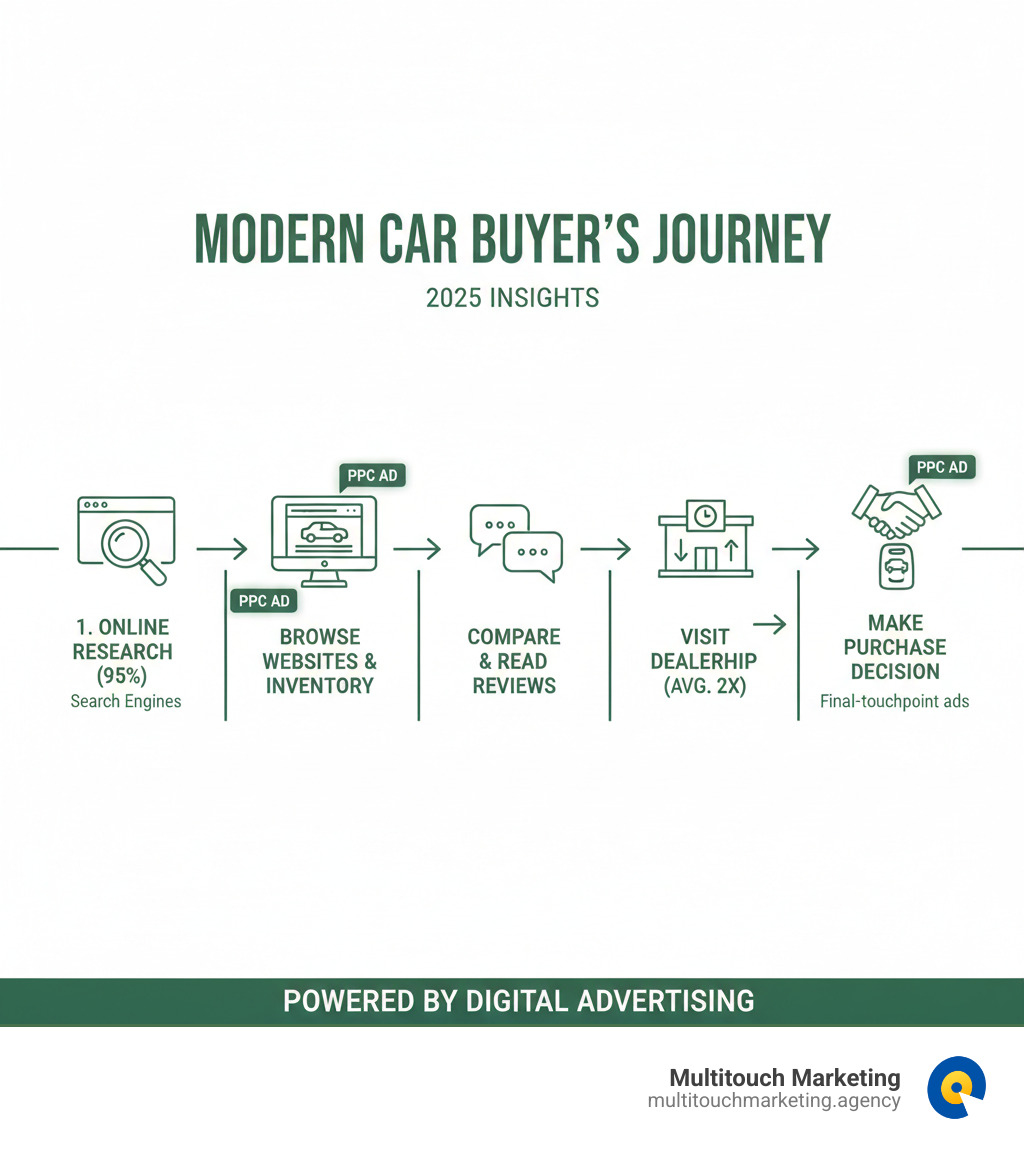
The automotive buying journey has fundamentally changed. With 95% of vehicle buyers researching online before purchasing, your digital visibility is paramount. Today’s shoppers spend less time at dealerships because they’ve already done their homework online. If you’re not visible when they search for “Toyota Camry near me,” you’re losing sales to competitors.
Unlike traditional advertising’s wide-net approach, automotive PPC places your business directly in front of people who are already looking for what you offer. I’m Milton Brown, and I’ve managed automotive PPC campaigns since 2008. My experience has shown that strategic PPC transforms online visibility into showroom visits and measurable revenue.
Why Invest in Automotive PPC?
Investing in automotive PPC offers numerous impactful advantages for your dealership or auto parts business. Since 75% of users don’t look past the first page of search results, securing a top spot is essential. Learn more about Why PPC Advertising is Beneficial in Business.
- Increased Visibility & Targeted Reach: PPC ensures your business is seen when it matters most. We can target specific demographics, geographic locations like Raleigh, NC, and users with high purchase intent, such as those searching for a “new SUV for sale in Raleigh.”
- Budget Control & Measurable ROI: You set the budget and only pay when someone clicks. Every dollar is trackable, allowing for precise ROI calculation. For example, a $250 ad spend to attract a car buyer can yield a 648.8% ROI on a $48,000 vehicle sale. This is why PPC ads convert 50% better than SEO.
- Immediate Lead Generation: Unlike SEO, PPC drives qualified leads from day one. Campaigns can be configured to generate test drive requests, phone calls, or parts inquiries.
- Brand Growth: Consistent visibility at the top of search results builds brand awareness, trust, and reinforces your authority in the market.
Your Roadmap: Key Automotive PPC Campaign Types
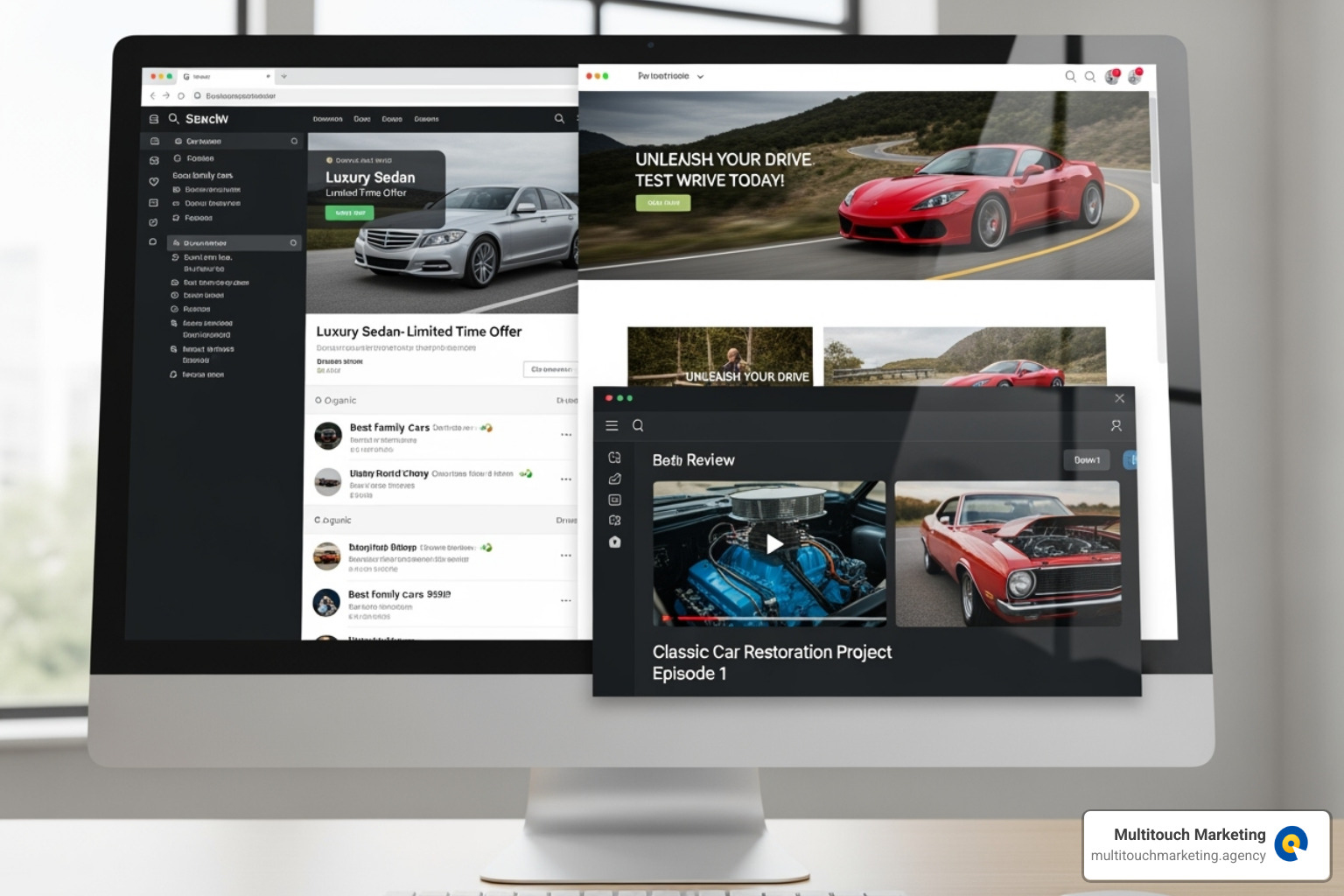
A successful automotive PPC strategy orchestrates a mix of campaign types, each designed to reach customers at different stages of their buying journey.
Foundational Campaigns: Search & Display
- Search Ads: These are the workhorses of PPC, appearing as text ads at the top of Google and Bing when a customer searches for something specific, like “Honda CR-V for sale near me.” They connect you with buyers who have high intent and are actively looking to make a purchase.
- Display Ads: These visual banner ads appear across the Google Display Network of websites and apps. While search ads capture existing demand, display ads create it by building brand awareness and keeping your business top-of-mind.
Engagement-Driven Campaigns: Social & Video
- Social Media Ads: Advertising on platforms like Facebook and Instagram allows for precise targeting based on demographics, interests, and life events. It’s perfect for promoting family SUVs to local parents or luxury models to affluent buyers. Find Tips for Successful Paid Social Media Campaigns here.
- Video Ads: Using platforms like YouTube, you can bring your inventory to life with virtual walkarounds, testimonials, and brand stories. Video is powerful for conveying emotion and building the trust needed for major automotive purchases.
Strategic & Advanced Campaigns
- Branded Campaigns: Target your own business name to protect your brand from competitors and capture users already looking for you.
- Competitor & Conquest Campaigns: Target keywords related to your rivals to show customers why you’re the better choice, highlighting superior pricing, service, or inventory.
- Dynamic Campaigns: Leverage dynamic PPC to automatically generate ads from your website content, which is ideal for large, changing inventories of vehicles or parts.
- Remarketing Campaigns: Re-engage users who visited your site but didn’t convert. By showing them ads for the exact vehicle they viewed, you can nudge them back to complete the process. Learn how to Set up Dynamic Remarketing Google Ads.
- Local Advertising: Use geo-targeting and platforms like Nextdoor to focus your budget on customers in your immediate service area, since 80% of buyers prefer a nearby dealership.
A cohesive strategy that combines these campaign types is how you build an automotive PPC machine that consistently delivers results.
Building a High-Performance Campaign: A Step-by-Step Guide
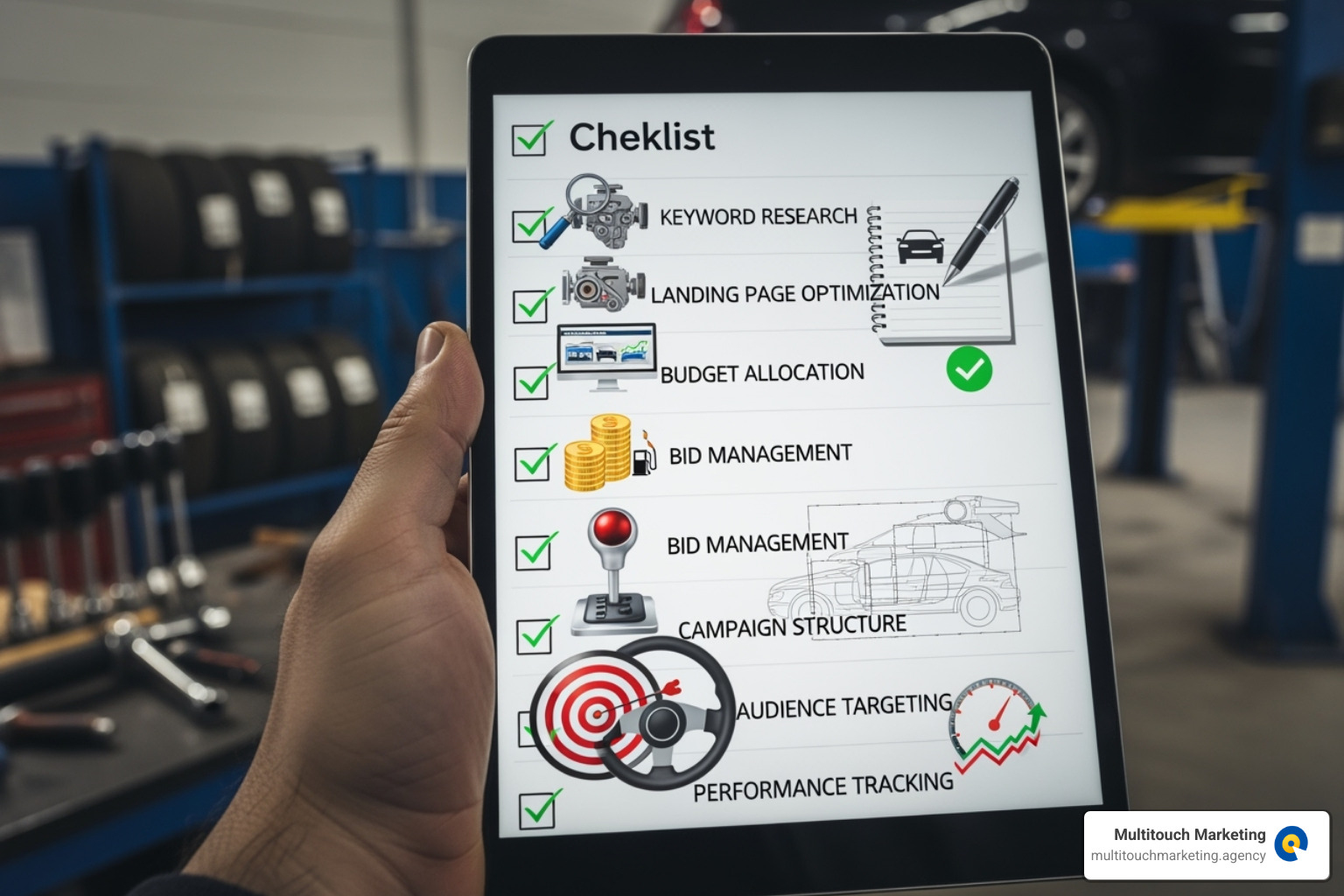
Creating a successful automotive PPC campaign is a deliberate, strategic process. Each step must be tuned for peak performance.
Step 1: Goal Setting & Budgeting
First, define what success looks like. For dealerships, this is typically generating qualified leads (test drives, quotes, calls). For auto parts retailers, it’s direct online sales. These goals dictate your campaign structure and messaging.
Next, set a budget. Automotive PPC operates on a cost-per-click (CPC) model, which is highly efficient but requires smart budgeting. High-intent keywords can cost $15-$30+ per click, while more specific long-tail keywords might be under $2. The key is balancing cost with conversion potential. For guidance, see our guide on PPC Campaign Budgeting for Small Businesses.
Step 2: Precision Targeting & Keyword Research
Identify your ideal customer and what they search for. Effective audience targeting goes beyond demographics to include interests (e.g., car enthusiasts) and behaviors. Geotargeting is crucial for focusing ads on your service area, like Raleigh or Durham. Google’s “in-market audiences” also let you target users actively researching car purchases.
For keyword research, we use tools like Google Keyword Planner to find relevant, affordable keywords with strong buyer intent. We focus on long-tail keywords (e.g., “best used family SUV in Raleigh”), which account for 70% of searches and indicate a user who knows what they want. Equally important is our PPC Negative Keyword Strategy to exclude irrelevant searches and prevent wasted spend.
Step 3: Crafting Compelling Ads & Landing Pages
Your ad must convince a user to click. Great ad copy is concise, benefit-driven, and has a clear Call-to-Action (CTA) like “Schedule a Test Drive” or “Shop Now.” Ad extensions add valuable information like your phone number, location, or special promotions. Since 61% of shoppers call the dealership after a search, call extensions are vital.
A click is wasted if the landing page doesn’t deliver. Your landing page must be laser-focused on the ad’s promise, load quickly, and work flawlessly on mobile, where over 60% of car research happens. A clean, scannable design with prominent CTAs is essential for conversion. Our Responsive Web Design for SEO approach ensures your pages convert on any device.
Advanced Tactics for the Automotive PPC Pro
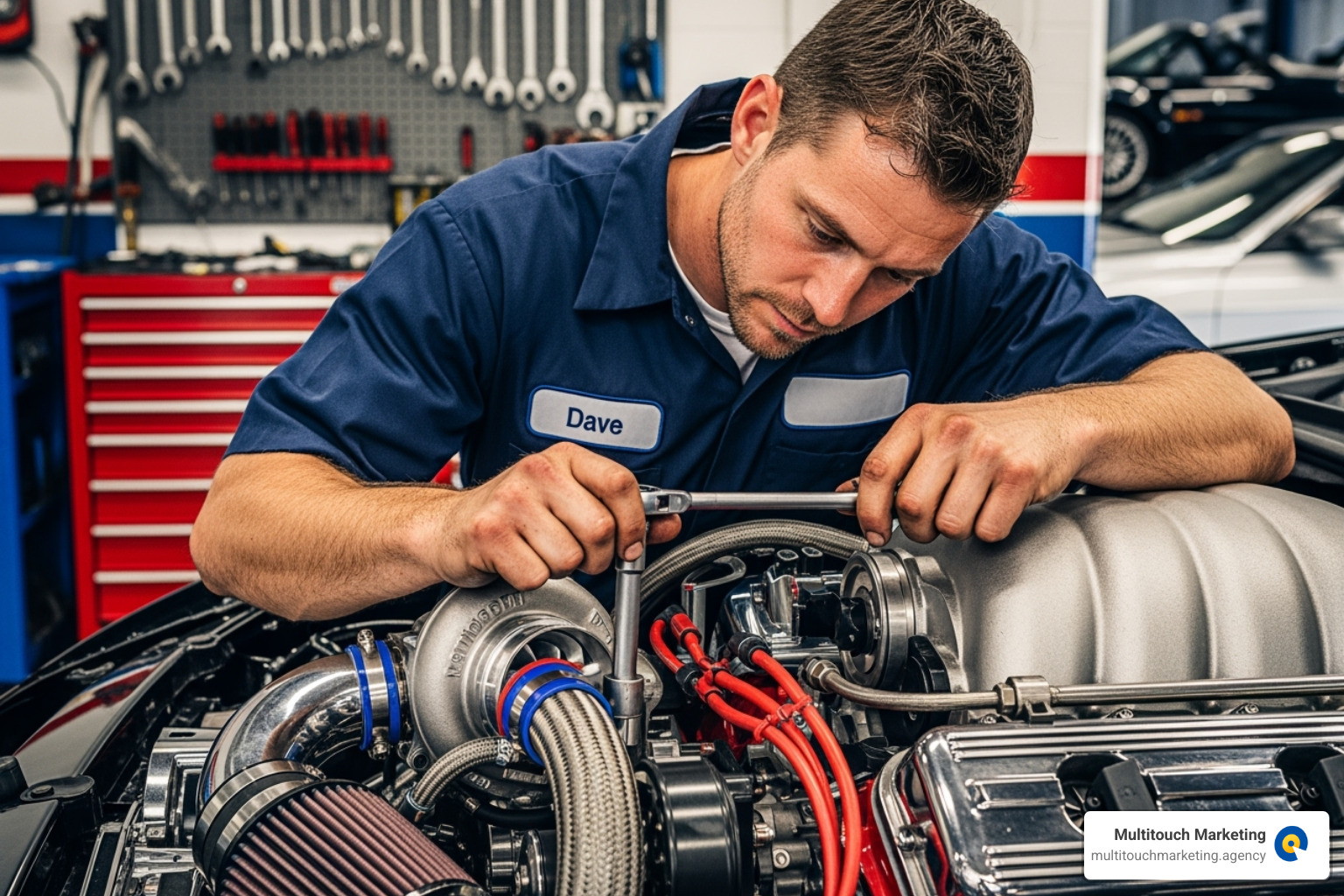
Mastering the fundamentals of automotive PPC is just the start. Exceptional campaigns require a deeper understanding of your business model and sophisticated tools.
Dealerships vs. Auto Parts: Tailoring Your Approach
A car dealership and an auto parts retailer require completely different PPC strategies. Dealerships focus on local search to drive traffic to a physical location, targeting keywords like “Toyota dealership near me.” Their goal is lead generation for test drives and service appointments. Learn more about PPC for Car Dealerships.
Auto parts businesses, however, focus on e-commerce. They manage thousands of SKUs and target highly specific keywords like part numbers or “brake pads for 2019 Honda Civic.” Their goal is direct online sales.
| Feature | PPC for Car Dealerships | PPC for Auto Parts Businesses |
|---|---|---|
| Primary Goal | Lead generation (test drives, inquiries), vehicle sales | E-commerce sales of specific parts, accessories |
| Keywords | New/used car models, “dealership near me,” financing, service | Part numbers, “brake pads Honda Civic,” brand-specific parts |
| Landing Pages | Vehicle Detail Pages (VDPs), lead forms, inventory pages | Product pages, category pages, fitment search results |
| Targeting | Local geo-targeting, in-market audiences for car buyers | Specific vehicle fitment, DIY enthusiasts, brand loyalty |
| Ad Copy | Emphasize deals, inventory, customer service, location | Highlight part compatibility, price, shipping, reviews |
| Conversion | Test drive, phone call, form submission, showroom visit | Online purchase, adding to cart, account creation |
The Power of Data: ACES, PIES, and Product Feeds
For auto parts businesses, the secret weapon is data. ACES and PIES standards are the backbone of aftermarket data management, handling vehicle fitment (ACES) and product attributes (PIES). Using this data ensures your ads show the exact right part for a specific vehicle search.
This vehicle fitment data transforms campaigns from guesswork to precision, dramatically improving relevance, click-through rates, and conversions. Dynamic inventory ads, powered by optimized product feeds with rich, accurate data, give auto parts retailers a massive competitive advantage.
Leveraging AI and Automation
Artificial intelligence is revolutionizing automotive PPC. Tools like Smart Bidding use machine learning to automatically adjust bids in real-time, analyzing hundreds of signals to optimize for your goals. Learn more about AI in Google Ads.
Performance Max campaigns use AI to find customers across all Google channels. You provide the goals and creative, and the AI does the rest.
Don’t overlook call tracking. Since 61% of vehicle shoppers call the dealership after a search, tracking these calls is crucial. Modern call tracking attributes calls to specific keywords and campaigns, revealing your true Cost Per Acquisition (CPA) and ROI. An independent study found that call tracking can optimize paid search campaigns by 25%, saving money and providing clear performance insights.
Measuring Success and Optimizing for Peak Performance
Launching an automotive PPC campaign is just the beginning. Continuous monitoring and fine-tuning are what drive true performance. Regular PPC Campaign Optimization is key.
Key Performance Indicators (KPIs) to Track
Focus on the metrics that directly impact your bottom line:
- Click-Through Rate (CTR): Measures how compelling your ads are. A high CTR indicates relevant messaging and targeting.
- Conversion Rate: The percentage of clicks that result in a desired action (lead form, phone call, purchase). This shows the effectiveness of your landing pages.
- Cost Per Acquisition (CPA): Tells you what it costs to get a new lead or customer, which is essential for understanding profitability.
- Return on Ad Spend (ROAS): The ultimate measure of success, showing the revenue generated for every dollar spent on advertising.
Common Challenges and How to Overcome Them
Even the best campaigns face obstacles. Here’s how we address them:
- High CPCs: We combat high costs by finding long-tail keyword opportunities, improving your Quality Score through better ad relevance, and using AI-powered Smart Bidding.
- Low Quality Score: Google penalizes poor relevance. We fix this by creating tightly themed ad groups and ensuring your ads and landing pages perfectly match user intent.
- Ad Fatigue: We prevent audiences from ignoring your ads by regularly refreshing ad copy and creative assets.
- Wasted Spend: Our robust PPC Negative Keyword Strategy prevents your budget from being spent on irrelevant clicks.
- A/B Testing: We continuously test different ad and landing page versions to find what resonates best and boosts conversion rates.
- Budget Management: We monitor campaigns daily, reallocating spend from underperforming areas to those that are delivering results.
- Regular Audits: We use our Google Ads Account Audit Checklist to perform comprehensive reviews, uncovering hidden opportunities and ensuring peak efficiency.
Frequently Asked Questions about Automotive PPC
How much should I spend on automotive PPC?
There’s no single answer, as your automotive PPC budget depends on your goals, market, and business type. Key factors include:
- Business Goals: Aggressive growth in a competitive market requires a larger budget than simply maintaining a steady lead flow.
- Keyword Competition: Costs vary widely. High-intent keywords can cost $15-$30+, while the average automotive click is around $2.50.
- Geographic Market: Major metro areas have higher costs than smaller markets with less competition.
- Business Type: Dealerships typically need larger budgets (often several thousand dollars monthly) than niche auto parts retailers.
While you can test with a few hundred dollars, most dealerships need a more significant investment to see meaningful results. The focus should always be on ROI; a strong campaign makes the ad spend worthwhile. For more details, see our guide on PPC Campaign Budgeting for Small Businesses.
How long does it take to see results from PPC?
One of PPC’s biggest advantages is its speed. Immediate traffic can begin flowing within hours of launching a campaign. However, true results come in phases:
- Data Collection (First Few Weeks): Clicks and leads start coming in, but the main goal is gathering data on what works.
- Optimization (1-3 Months): Using the data collected, we refine targeting, keywords, and ads. You’ll see better lead quality and lower costs.
- Stable ROI (3-6 Months): Campaigns are fully optimized, delivering a predictable and stable return on investment.
Unlike SEO, which can take many months to gain traction, PPC generates business and valuable data from day one.
Can I run PPC campaigns myself or should I hire an agency?
While you can run campaigns yourself, it comes with significant challenges. The complexity of platforms like Google Ads, the substantial time commitment for daily monitoring and optimization, and the high risk of wasted spend make DIY PPC difficult for busy owners.
When you hire an agency like Multitouch Marketing, you get specialized expertise in automotive PPC. We understand the nuances of the industry, from dealership lead generation to ACES/PIES data for auto parts. We use advanced tools and proven strategies to maximize your ROI, leveraging tools like AI in Google Ads to deliver results that far exceed our fees.
For businesses serious about growth, partnering with a specialist frees you to focus on what you do best—selling cars and parts—while we handle the complex world of digital advertising.
Drive Your Business Forward with Expert PPC Management
The automotive industry has transformed. With 95% of car buyers starting online and 75% never scrolling past the first page of search results, a strong digital presence is non-negotiable. Strategic automotive PPC is the key to turning online searches into showroom traffic, parts sales, and service appointments.
The future of PPC is intelligent, driven by AI tools like Smart Bidding and Performance Max. However, technology is only as effective as the expertise behind it. Creating a campaign that drives profitable growth requires deep industry knowledge and constant optimization.
At Multitouch Marketing, we specialize in automotive PPC. We have mastered the unique challenges of this industry, from optimizing dealership campaigns to managing complex parts inventories with ACES and PIES data. Your competitors are already vying for top ad positions. The question is whether you have a partner who can deliver a winning strategy.
Ready to accelerate your leads and leave the competition behind? Explore our specialized PPC services for car dealerships today, and let’s turn your ad spend into serious revenue.