
Why Professional PPC Management Matters for Your Business Growth
Professional PPC management is the process of having experienced specialists oversee, optimize, and scale your pay-per-click advertising campaigns across platforms like Google Ads and Microsoft Advertising. It includes strategic planning, keyword research, ad creation, bid management, landing page optimization, and continuous performance tracking to maximize return on ad spend (ROAS) while minimizing wasted budget.
Key components of professional PPC management:
- Strategic Planning – Setting clear objectives, target audiences, and conversion goals aligned with business outcomes
- Campaign Structure – Organizing ad groups, keywords, and targeting for optimal Quality Score and Ad Rank
- Ongoing Optimization – Continuous bid adjustments, A/B testing, and negative keyword refinement
- Performance Analysis – Tracking metrics like CTR, conversion rate, CPA, and ROAS to guide decisions
- Budget Management – Allocating spend efficiently across campaigns and adjusting based on performance data
Be honest. Did you start your first PPC campaign feeling pretty confident, only to watch your budget disappear faster than you could say “negative keywords”? You’re not alone. According to research, 72% of companies haven’t reviewed their ad campaigns in over a month, leading to massive wasted spend.
The complexity of modern PPC platforms goes far beyond setting up a simple ad. What looks like a straightforward dashboard actually hides layers of settings around Quality Score, Ad Rank, match types, audience targeting, bid strategies, and conversion tracking. Each decision impacts not just if your ad shows, but where it appears and how much you pay per click.
Professional management solves this challenge through specialized expertise. Agencies and specialists bring battle-tested experience across industries, stay ahead of constant platform changes, access premium tools and benchmarks, and prevent costly mistakes learned through managing millions in ad spend for other clients. Research shows that paid search visitors are 50% more likely to purchase than organic visitors, and 41% of clicks go to the top three paid ads on search results pages.
The financial stakes are high. While DIY PPC might seem cost-effective initially, inexperienced management often leads to wasted spend that far exceeds professional fees. Half of marketing agencies report improved ROI from their PPC campaigns, prompting over 70% to invest more in paid advertising.
I’m Milton Brown, and I’ve managed Professional PPC management accounts ranging from $20,000 to $5 million across e-commerce, healthcare, higher education, and non-profit sectors since 2008. Throughout this guide, I’ll walk you through exactly how professional management delivers measurable results and what to look for when choosing the right partner for your business.
Must-know Professional PPC management terms:
Defining Professional PPC Management and Its Core Components
When we talk about PPC Pay Per Click Campaigns, we are referring to a dynamic auction environment where every millisecond counts. Professional PPC management isn’t just about “buying ads”; it’s about the art and science of What PPC Management Is—a comprehensive process of overseeing a company’s entire ad spend and strategy to ensure every dollar works toward a specific business goal.

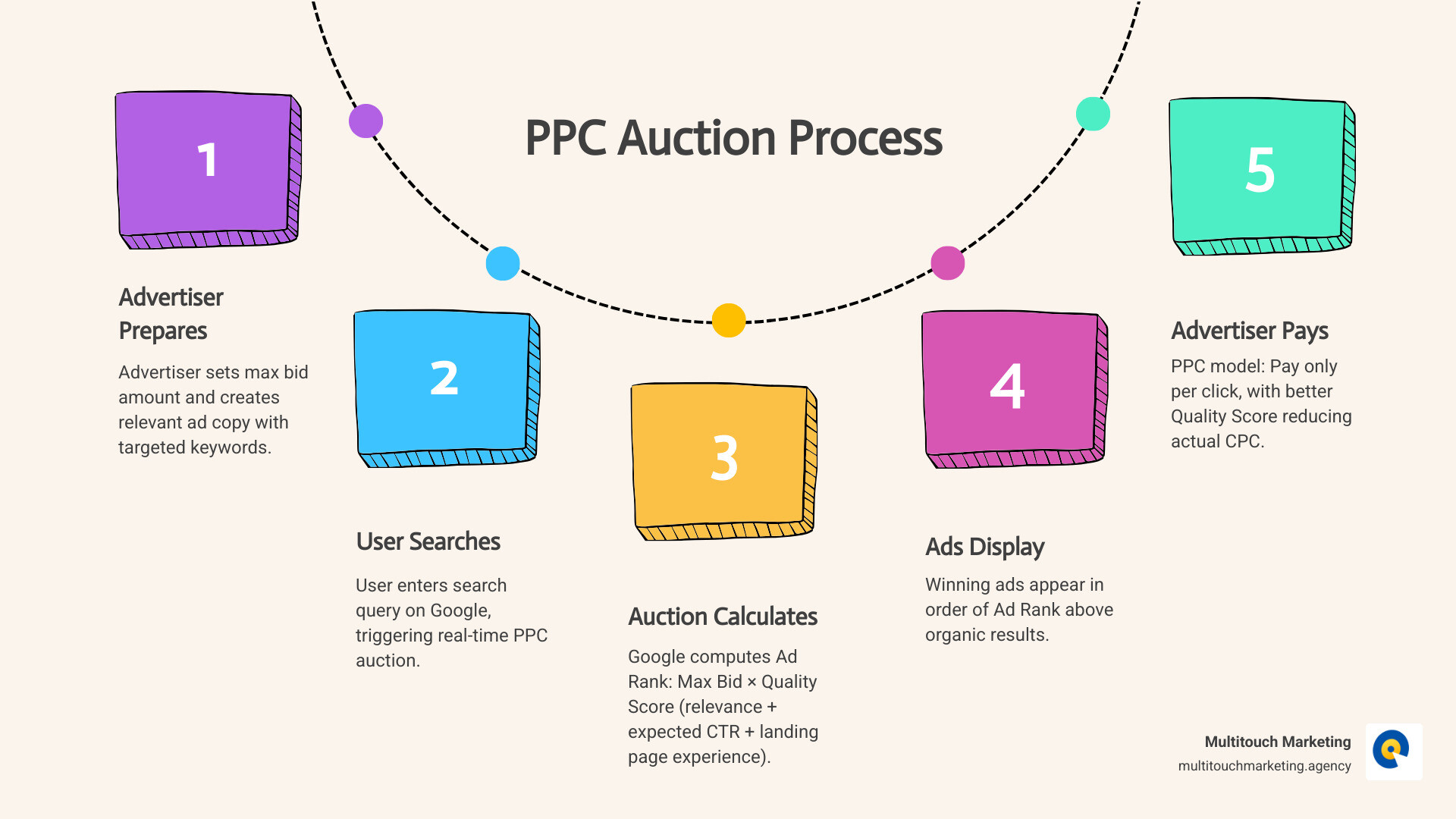
At its heart, professional management focuses on “Ad Rank.” This is the value used to determine your ad position. It isn’t just about who has the deepest pockets; it’s a combination of your bid amount, your ad quality, and the context of the user’s search. A professional manager structures your account so that your campaign architecture—the way you group your ads and keywords—maximizes relevance. This structure is the foundation of a high-performance campaign.
The Core Services of Professional PPC Management
What exactly do you get when you hire a pro? It’s a lot more than someone clicking a “promote” button.
- Keyword Research: We don’t just look for high-volume terms; we look for “buying intent.” We use advanced tools to find the terms your customers are actually typing into Google.
- Understanding PPC Keyword Match Types: This is where most DIYers fail. Using “Broad Match” can lead to your ad showing for completely irrelevant searches. Professionals use a mix of Exact, Phrase, and Broad Match (with heavy negative keyword lists) to control traffic quality.
- Google Ads Campaign Management Services: This includes the technical heavy lifting—setting up conversion tracking, linking Google Analytics, and configuring geographic targeting for areas like Raleigh, Durham, and Chapel Hill.
- Bid Management: Whether using manual bidding for precision or AI in Google Ads for automated scaling, we ensure you aren’t overpaying for clicks.
Measuring Success in Professional PPC Management
How do we know if it’s working? We look at the “North Star” metrics. A Pay Per Click Audit often reveals that businesses are tracking the wrong things.
- Quality Score: This is Google’s 1-10 rating of the relevance of your ads. A high Quality Score can actually lower your cost per click.
- Click-Through Rate (CTR): This tells us if your ad is enticing enough.
- ROAS (Return on Ad Spend): The ultimate metric. If you spend $1,000, did you make $5,000 back?
- Google Ads tracking tools: We use these to see exactly which keyword led to a phone call or a sale.
Why Businesses Choose Professional PPC Management Over DIY
The “Do-It-Yourself” approach often feels like a way to save money, but in paid search, it can quickly become a “black hole” of wasted ad spend. When you consider that 41% of clicks go to the top three paid ads, you realize how competitive this space is. If your ad is sitting at the bottom of the page or showing for the wrong terms, you are essentially donating money to Google.
Following Tips for Expert PPC Management requires more than just a few hours a week. It’s a full-time job staying ahead of platform complexity. Google and Microsoft update their algorithms and ad formats constantly. A professional team doesn’t just “set and forget”; we live in these accounts every day.
Avoiding the “Black Hole” of Wasted Ad Spend
One of the biggest advantages of PPC Management for Small Business is “Negative Keyword” management. This is the process of telling Google what you don’t want to show up for. For example, if you sell “luxury watches,” you want to make sure you aren’t paying for clicks from people searching for “free watch wallpapers” or “cheap plastic watches.”
Our PPC Negative Keyword Strategy acts as a filter, ensuring your budget is only used on high-intent traffic. We also implement fraud detection to protect your budget from bot clicks and competitor clicks, which can drain a daily budget in minutes if left unchecked.
Access to Advanced Industry Insights
When you work with a professional agency like Multitouch Marketing, you get access to “Beta” features—new ad formats or targeting options that aren’t available to the general public yet. We also use Advanced PPC Techniques like competitor analysis to see exactly what your rivals in the Raleigh-Durham area are bidding on. By knowing their strategy, we can find gaps they’ve missed and capitalize on them.
The Strategic Framework: Keywords, Ad Copy, and Landing Pages
Success in Professional PPC management is a three-legged stool: Keywords, Ad Copy, and Landing Pages. If one leg is weak, the whole thing falls over. We focus on PPC Campaign Strategies that target transactional intent—reaching users who are ready to pull out their credit card or book a service.
We use PPC Campaign Optimization to ensure these three elements are perfectly aligned. This is often called “Message Match.” If someone clicks an ad for “Emergency AC Repair in Chapel Hill,” the landing page they land on better say “Emergency AC Repair” in big, bold letters.
Crafting Compelling Ad Copy
Writing a great ad is part psychology, part data. We use the Four Es of a PPC Campaign—Engage, Educate, Excite, and Ease—to guide our copywriting.
- Headline Psychology: We use “Dynamic Keyword Insertion” to make sure the user’s exact search term appears in the headline.
- Ad Extensions: We add “Sitelinks,” “Callouts,” and “Location Extensions” to make your ad take up more real estate on the screen and provide more value to the user.
- Value Propositions: Why should they click you instead of the guy above you? We highlight your unique benefits, like “24/7 Service” or “Free Estimates.”
Optimizing Landing Pages for Conversion
Driving traffic is only half the battle. You have to convert that traffic. When we Promote Website PPC Advertising, we look at page speed, mobile responsiveness, and “Trust Signals” like reviews and certifications. A slow-loading page is the fastest way to lose a lead you just paid $5 for.
Navigating Costs, Pricing Models, and Expected Timelines
Let’s talk about the elephant in the room: money. PPC Campaign Budgeting for Small Businesses can be tricky. There are two costs to consider: your “Ad Spend” (paid directly to Google/Microsoft) and your “Management Fee” (paid to the agency).
While there is a cost of hiring a professional, it’s an investment that pays for itself through efficiency.
| Pricing Model | Description | Best For |
|---|---|---|
| Flat Fee | A set monthly price regardless of spend. | Budget predictability for SMBs. |
| Percentage of Spend | Management fee is 10-20% of the ad budget. | Scaling large accounts. |
| Performance-Based | Fee tied to leads or sales generated. | High-volume lead gen. |
| Retainer + Tiered | Monthly fee based on the number of ad groups. | Structured, multi-service needs. |
Understanding PPC Pricing Packages
Most Google Ads Budget Management services offer tiered packages. A “Basic” package might cover a few ad groups for a local business in Durham, while an “Enterprise” package would involve multi-channel management across search, social, and display. Setup fees are common because the initial research and account build-out are the most labor-intensive parts of the process.
What Results Can Businesses Expect and When?
PPC is famous for providing “immediate traffic,” but “immediate ROI” takes a little longer. Does PPC Work for Small Businesses? Absolutely, but there is a “Learning Phase.”
During the first 30 days, we gather data. By day 60, we are optimizing based on that data. By day 90, the campaign is usually hitting its stride. Paid search visitors are 50% more likely to purchase than organic visitors, making the wait well worth it.
Integrating PPC with SEO and Other Marketing Strategies
We believe that PPC shouldn’t live in a silo. With 8.5 million searches happening on Google every day, you want to be visible in as many places as possible. Busting PPC Marketing Myths often involves explaining that PPC doesn’t “hurt” your SEO; it actually helps it by providing data on which keywords convert best.
Since 62% of the population is on social media, we often use Remarketing. If someone visits your site through a search ad but doesn’t buy, we can show them a display ad on Facebook or Instagram to bring them back.
Choosing the Right PPC Management Partner
When looking for PPC Management Raleigh, don’t just look for the lowest price. Use a Google Ads Account Audit Checklist to vet potential partners. Do they have local experience in North Carolina? Do they provide transparent, weekly reporting? A good partner acts as an extension of your team, not just a vendor.
Frequently Asked Questions about Paid Search
How does professional management differ from in-house?
In-house employees often wear many hats and may not have the time to stay updated on every Google Ads change. Agencies offer specialized expertise, access to enterprise-level tools, and a broader perspective from managing multiple accounts. For more, check our PPC Expert Tips Businesses Recommendations.
Should I combine PPC with SEO?
Yes! This is the “holistic” approach. PPC gives you immediate visibility and keyword data, while SEO builds long-term authority. Dominating both the paid and organic sections of the search results page (SERP) significantly increases your brand’s credibility. Learn Why PPC Advertising is Beneficial in Business alongside organic efforts.
What are real-world examples of PPC success?
- Automotive: Using PPC for Automotive Industry strategies to drive “test drive” bookings for local dealerships.
- Construction: Implementing PPC for Construction Industry tactics to capture high-value leads for home remodeling during peak seasons.
- Local Services: A plumber in Raleigh appearing at the top of the page exactly when a homeowner’s pipe bursts.
Conclusion
Mastering paid search isn’t about luck; it’s about a disciplined, professional approach to data and strategy. At Multitouch Marketing, we specialize in helping businesses in Raleigh, Durham, and Chapel Hill steer this complex landscape to find Unlocking Success PPC Management Strategies in Raleigh.
Ready to stop guessing and start growing? Whether you need a full account build-out or a Free PPC Audit, we are here to ensure your ad spend turns into actual revenue. Let’s build a campaign that doesn’t just get clicks, but gets customers.