
Why PPC Optimization is Non-Negotiable in Today’s Digital Landscape
To optimize PPC campaigns effectively, you need a clear, data-driven process that turns ad spend into real business growth.
Here are the essentials that matter most for businesses in Raleigh, Durham, Chapel Hill, and across North Carolina:
- Track Business Outcomes – Focus on conversion rate, CPA, and ROAS, not vanity metrics like impressions alone.
- Refine Keywords Continuously – Use negative keywords, analyze search terms, and target long-tail keywords aligned with intent.
- Improve Quality Score – Better ad relevance and landing page experience can reduce costs significantly.
- Test and Adjust Regularly – A/B test ad copy, optimize landing pages, and adjust bids based on performance data.
- Leverage Automation – Use smart bidding strategies like Target CPA or Target ROAS when you have sufficient conversion data.
The “set it and forget it” approach to PPC no longer works. With a 13% year-over-year growth in CPC and rising competition, you can’t let campaigns run on autopilot. The good news is that effective PPC delivers impressive results: advertisers can achieve a 200% ROI on average, or $2 back for every $1 spent.
At the same time, 49% of marketers say PPC has become harder to manage than it was two years ago. Privacy changes, algorithm updates, and more competitors make optimization challenging. With only 10% of marketing professionals prioritizing PPC in their budgets, proving ROI is critical.
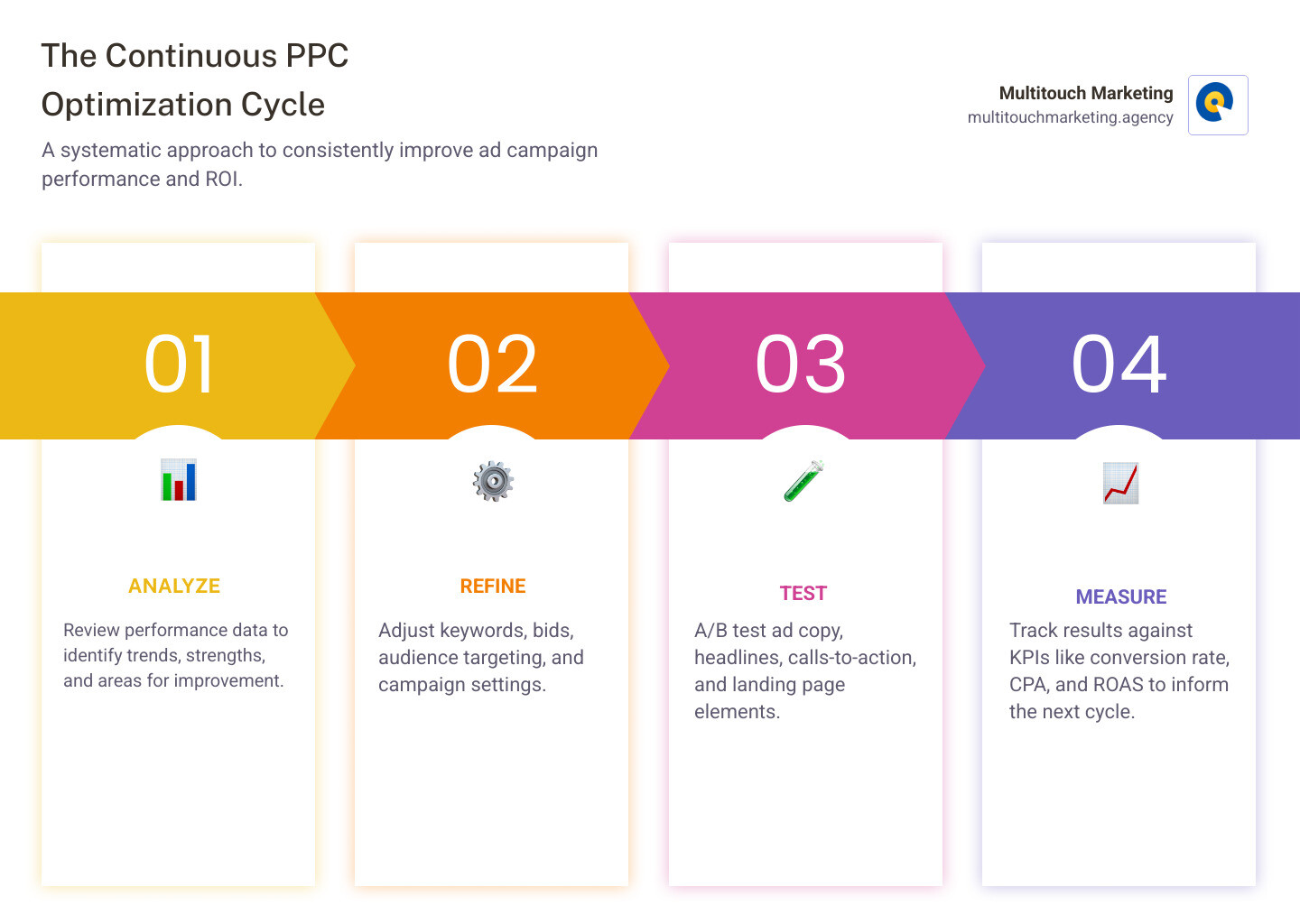
Profitable campaigns require continuous optimization: refining keywords, adjusting bids, testing ad copy, and monitoring performance. This isn’t about being “good enough” but being better than your competitors. Every improvement in conversion rate means more revenue from the same ad spend.
I’m Milton Brown, and I’ve managed PPC campaigns from $20,000 to $5 million across various sectors since 2008. In my career helping organizations optimize PPC campaigns, I’ve seen how systematic testing and data-driven refinement transform ads into profit engines. This guide shares the exact strategies that deliver results—practical, repeatable tactics you can apply to your own accounts.
Optimize PPC campaigns terms to remember:
Foundational Pillars: Mastering Keywords, Bids, and Quality Score
The bedrock of any successful PPC campaign lies in a solid understanding and continuous refinement of your keywords, bids, and Quality Score. These elements work together to determine your ad’s visibility, cost, and overall effectiveness.
Way 1: How to Optimize PPC Campaigns with a Master Keyword Strategy
Keywords bridge user searches and your offerings. A master keyword strategy digs into the intent behind each search, not just listing terms.
For businesses in Raleigh, Durham, and Chapel Hill, we start with keyword intent. Are users looking for information, comparing options, or ready to buy? Tailoring keywords to these intents ensures ads appear at the right moment.
Leveraging long-tail keywords is a key tactic to optimize PPC campaigns. These longer, specific phrases have lower search volume but often higher conversion rates. For example, a search for “PPC management for small business Chapel Hill” indicates a user is closer to deciding than someone searching for just “PPC.” Campaigns using long-tail keywords can see up to 30% higher conversion rates, particularly with voice search.
Crucially, keyword management isn’t just about what you target, but also what you don’t. That’s where negative keywords come in. These terms tell the ad platform to exclude your ads from irrelevant searches. For example, a premium PPC service would add “free” or “jobs” as negative keywords to avoid wasting budget. Regularly reviewing search term reports is vital for finding new negative keywords and protecting your budget.
To get started, tools like Google’s Keyword Planner are indispensable for building comprehensive keyword lists. Understanding PPC Keyword Match Types (broad, phrase, exact) allows you to control targeting precision, balancing reach with relevance.
Way 2: Obsess Over Your Quality Score
Quality Score (QS) is the structural integrity of your PPC campaign. Google assigns a 1-10 score to each keyword, evaluating ad and landing page quality. QS directly impacts your ad position and cost-per-click (CPC).
A higher Quality Score means you pay less per click and often achieve a better ad position. For instance, a keyword with a QS of 8 might get the same position as a competitor’s identical bid with a QS of 5, but you could pay 30% less per click. That’s a huge competitive advantage.
The three main components of Quality Score are:
- Ad Relevance: How closely your ad copy matches the user’s search intent.
- Expected Click-Through Rate (CTR): The likelihood your ad will be clicked, based on past performance.
- Landing Page Experience: How relevant, transparent, and easy-to-steer your landing page is.
To optimize PPC campaigns for a better Quality Score, create tightly themed ad groups, write compelling ad copy with target keywords, and ensure your landing pages are fast and user-friendly. Ignoring Quality Score is a costly mistake, as scores below 5 can increase costs by 25-400%. We integrate Quality Score improvements into every Adwords Campaign Setup and Optimization project.
Way 3: Track the Right Metrics for Success
To truly optimize PPC campaigns for North Carolina businesses, we focus on metrics tied to business outcomes, not vanity metrics.
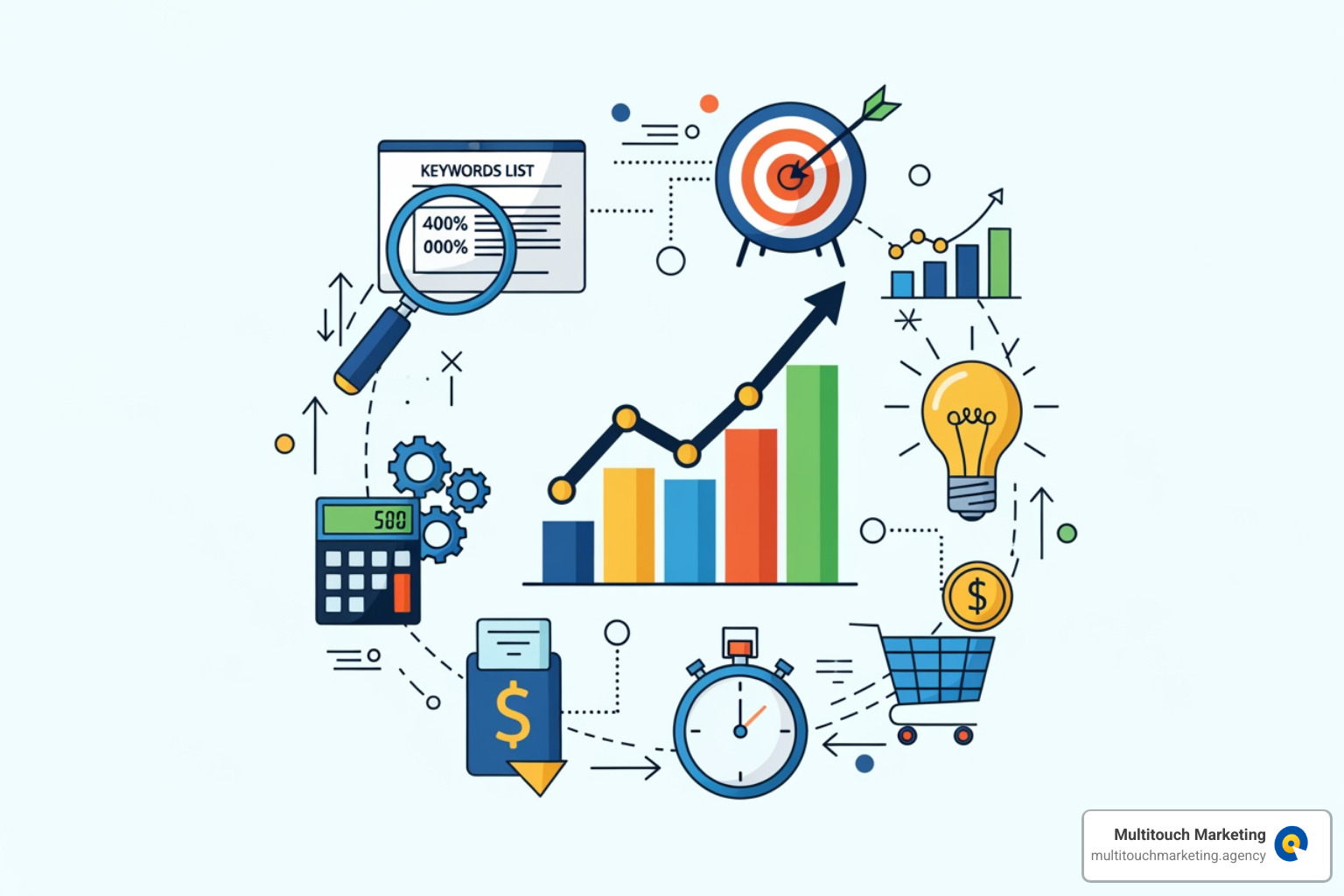
Here are the essential PPC metrics we track:
- Conversion Rate: The percentage of clicks that result in a desired action (e.g., a purchase or lead). The average conversion rate in Google Ads is 6.96%, but this varies by industry. Our goal is always to exceed our clients’ industry average.
- Cost Per Acquisition (CPA): How much it costs to acquire one customer or lead. This is a direct measure of efficiency.
- Return on Ad Spend (ROAS): The revenue generated for every dollar spent on advertising. A ROAS of 3:1 means you get $3 back for every $1 invested. The average is 1.55:1, but many consider 4:1 a good benchmark.
- Click-Through Rate (CTR): The percentage of people who see your ad and click it. The average CTR in Google Ads is 6.42%. While a good indicator of ad relevance, a high CTR doesn’t guarantee success if those clicks don’t convert.
We steer clients away from focusing only on impressions or clicks. These don’t directly impact your bottom line. We want to know your investment is bringing in qualified leads and sales. This is why proper conversion tracking is critical. Without it, you’re flying blind, leading to poor budget allocation and wasted spend.
Crafting the Perfect User Journey: Ads, Landing Pages, and Mobile
Once the groundwork is laid, the next step is perfecting the user’s journey from ad to conversion. This involves crafting compelling ads, enhancing visibility, and ensuring a seamless landing page experience.
Way 4: Write Compelling Ad Copy That Converts
Your ad copy is your first impression. It must grab attention, communicate value, and compel action within strict character limits, blending the art and science of copywriting.
To optimize PPC campaigns for conversion, we employ several strategies:
- A/B Testing: We never run just one ad. We create at least 2-3 variations and continuously test them to see which headlines, descriptions, and calls-to-action resonate most with your audience.
- Emotional Triggers: We tap into user needs and pain points. Whether they seek security, convenience, or savings, our copy addresses these directly.
- Strong Calls-to-Action (CTAs): Phrases like “Shop Now,” “Get a Free Quote,” or “Contact Us Today” clearly tell users what to do next. We make them urgent and benefit-oriented.
- Including Numbers and Statistics: Specifics stand out. “Save 20% Today!” is more impactful than “Save Money.” “Over 15 Years of Experience” builds trust.
- Keyword Integration: Weaving target keywords into ad copy improves relevance and Quality Score.
Your ad copy convinces people to click, so it must be persuasive and clear. For more in-depth strategies, see our insights on Advanced PPC Techniques.
Way 5: Maximize Visibility with Ad Extensions
Ad extensions are PPC’s unsung heroes. They add extra information to your ads, making them larger and more informative, which significantly boosts click-through rates. In fact, ads with extensions can achieve 10-15% higher click-through rates than those without.
For our clients in Raleigh, Durham, and Chapel Hill, local extensions are particularly valuable for increasing foot traffic and local engagement.
Here are some essential ad extension types we leverage to optimize PPC campaigns:
- Sitelink Extensions: Add links to specific pages on your website (e.g., “Services,” “About Us,” “Contact”).
- Call Extensions: Allow users to call your business directly from mobile ads.
- Location Extensions: Display your business address, phone number, and a map marker.
- Price Extensions: Showcase specific products or services with their prices.
- Callout Extensions: Highlight unique selling points (e.g., “Free Shipping,” “24/7 Support”).
- Structured Snippet Extensions: Feature specific aspects of your products or services (e.g., “Service list: HVAC, Plumbing, Electrical”).
Using relevant ad extensions is a simple, powerful way to improve ad performance and user experience. It’s one of many reasons PPC Advertising is Beneficial in Business.
Way 6: Perfect Your Landing Page Experience
After a user clicks your ad, your landing page takes center stage. A poorly optimized landing page can undo all your hard work, turning interested clicks into frustrated bounces.
The golden rule for landing pages is message match. The content and offer on your landing page must align with the ad that brought the user there. If your ad promises “50% off X product,” that offer must be immediately visible. Anything less creates distrust.
Beyond message match, speed is paramount. Google research shows that 53% of mobile visitors abandon pages taking over 3 seconds to load. This is critical, as 70% of U.S. search ad impressions are on mobile, and mobile is expected to contribute over 70% of PPC spending by 2025. Our team ensures client landing pages are optimized for fast loading on all devices. You can Test your site speed with Google PageSpeed Insights.
Other key elements for a high-converting landing page to optimize PPC campaigns include:
- Mobile-First Design: Your landing page must be responsive and easy to steer on a small screen, with clear, tappable calls-to-action.
- Clear Value Proposition: Instantly communicate the problem you solve and the benefit you offer.
- Trust Signals: Use customer testimonials, security badges, and client logos to build credibility.
- Simple Forms: Keep lead-collection forms concise and ask only for essential data.
Advanced Strategies to Optimize PPC Campaigns and Maximize ROI
With a strong foundation and smooth user journey, we can deploy advanced strategies to further optimize PPC campaigns and maximize ROI.
Way 7: Leverage Smart Bidding and Automation
Manual keyword bidding is largely obsolete. Modern PPC platforms like Google Ads offer sophisticated, AI-powered automated bidding strategies. They analyze vast data in real-time to make bid adjustments beyond human capability.
Here are some automated bidding strategies we use to optimize PPC campaigns:
- Target CPA (Cost Per Acquisition): Sets a target average cost per conversion, and the system automatically adjusts bids to achieve it.
- Target ROAS (Return On Ad Spend): Aims to maximize conversion value while achieving a specific average return on ad spend.
- Maximize Conversions/Conversion Value: Automatically sets bids to get the most conversions or conversion value within your budget.
- Performance Max: A goal-based campaign type that accesses all of Google Ads inventory from a single campaign, using AI to find converting customers.
Automated bidding performs best with sufficient conversion data—typically, a minimum of 30+ conversions per month is needed to train the algorithms effectively. While powerful, these strategies still require monitoring and strategic input to ensure they align with business goals. The growing role of AI in Google Ads means these tools are constantly evolving.
Way 8: Refine Your Audience Targeting
Understanding who you’re targeting is as important as keywords. Audience targeting lets us show ads to specific groups based on demographics, interests, and behaviors. This precision helps optimize PPC campaigns by reaching the most receptive audience.
Key audience targeting strategies include:
- Remarketing/Retargeting: Showing ads to people who have previously visited your website. We can Set up Dynamic Remarketing Google Ads to show them products they viewed.
- Customer Match: Uploading customer email lists to target or exclude existing customers.
- In-Market Audiences: Targeting users Google identifies as actively researching products or services like yours.
- Similar Audiences: Targeting users who share characteristics with your existing customers.
- Demographic Targeting: Focusing on age, gender, parental status, or household income.
- Excluding Converters: Preventing ads from showing to users who have already completed a desired action.
Layering these audience segments onto keyword campaigns achieves unparalleled precision, reaching the right people in Raleigh, Durham, and Chapel Hill with the right message.
Way 9: Manage Your Budget for Maximum Impact
Effective budget management is about strategically allocating resources to maximize ROI. With only 10% of marketing professionals identifying PPC as a primary budget focus, proving ROI through smart budget management is crucial.
Here’s how we optimize PPC campaigns through budget allocation:
- 80/20 Rule: We find that 20% of campaigns often generate 80% of results. We identify these top performers and fund them accordingly.
- Dayparting: We schedule ads to run only during specific hours or days when your audience is most likely to convert.
- Budget Pacing: We monitor daily spend to ensure it’s distributed evenly throughout the month, preventing budget depletion.
- Shared Budgets: We use these selectively, as they can sometimes obscure which campaigns are consuming the budget. We prefer granular control.
Strategic budget management ensures every dollar works as hard as possible for our North Carolina clients. For more details, explore our guide on Google Ads Budget Management.
Avoiding Pitfalls and Understanding Platform Nuances
It’s easy to fall into common PPC traps. Understanding these pitfalls and the nuances between platforms like Google Ads and Amazon PPC can save you significant time and money.
Way 10: Avoid These Common (and Costly) PPC Mistakes
These common mistakes can be costly. Avoiding them is a fast track to better performance when you optimize PPC campaigns:
- Focusing on Clicks vs. Conversions: Clicks are a vanity metric if they don’t lead to sales or leads. We prioritize conversion tracking and optimization above all else.
- “Set and Forget” Mentality: PPC is not static. The market, competition, and user behavior constantly change, so campaigns need continuous adjustment. It’s no surprise that 49% of marketing specialists claim it’s harder to manage PPC campaigns today than two years ago.
- Ignoring Mobile: This is a huge oversight. With 53% of PPC ad clicks coming from mobile devices and mobile expected to contribute over 70% of PPC spending by 2025, your ads and landing pages must be mobile-friendly.
- Poor Budget Allocation: Spreading your budget too thin prevents any single area from getting enough traction for optimization. Focus your spend where it performs best.
- Not Using Negative Keywords Properly: This is a budget killer. While 65% of buyer-intent keywords are paid clicks, many advertisers waste money on irrelevant clicks because they haven’t aggressively managed their negative keyword lists. Check out our detailed guide on PPC Negative Keyword Strategy.
Key Differences: How to Optimize PPC Campaigns for Google Ads vs. Amazon PPC
While both are pay-per-click, Google Ads and Amazon PPC have different ecosystems and user intents. Understanding these differences is crucial to optimize PPC campaigns on each platform.
| Feature | Google Ads | Amazon PPC |
|---|---|---|
| User Intent | Broad: informational, navigational, commercial, transactional. Users search for solutions, products, or information. | Highly transactional: Users are primarily looking to buy products. |
| Key Optimization Metric | Quality Score, Conversion Rate, CPA, ROAS | ACoS (Advertising Cost of Sale), TACoS (Total ACoS), ROAS |
| Ad Types | Search, Display, Video, Shopping, Performance Max | Sponsored Products, Sponsored Brands, Sponsored Display |
| Competition | Broad range of businesses, service providers, e-commerce | Primarily product sellers and brands |
| Landing Page Focus | Any relevant page: product pages, service pages, lead forms | Product Detail Page (PDP) |
| Keyword Strategy | Extensive keyword research, negative keywords, match types | Product-focused keywords, auto campaigns, ASIN targeting |
| Product Listing | Not directly applicable | Crucial: High-quality images, titles, descriptions, and reviews directly impact ad performance. |
Google Ads is ideal for businesses in Raleigh, Durham, and Chapel Hill needing to capture a wide array of customer intents. It’s powerful for service-based businesses, lead generation, and brand awareness, as seen in the PPC for Automotive Industry or the PPC for Travel Industry.
Amazon PPC is for businesses selling products directly on Amazon. Optimization here focuses heavily on the product listing itself, where the conversion happens. ACoS (Advertising Cost of Sale) is a critical metric. For Amazon, product listing optimization is as important as the ad campaign settings.
Frequently Asked Questions about PPC Optimization
Here are answers to common questions we get from our North Carolina clients.
How often should I optimize my PPC campaigns?
PPC optimization is an ongoing process. We recommend a consistent, multi-tiered approach:
- Weekly Tasks (15-20 minutes): Review search terms for negative keywords, check budget pacing, and adjust bids.
- Monthly Tasks (2-3 hours): Update audience targeting, test new ad copy, and audit landing pages.
- Quarterly Tasks (4-6 hours): Conduct a comprehensive account audit, review overall strategy, and re-assess long-term goals.
Consistency is key. Small, regular adjustments are more effective than sporadic, large overhauls.
What’s a good ROAS (Return on Ad Spend) for PPC?
A “good” ROAS varies by industry, margin, and business goals. While the average is 1.55:1, many marketers aim for 4:1 ($4 revenue for every $1 spent). A 2:1 ROAS might be acceptable for businesses with high customer lifetime value or aggressive growth goals.
A good ROAS covers all costs and contributes to profitability. We help our Raleigh, Durham, and Chapel Hill clients define specific ROAS goals based on their financial models.
How long does it take to see results from PPC optimization?
The timeline for results depends on the changes made:
- Simple Changes (24-48 hours): Adding negative keywords or pausing ads can show immediate improvements.
- Landing Page Tests (1-2 weeks): A/B testing landing pages needs enough time to gather significant data.
- Bidding Strategy Changes (2-4 weeks): Automated bidding strategies need a learning period to optimize effectively.
- Comprehensive Optimization (3-6 months): Major strategic overhauls will show full results over several months.
Patience and persistence are virtues in PPC.
Conclusion: Building a Sustainable Optimization Process
To truly optimize PPC campaigns is to accept continuous improvement through analysis, refinement, testing, and measurement. In today’s digital landscape, a “set it and forget it” approach leads to wasted ad spend and missed opportunities.
At Multitouch Marketing, we help businesses in Raleigh, Durham, and Chapel Hill steer these complexities, turning PPC campaigns into profit-generating machines. We use data-driven strategies and deep platform knowledge to ensure your campaigns thrive, not just run.
Don’t let your ad budget go to waste. To ensure your campaigns perform at their peak, explore our expert digital marketing services.