
Why Paid Search Optimization is Your Growth Engine
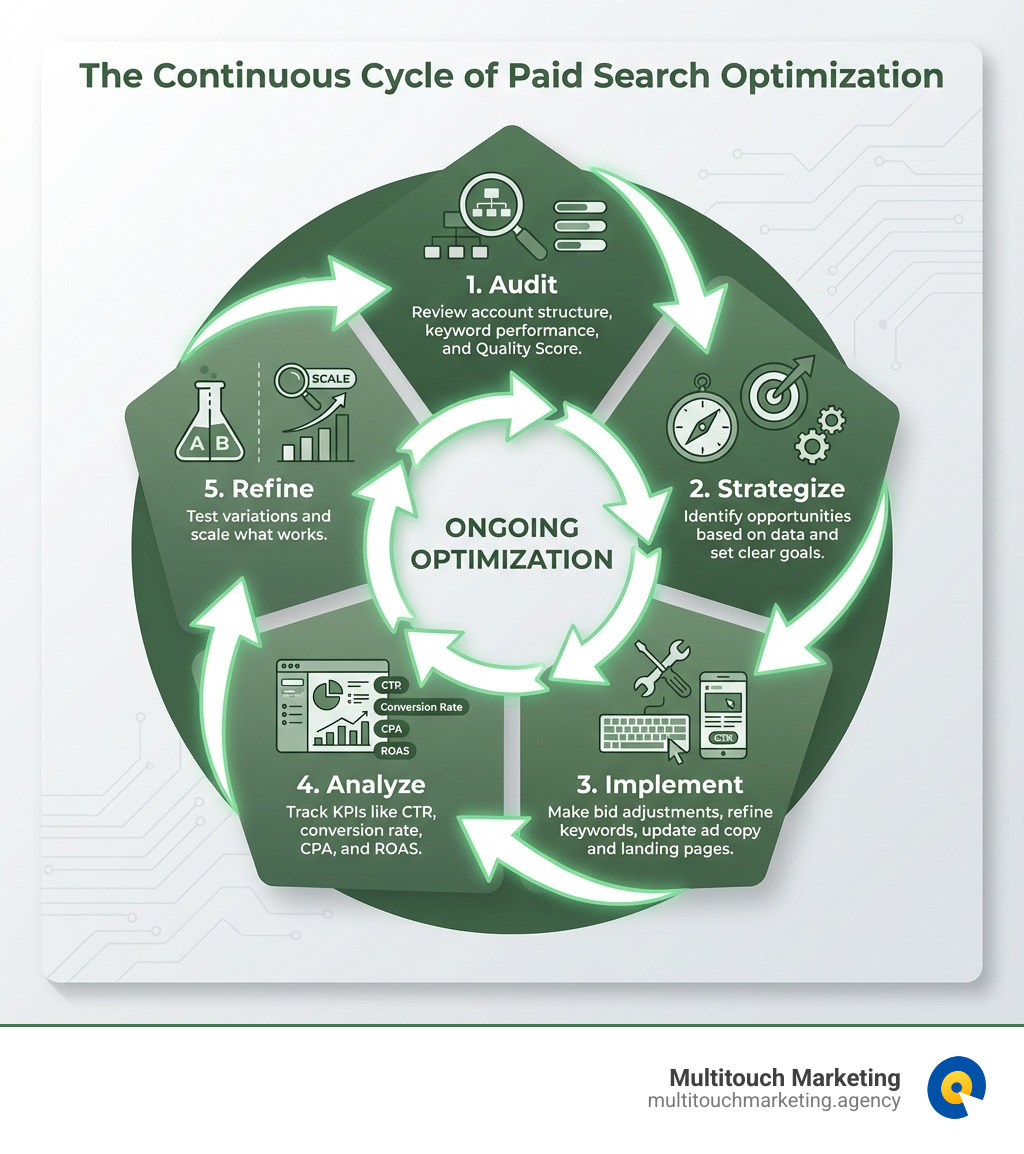
Paid search optimization is the continuous process of improving your pay-per-click (PPC) campaigns to increase conversions, reduce costs, and maximize return on investment. Here’s what it involves:
Core Components of Paid Search Optimization:
- Keyword Management – Researching, refining, and adding negative keywords to target the right audience
- Bid Optimization – Adjusting bids based on performance data to lower costs and improve ad position
- Quality Score Improvement – Enhancing ad relevance, expected CTR, and landing page experience
- Ad Copy Testing – A/B testing headlines and descriptions for better click-through rates
- Landing Page Refinement – Ensuring fast load times, mobile-friendliness, and clear conversion paths
- Performance Tracking – Monitoring KPIs like CTR, conversion rate, and ROAS to guide decisions
In today’s noisy digital landscape, where people see up to 10,000 ads daily, algorithms decide which ones get shown. Competition is fierce, and simply launching a campaign isn’t enough—you need to continuously optimize to survive and thrive.
The reality is stark: paid search campaigns can be a colossal waste of money if not managed properly. But the good news is that search ads convert visitors at more than twice the rate of organic results and have a higher click-through rate (3-5%) than display or social ads (around 1%). This makes paid search one of the most powerful tools in digital marketing when optimized correctly.
The challenge? Optimization isn’t a one-time task. It’s a continuous cycle of auditing, strategizing, implementing, and refining as markets, competitors, and algorithms evolve. Many businesses watch their budget drain with disappointing results because they neglect this ongoing process.
I’m Milton Brown, and I’ve managed paid search campaigns since 2008, working with accounts from $20,000 to $5 million in monthly spend. Throughout my experience with paid search optimization across various industries, I’ve seen how strategic refinements transform underperforming campaigns into profitable growth engines. The key is understanding that optimization is an ongoing journey, not a destination.
Common Paid search optimization vocab:
The Foundation: Auditing Your Strategy and Structure
Before diving into daily tweaks, we must establish the bedrock of a successful paid search strategy: a thorough audit and a well-structured account. Many businesses, especially in competitive markets like Raleigh, Durham, and Chapel Hill, jump into paid advertising without understanding the crucial differences between paid and organic search.
Paid search uses ad networks for immediate visibility in search results, requiring payment per click to target users with high intent. In contrast, organic search (SEO) improves a page’s natural visibility through relevance and authority over time. While top organic results have a higher CTR (position one averages ~32%) and a $0.00 CPC, they take significant time and effort to achieve.
We view paid search not as a replacement for SEO, but as a powerful complement. SEO builds your long-term online real estate, while paid search is your express lane to immediate customer engagement.
A solid foundation for paid search optimization begins with a clear account structure, defined goals, and robust conversion tracking. Without accurate tracking, we’re flying blind. We must know what happens after a click—a purchase, form submission, or phone call. As Google Ads emphasizes, conversion measurement connects ad interactions to valuable on-site actions. Without this data, we can’t measure success or find areas for improvement. Our PPC Audit Services are designed to ensure these foundational elements are rock-solid.
In a dynamic digital landscape where algorithms and markets constantly shift, a “set it and forget it” approach is a recipe for disaster. Continuous optimization is non-negotiable to eliminate wasted ad spend, adapt to change, and gain a competitive edge. It’s how we ensure your campaigns thrive, turning digital marketing into an essential investment, not a discretionary expense.
[TABLE] Comparing Paid Search and Organic Search
To truly master the digital landscape, understand the distinct roles and complementary nature of paid search and organic search. Here’s a quick comparison:
| Feature | Paid Search (PPC) | Organic Search (SEO) |
|---|---|---|
| Metrics | CTR (3-5%), Conversion Rate (3.75%), CPC, CPA, ROAS | CTR (Pos 1: ~32%), lower CPC ($0.00), rankings, traffic |
| Speed of Results | Immediate visibility upon launch | Long-term, takes significant time (months to years) |
| Cost Model | Pay-per-click (CPC), budget-controlled | “Free” clicks, but significant investment in time/resources |
| Placement on SERP | Top and bottom of results, labeled “Sponsored” | Middle section, based on relevance and authority |
| Content Requirements | Highly relevant to ad/keyword, concise, conversion-focused | High-quality, comprehensive, authoritative, user-focused |
| Long-Term Value | Flexible, immediate impact, scalable traffic | Builds domain authority, sustainable traffic, brand equity |
Mastering the Ad Auction: Keywords, Bids, and Quality Score
At the heart of every successful paid search campaign is the intricate dance of the ad auction. This isn’t just about throwing money at Google; it’s a strategic game where relevance, bid, and quality determine who wins the coveted ad spots. Understanding how the ad auction works is fundamental to paid search optimization.
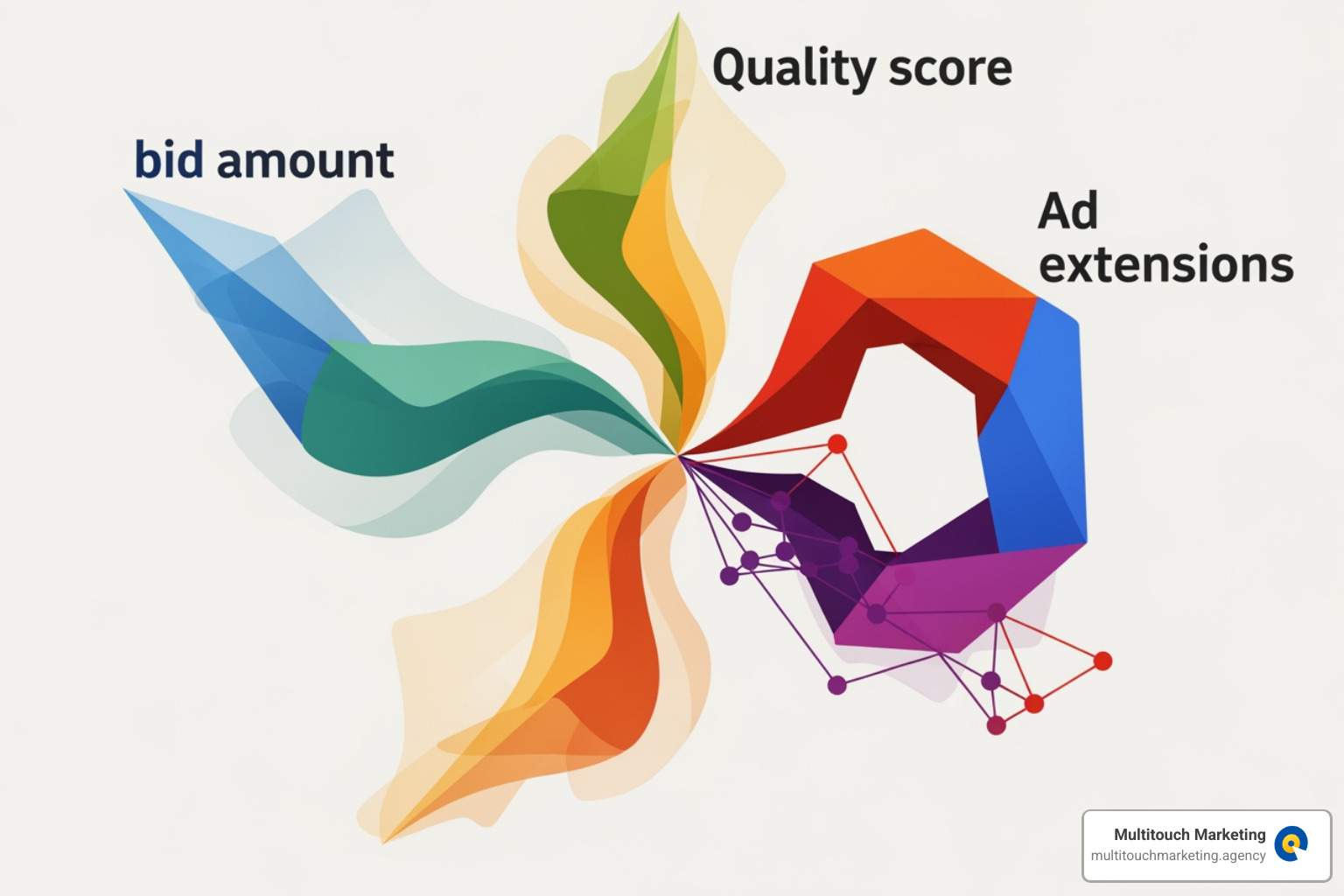
When a user in Raleigh, Durham, or Chapel Hill types a query into Google, an instant auction takes place. Google determines which ads to show and in what order, based on a crucial metric called Ad Rank. As Google explains, Ad Rank is calculated by multiplying your bid amount by your Quality Score, then factoring in the expected impact of extensions and other ad formats. This means we can have a lower bid than a competitor but still outrank them if our Quality Score is significantly higher. The actual cost per click (CPC) we pay isn’t our maximum bid; it’s just enough to beat the Ad Rank of the advertiser below us. This system rewards relevance and quality, making paid search optimization a powerful lever for efficiency.
Strategic Keyword Research for Paid Search Optimization
Keywords are the lifeblood of our PPC campaigns. They are the bridge connecting what users are searching for with the solutions we offer. Effective keyword research and management are paramount for successful paid search optimization.
- Understanding User Intent: This is where we truly shine. Is the user searching for information (“how to fix a leaky faucet”), navigation (“Multitouch Marketing Raleigh”), a transaction (“buy new furnace Raleigh NC”), or commercial investigation (“best furnace repair Durham”)? Each intent requires a different approach. For instance, someone searching for “organic dog food free shipping” is much further down the buying cycle than someone just searching for “dog food.”
- Long-Tail Keywords: These are often highly specific phrases that indicate stronger intent. While they might have lower search volume, their conversion rates are typically higher. We might target “PPC management for small business Raleigh NC” instead of just “PPC management” to capture more qualified leads.
- Branded vs. Generic Keywords: Branded keywords (e.g., “Multitouch Marketing services”) typically have lower CPCs and higher conversion rates. Generic keywords (e.g., “digital marketing agency”) offer broader reach but can be more competitive and costly. We also analyze competitor keywords to ensure we’re appearing for relevant searches where our clients can compete.
- PPC Keyword Match Types: We use exact match, phrase match, and broad match to control how closely a user’s search query must match our keywords. This precision is vital for minimizing wasted spend.
- Negative Keywords: Just as important as the keywords we target are the ones we exclude. Negative keywords filter out irrelevant searches, preventing our ads from showing for terms that won’t convert. For example, if we’re advertising for an optometrist, we’d add “wine glasses” or “drinking glasses” as negative keywords. This keeps our ads relevant and saves budget. Our PPC Negative Keyword Strategy is a critical component of every campaign.
Optimizing Bid Management to Maximize ROI
Bid management is the art of controlled chaos, a delicate balance between visibility and cost. Our goal is always to maximize return on investment (ROI), and this requires a dynamic approach to bidding.
- Manual vs. Automated Bidding: For new accounts or campaigns with specific goals, we might start with manual CPC bidding to gain closer control and gather performance data. This allows us to fine-tune bids for individual keywords or ad groups. However, once sufficient conversion history is available (ideally 15 conversions in 30 days for value-based bidding), we often transition to automated bidding strategies. These AI-powered strategies, like Target CPA (Cost Per Acquisition) or Target ROAS (Return On Ad Spend), use machine learning to adjust bids in real-time, optimizing for our specific goals. While Google’s primary interest is maximizing clicks for their revenue, Smart Bidding, when properly configured with the right conversion data, can be incredibly effective for our clients.
- Bid Adjustments: We can further refine our bids by applying bid adjustments based on factors like device, location, and time of day. If we know users in Chapel Hill convert better on mobile devices during evening hours, we can increase our bids for those specific conditions. Our comprehensive guide on Evaluate and optimize your bids details these strategies.
- Strategic Bidding: This involves continuously analyzing keyword performance. If a keyword has a low average CPC but converts well, we might increase its max CPC bid to capture more traffic. Conversely, if a keyword has a high average CPC but rarely converts, we’ll reduce its bid or pause it altogether. This data-driven approach ensures our budget is allocated to the most profitable opportunities.
The Power of Quality Score
Google’s Quality Score is the unsung hero of paid search optimization. It’s a rating from 1-10 that gives us a sense of how well our ad quality compares to other advertisers. A higher Quality Score means lower costs and better ad positions, even if our maximum bid isn’t the highest.
Quality Score is determined by three main factors:
- Expected Click-Through Rate (CTR): How likely our ad is to be clicked when shown for a specific search query. Highly relevant and compelling ads lead to a higher expected CTR.
- Ad Relevance: How closely our ad copy matches the user’s search intent and our keywords.
- Landing Page Experience: The quality and relevance of the page users land on after clicking our ad. This includes factors like page speed, transparency, and ease of navigation.
By focusing on improving these three areas, we can significantly boost our Quality Score. This isn’t just about saving money; it’s about providing a better user experience, which Google (and users) rewards. Our AdWords Campaign Setup and Optimization services prioritize building campaigns with high Quality Scores from the ground up.
Crafting the Conversion Journey: Ad Copy and Landing Pages
Once we’ve mastered the ad auction, the next critical step in paid search optimization is guiding the user seamlessly from click to conversion. This journey is crafted through compelling ad copy and optimized landing pages. There must be message consistency between the ad and the landing page, ensuring a smooth user experience (UX) and a clear conversion path. If your ad promises one thing and your landing page delivers another, users will bounce faster than a tennis ball on concrete.

Writing Ad Copy That Clicks and Converts
When people are bombarded with 10,000 ads daily, our ad copy needs to stand out. It’s not enough to just show up; we need to make people want to click. Effective ad copy is crucial for paid search optimization.
- Clear Value Proposition: What makes us different? Why should a user choose us over a competitor? We highlight unique selling points right in the headline.
- Strong Call-to-Action (CTA): We tell users exactly what we want them to do: “Get a Free Quote,” “Shop Now,” “Learn More.” A clear, action-oriented CTA is non-negotiable.
- Highlighting Benefits, Not Just Features: Users care about how a product or service solves their problem. Instead of “24/7 Support,” we might say “Never wait for help again with 24/7 expert support.”
- A/B Testing Headlines and Descriptions: We continuously test different variations of headlines and descriptions to see which ones resonate best with our target audience. This iterative process, detailed in our Four Es of a PPC Campaign guide, is vital for optimizing CTR. We avoid “tomfoolery” like all caps or multiple exclamation points; a professional, relevant message is always more effective.
Amplifying Ads with Extensions
Ad extensions are like the Swiss Army knife of paid search. They are additional snippets of information that appear below our main ad text, providing extra details and boosting visibility. They don’t just make our ads bigger; they make them better, often improving Quality Score and CTR.
Here are some key ad extensions we leverage:
- Sitelink Extensions: Direct users to specific pages on our website (e.g., “Services,” “About Us,” “Contact”).
- Callout Extensions: Highlight unique selling points or offers (e.g., “Free Shipping,” “24/7 Support,” “Award-Winning Service”).
- Structured Snippets: Showcase specific aspects of our products or services (e.g., “Service catalog: HVAC Repair, Plumbing, Electrical”).
- Location Extensions: Display our business address and phone number, especially useful for local businesses in Raleigh, Durham, or Chapel Hill.
- Price Extensions: Show specific product prices, giving users immediate transparency.
- Image Extensions: Add compelling visuals to make our ads more engaging and stand out.
- Lead Form Assets: Allow users to submit their information directly from the ad, streamlining the lead generation process.
These extensions amplify our ad performance, providing more reasons for users to click and giving us more real estate on the search results page.
Critical Landing Page Optimization Elements
The landing page is where the magic (or heartbreak) happens. Even the most perfectly crafted ad can fail if it leads to a poorly optimized landing page. For effective paid search optimization, our landing pages must be exceptional.
- Page Speed: A mere second of lag on a landing page can send potential customers away. If your page crawls along like a drunken sloth, don’t expect anyone to hang around. We optimize for lightning-fast load times.
- Mobile-Friendliness: The majority of traffic now comes from mobile devices. Our landing pages must be responsive, easy to steer, and convert seamlessly on any screen size.
- Headline-Ad Consistency: The headline on the landing page should directly mirror the promise made in the ad. This message consistency reassures the user they’ve landed in the right place.
- Social Proof: What others say about our business matters more than what we say ourselves. We integrate testimonials, reviews, and case studies to build trust. According to statistics published by Brightlocal, around 87% of people use Google to find reviews before making a purchase.
- Clear Call-to-Action (CTA) Button: Our CTA needs to be direct, bold, and specific. According to HubSpot data, aligned CTAs convert 202% better than basic ones. We make it stand out with contrasting colors and strategic placement.
- Frictionless Forms: Simplify the lead capture process. We only ask for essential information and use elements like reCAPTCHA to improve lead quality without adding unnecessary barriers. Unbounce highlights a company that increased conversions by 120% by reducing a form from 11 fields to four. Eliminate any kind of on-page barrier that makes it hard or frustrating to get information or sign up for services.
79% of users only scan web page content and don’t read word-by-word. We design our landing pages for scannability, clarity, and a direct path to conversion. This meticulous approach to PPC Campaign Optimization ensures we convert clicks into valuable actions.
Data-Driven Mastery: Analytics, Testing, and AI
In paid search optimization, data is our compass, A/B testing is our laboratory, and AI is our powerful assistant. Relying on gut feelings is a recipe for mediocrity; true mastery comes from a continuous cycle of data analysis, hypothesis testing, and intelligent automation. As Google rightly points out, we must Use data to optimize your Search campaigns.
Key Performance Indicators (KPIs) You Must Track
To measure the success of our paid search optimization efforts, we carefully track a range of Key Performance Indicators (KPIs). These metrics provide the insights we need to make informed decisions and steer our campaigns towards maximum profitability.
- Click-Through Rate (CTR): The percentage of people who click our ad after seeing it. A high CTR indicates our ad copy is relevant and compelling.
- Conversion Rate: The percentage of clicks that result in a desired action (e.g., purchase, lead form submission). The overall estimated conversion rate for Search ads is 3.75%, but this varies substantially by industry. We always aim to exceed industry benchmarks for our clients in North Carolina.
- Cost Per Acquisition (CPA): The average cost to acquire one conversion. This helps us understand the efficiency of our campaigns.
- Return On Ad Spend (ROAS): The revenue generated for every dollar spent on advertising. This is a critical metric for measuring profitability.
- Impressions: The number of times our ads are shown. Important for brand awareness goals.
- Average CPC (Cost Per Click): The average amount we pay for each click.
- Impression Share: The percentage of times our ads were shown compared to the total number of times they could have been shown. This helps us understand our visibility in the market.
By continuously monitoring these KPIs, we can identify patterns, uncover opportunities, and quickly address underperforming elements in our campaigns.
Leveraging A/B Testing for Continuous Refinement
A/B testing is our secret weapon for continuous paid search optimization. It allows us to compare two versions of an ad, landing page, or bidding strategy to see which performs better, removing guesswork from the equation.
- Testing Variables: We might test different headlines, descriptions, CTAs, ad extensions, or even entire landing page layouts. The key is to test one variable at a time to accurately attribute performance changes.
- Statistical Significance: We don’t just eyeball results. We ensure that any performance difference is statistically significant, meaning it’s unlikely to be due to random chance. This gives us confidence in our optimizations.
- Google Ads Experiments: Google provides built-in tools like Google Ads Experiments that make A/B testing straightforward, easily tracking results and indicating statistical significance. This allows us to refine our campaigns and identify optimal strategies without risking our entire budget.
The Role of AI and Automation in Paid Search Optimization
AI and automation are no longer futuristic concepts; they are integral to modern paid search optimization. They don’t replace human expertise but rather augment it, handling repetitive tasks and processing vast amounts of data at speeds humans can’t match. Our AI in Google Ads and AI Tools for PPC insights show how we integrate this power.
- Smart Bidding: This is Google’s suite of AI-powered bidding strategies (e.g., Target CPA, Target ROAS, Maximize Conversions). They use machine learning to optimize bids in real-time based on a multitude of signals like device, location, time of day, audience, and more, all with the goal of achieving our specific conversion objectives.
- Performance Max: This is Google’s newest campaign type, leveraging AI to automate bidding, targeting, and creative optimization across all Google channels (Search, Display, YouTube, Find, Gmail, Maps). It’s particularly powerful for lead generation, finding high-quality leads at scale.
- Dynamic Search Ads (DSAs): These ads automatically generate headlines and landing pages based on the content of our website and the user’s search query, making them ideal for businesses with extensive product or service offerings.
- Responsive Search Ads (RSAs): RSAs allow us to provide multiple headlines and descriptions, and Google’s AI then mixes and matches them to create the best-performing ad for each individual search.
- Audience Insights: AI helps us uncover deeper insights into our target audience, identifying new segments and understanding their behavior patterns, which informs our targeting strategies in Raleigh, Durham, and Chapel Hill.
By integrating AI and automation, we can achieve improved efficiency and better results, freeing up our human experts to focus on strategic oversight, creative development, and continuous refinement.
Conclusion: Your Path to Paid Search Mastery
The journey to paid search optimization mastery is a continuous one, demanding vigilance, adaptability, and a data-driven mindset. We’ve explored the critical pillars: from building a solid foundation with thorough audits and understanding the nuances of the ad auction, to crafting compelling ad copy and optimizing landing pages for conversion, and finally, leveraging the power of analytics, A/B testing, and AI for continuous improvement.
In competitive markets like Raleigh, Durham, and Chapel Hill, simply launching a campaign isn’t enough. It’s the ongoing, iterative process of optimization that transforms a budget drain into a powerful growth engine. We’ve seen how strategic refinements can significantly improve ROI, reduce costs, and drive more valuable leads and sales for businesses across North Carolina.
At Multitouch Marketing, we believe that while AI and automation are invaluable tools, they are most effective when paired with human expertise. Our team specializes in navigating the complex and dynamic nature of PPC marketing, ensuring your campaigns are not just running, but truly thriving. We’re here to help you take your campaigns from good to great, turning clicks into customers and maximizing your digital advertising potential.
Ready to open up the full potential of your paid search campaigns? Don’t let your budget go to waste. Get your Free PPC Audit today and let us show you how we can transform your paid search efforts into a consistent, profitable growth channel.