

Why Social Media Analytics Tools Matter for Your Business
Social Media Analytics Tools are software applications that collect, monitor, and analyze data from your social media platforms. Here’s what you need to know:
What They Do:
- Track performance metrics like reach, impressions, engagement, and conversions
- Monitor audience demographics and behavior patterns
- Measure campaign ROI and content effectiveness
- Provide insights to optimize your social strategy
Key Metrics They Track:
- Engagement – likes, shares, comments, clicks
- Reach – how many people saw your posts
- Follower Growth – how your audience is expanding
- Conversion Rates – leads or sales generated
- Click-Through Rates (CTR) – how often people click your content
In today’s digital landscape, social media is often the first interaction clients have with your business. Yet many small business owners struggle with proving ROI and understanding what’s actually working. Native platform insights give you basic numbers, but they don’t tell you the full story.
Social Media Analytics Tools move you beyond guesswork. They aggregate data from multiple platforms into one unified view. You can see which content resonates with your audience, when they’re most active, and how your efforts translate into real business results. These tools help you make informed decisions about where to spend your time and budget.
The shift toward community-led growth, social commerce, and social search means understanding your social media performance isn’t just helpful anymore – it’s essential for staying competitive.
With over 15 years of experience helping businesses leverage Social Media Analytics Tools to drive measurable outcomes across paid media, e-commerce, healthcare, and education sectors, we’ve seen what works. Throughout this guide, we’ll break down exactly what you need to know to choose and use the right analytics solution for your business.
The Core Benefits of Using Social Media Analytics
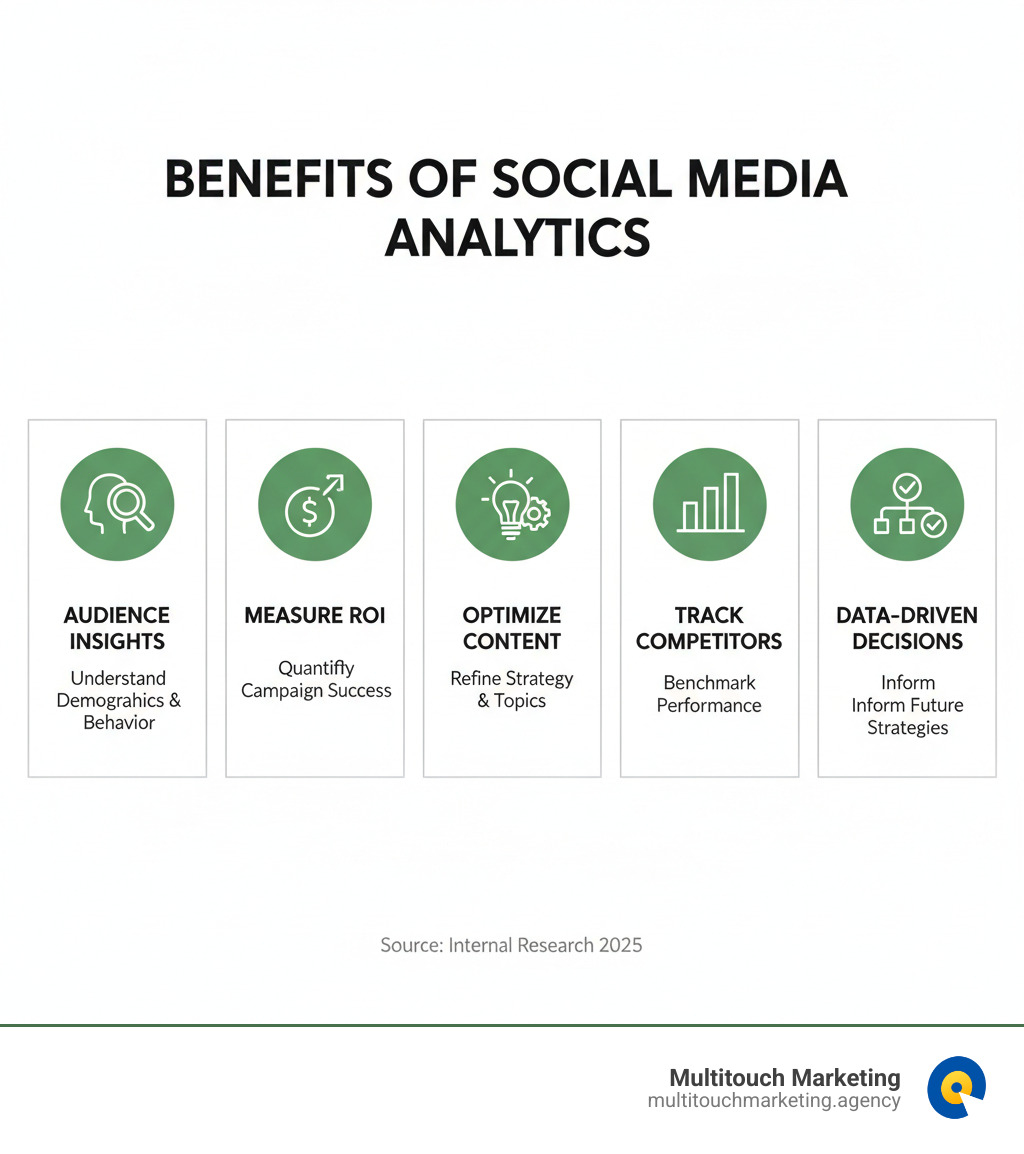
Here’s the truth: posting on social media and hoping for the best isn’t a strategy anymore. If you’re investing time and money into your social channels, you need to know what’s actually working. That’s where Social Media Analytics Tools become your competitive advantage.
These tools give you the clarity to stop guessing and start making confident decisions based on real data. Instead of reacting to what happened last week, you can build a proactive strategy that consistently moves your business forward. Let’s look at the three biggest ways analytics tools transform your social media efforts.
Gain Deep Audience and Behavioral Insights
The most powerful thing about Social Media Analytics Tools is how they help you truly understand who’s following you and what they care about. You’ll see basic demographics like age, gender, and location. But the real value goes much deeper.
These tools reveal how people interact with your content. What topics get them excited? When are they scrolling through their feeds? What makes them stop and engage versus just keep scrolling? For businesses serving specific local areas, this granular understanding matters enormously. For example, an audience in one city might love Instagram stories, while customers in a neighboring city prefer LinkedIn articles.
This granular view helps you speak directly to what your audience needs and wants. You can build detailed customer personas that reflect real behavior, not assumptions. When you understand peak engagement times, content preferences, and user behavior patterns, you can create content that genuinely resonates. This builds customer loyalty because your audience feels like you actually get them.
The insights you gain about your social media audience become the foundation for stronger connections and more effective marketing across every channel.
Optimize and Prove Social Media ROI
Let’s address the elephant in the room: proving social media ROI has historically been frustrating. Executives want to see numbers. They want to know if those hours spent crafting posts are actually generating revenue. With the right Social Media Analytics Tools, you can finally give them clear answers.
These tools excel at social media conversion tracking, connecting the dots between a social post and an actual sale or lead. You can track the metrics that matter most to your business, whether that’s impressions, engagement rates, share of voice, or direct conversions. When you integrate your analytics with your CRM, you can even track how social interactions move prospects through your pipeline.
This means you can show stakeholders exactly which campaigns drove results. You can identify which organic posts generate the most conversions and create more content like them. You can compare your paid versus organic performance to allocate budget more effectively. When you present data showing that your social media efforts generated X number of qualified leads or drove Y dollars in revenue, suddenly those budget conversations get a lot easier.
Being able to prove social media ROI isn’t just nice to have anymore. It’s essential for securing the resources you need to grow.
Improve Content Strategy and Engagement
Wouldn’t it be amazing to know exactly what content your audience wants before you create it? Social Media Analytics Tools get you pretty close to that reality. They show you which posts get the most engagement, which formats perform best, and what topics your audience can’t get enough of.
This insight transforms how you plan content. Instead of throwing ideas at the wall to see what sticks, you can build a strategic social media content calendar based on proven performance data. You can identify patterns over time and spot trends before your competitors do.
The tools also help you optimize when you post. For example, your audience in one location might love video content on Tuesday mornings, while your followers in another engage more with carousel posts during their lunch break. You can run A/B tests on headlines, images, and calls-to-action to continuously improve your results.
This data-driven approach to content creation means you’re not wasting time on posts that fall flat. You’re creating more of what your audience loves, which naturally increases engagement and builds trust. Over time, this consistent delivery of valuable content strengthens your brand and keeps your audience coming back for more.
Essential Features to Look for in Social Media Analytics Tools in 2025
The world of social media never stands still, and neither should our analytics capabilities. As we steer through 2025, the Social Media Analytics Tools we choose need to do more than just count likes and followers. We need sophisticated solutions that can predict trends, streamline our workflow, and help us understand our competitive landscape in real depth.

For businesses across North Carolina, picking the right analytics software isn’t just about today’s needs. It’s about future-proofing our strategy and making sure we have the capabilities to make smarter decisions as social media continues to evolve.
AI-Powered Insights and Predictive Analytics
Artificial intelligence has moved from “nice to have” to “absolutely essential” in modern Social Media Analytics Tools. The difference is remarkable. Where we once spent hours manually sifting through data, AI can now analyze millions of conversations in seconds, surfacing the insights that actually matter.
These AI-powered features help us understand not just what happened, but what’s likely to happen next. We can spot emerging trends before they go mainstream, giving us a competitive edge in our local markets. The technology identifies patterns that human eyes might miss, helping us predict which content will resonate and when our audience will be most receptive.
One of the most valuable AI capabilities is sentiment analysis. This goes beyond counting mentions to understanding the emotional tone behind every comment, review, and post about our brand. Are people genuinely excited about our new product, or just politely acknowledging it? Sentiment analysis tells us the difference, which is crucial for managing our reputation and responding to customer needs.
Machine learning also enables predictive analytics that can suggest optimal post types, recommend caption lengths, and even forecast conversation volumes around specific topics. This means we can plan our content calendars with confidence, knowing we’re not just guessing what might work.
Comprehensive Reporting and Integration
Remember when we had to log into five different platforms, export spreadsheets, and manually compile everything into a single report? Those days are thankfully behind us. Today’s Social Media Analytics Tools bring all our data together in customizable dashboards that make sense at a glance.
These unified views save us countless hours and, more importantly, help us see the bigger picture. We can spot connections between our Facebook campaigns and Instagram stories, or understand how LinkedIn engagement correlates with website traffic. The best tools present this information through clear visuals and actionable reports that anyone on our team can understand.
For agencies serving clients throughout Raleigh, Durham, and Chapel Hill, white-label reporting capabilities are particularly valuable. We can present professional, branded reports that showcase the results we’re delivering without the client seeing the underlying tool. This flexibility extends to export options too, with the ability to share insights in whatever format stakeholders prefer, whether that’s CSV, Excel, PDF, or presentation slides.
But comprehensive reporting isn’t just about pretty dashboards. The real power comes from integration capabilities that connect social media data with our other marketing platforms. When our Social Media Analytics Tools can talk to our CRM, email marketing platform, and website analytics, we get that holistic view of the customer journey we’ve always wanted. This moves us beyond surface-level metrics into truly advanced social media analytics that inform our entire marketing strategy.
Real-Time Monitoring and Competitive Benchmarking
Social media moves at the speed of conversation, and our analytics need to keep up. Real-time monitoring lets us see how our audience responds to content the moment we publish it. This immediate feedback is invaluable. We can identify a winning post and amplify it right away, or catch a potential issue before it snowballs into a crisis.
The ability to track data in real-time also means we can jump on trending topics while they’re still relevant. When something starts gaining traction in our local North Carolina communities, we can respond quickly and authentically, keeping our brand part of the conversation.
Understanding our own performance is only half the equation though. The most effective Social Media Analytics Tools include robust social media competitor analysis features that show us exactly where we stand in our market. We can benchmark our engagement rates, follower growth, and content performance against competitors, giving us context for our numbers.
These tools let us peek behind the curtain at what’s working for others in our industry. Which of our competitor’s posts are getting the most traction? What content formats are resonating with their audience? How does the sentiment around their brand compare to ours? By tracking share of voice and analyzing competitor strategies, we can identify gaps in the market and opportunities we might have missed.
This competitive intelligence isn’t about copying what others do. It’s about learning from the entire landscape, understanding what our audience responds to, and making informed decisions that help us stand out in the crowded social media space.
How to Leverage Analytics Data for Strategic Growth
Having access to data is only half the battle. The real magic happens when we transform that raw data into actionable intelligence that drives real business results. Social Media Analytics Tools empower us to move beyond simply looking at numbers and start making strategic decisions that fuel growth.

For businesses in Raleigh, Durham, and Chapel Hill, this means taking those insights and turning them into concrete actions that improve every aspect of our social media presence. Let’s explore how to make that happen.
Conducting In-Depth Competitor Analysis
Understanding our competition is essential if we want to stand out in a crowded market. Social Media Analytics Tools give us the power to peek behind the curtain and see what’s working for others in our industry. We can benchmark our performance against competitors to understand how our engagement rates, follower growth, and content strategy stack up.
This goes deeper than just tracking follower counts. We can analyze which of their posts get the most traction, identify patterns in their content strategy, and monitor their share of voice in our industry. For example, a local boutique might find that a competitor’s behind-the-scenes content consistently outperforms their product shots. That’s valuable intelligence.
The goal isn’t to copy what others are doing. Instead, we’re learning from their successes and avoiding their missteps. We can spot strategic opportunities they’re missing and capitalize on gaps in the market. This competitive intelligence helps us make smarter decisions about where to invest our time and resources, especially when targeting local audiences across the Triangle area.
Refining Your Content and Posting Schedule
Once we understand what’s happening in our market, it’s time to optimize our own approach. Social Media Analytics Tools show us exactly which content resonates with our audience. We can see which formats perform best, whether that’s video, images, or carousels. We can analyze which caption styles drive engagement and which calls-to-action get people to click.
But here’s where it gets really interesting. These tools reveal the optimal times to reach our audience. Instead of posting randomly and hoping for the best, we can use heatmaps and activity data to pinpoint when our followers are most active and receptive. For instance, an audience in one area might engage most during their morning coffee, while followers in another are scrolling during lunch breaks.
We can also conduct A/B testing on everything from headlines to social media ad creative. This means we’re not guessing which image will perform better or which headline will drive more clicks. We’re testing, learning, and continuously improving. By analyzing content pillar performance, we can double down on topics our audience loves and phase out what’s not working. This data-driven approach ensures every post we publish has a better chance of capturing attention and driving meaningful interactions.
Presenting Actionable Reports to Stakeholders
Here’s the truth: having great data means nothing if we can’t communicate it effectively. The final piece of the puzzle is presenting our insights in a way that drives action and demonstrates value. This is where many businesses stumble, but Social Media Analytics Tools make it easier.
The secret is telling a story with our data rather than just sharing numbers. We need to provide context that helps stakeholders understand what the metrics actually mean for the business. A chart showing a 30% increase in engagement is nice, but explaining how that translates to more website visits or qualified leads is what gets people excited.
Different audiences need different information. Executives typically want high-level summaries focused on ROI and how social media contributes to business goals. Marketing teams need the granular details about content performance and audience behavior. We can use the visualization tools built into analytics platforms to create clear, compelling charts and graphs that make complex data easy to digest.
The key is connecting every social media metric back to actual business outcomes. When we show how our efforts drive revenue, generate leads, or build brand awareness in the Raleigh-Durham-Chapel Hill market, we demonstrate real value. We wrap up each report with clear, data-driven recommendations for what to do next. This approach doesn’t just inform stakeholders—it empowers them to make confident decisions about future investments in social media marketing.
At Multitouch Marketing Agency, we focus on ensuring these insights translate into tangible business growth for our clients across North Carolina. Because at the end of the day, analytics are only valuable when they lead to better decisions and stronger results.
Frequently Asked Questions about Social Media Analytics Tools
We often get asked about the nuances of Social Media Analytics Tools. Here are some common questions we encounter, along with clear answers to help you steer this landscape.
What’s the difference between native and third-party analytics tools?
It’s a great question, and understanding the distinction is key to choosing the right solution for your business.
Native analytics are the built-in dashboards and reports provided directly by social media platforms like Facebook Insights, Instagram Analytics, or LinkedIn Page Analytics. They’re free, easy to access within each platform, and offer basic metrics specific to that platform. Think of them as quick overviews that give you foundational glimpses into your performance. The challenge? They’re platform-specific, meaning you have to log into each one separately to gather your data. They also lack the advanced features that help you really understand what’s happening across your entire social presence.
Third-party analytics tools are external software applications designed to aggregate, analyze, and report on data from multiple social media platforms simultaneously. They offer more detailed insights, advanced reporting capabilities, and multi-platform integration, providing a comprehensive analysis across all your channels. These tools often include features like competitor benchmarking, AI-powered insights, real-time monitoring, and customizable or white-label reports. They consolidate your data, saving you time and offering that unified view we all need. The trade-off? They typically come with a cost, and there can be a learning curve to master their advanced features.
For businesses in North Carolina looking for deeper insights and a unified view across all their social channels, third-party tools usually provide the strategic advantage needed to stay competitive.
What are the limitations of social media analytics tools?
While Social Media Analytics Tools are incredibly powerful, they aren’t a magic bullet. It’s important to be aware of their potential drawbacks so you can use them effectively.
One common pitfall is getting distracted by vanity metrics. Some tools might overemphasize raw follower counts or total likes without sufficient context. While these numbers look impressive in a presentation, they don’t always reflect true business impact or meaningful engagement. What really matters are metrics tied to your actual business goals, like conversion rates or qualified leads.
Data accuracy can sometimes vary between platforms or due to API limitations. These tools only analyze data that’s publicly available or explicitly shared via integrations, so there are natural boundaries to what they can capture. There’s also a learning curve involved. Advanced tools often require time, training, and a solid understanding of analytics principles to get the most value from them.
The potential cost is another consideration. While some tools offer free tiers or trials, the most robust solutions come with subscription fees. You’ll need to weigh the cost against the value and insights gained for your specific situation.
Perhaps most importantly, there’s the risk of misinterpreting data. A spike in mentions might be positive or negative, for example. We need human intelligence and strategic context to understand the “why” behind the numbers. Tools provide data, but they don’t create strategy. They inform our decisions, but we still need clear marketing objectives and business goals to guide our analysis.
Can Google Analytics track social media performance?
Yes, Google Analytics can track social media performance, but with an important distinction. It excels at tracking how social media drives traffic and conversions to your website, but it doesn’t provide in-depth analytics within social platforms themselves.
Google Analytics can identify social media as a referral source for your website traffic, showing you which platforms are sending visitors your way. Once users land on your site from social media, it tracks their user behavior, such as pages visited, time on site, and bounce rate. By setting up goals and e-commerce tracking, you can measure how many leads or sales originate from your social media efforts through conversion tracking.
For best results, we highly recommend using UTM parameters on all links shared on social media. This allows Google Analytics to accurately attribute traffic and conversions to specific campaigns, posts, or platforms, giving you much clearer visibility into what’s working.
However, Google Analytics cannot track metrics specific to the social platforms themselves. It won’t show you follower growth, likes, comments, shares, or engagement rates on your social posts. It can’t measure the reach and impressions of your social posts or provide sentiment analysis of conversations happening on social media.
For these on-platform metrics and deeper social insights, you’ll still need to use native social media analytics or a third-party Social Media Analytics Tool. Think of Google Analytics and social media tools as complementary—they each tell you different parts of the story, and together they give you the complete picture.
Conclusion: Making Data-Driven Decisions for Your Brand
We’ve covered a lot of ground together in this guide, and if there’s one takeaway I hope resonates with you, it’s this: Social Media Analytics Tools aren’t just fancy dashboards or reporting mechanisms. They’re your compass in the often overwhelming world of digital marketing, especially for businesses right here in Raleigh, Durham, and Chapel Hill.
Think about where we started. Many businesses are posting content, running campaigns, and hoping something sticks. But hope isn’t a strategy. The right analytics solution changes everything. It transforms those raw numbers and metrics into clear, actionable intelligence that tells you exactly what’s working, what’s not, and where your next opportunity lies.
We’ve explored how these tools provide deep audience insights that help you understand not just who your customers are, but what makes them tick. We’ve seen how they help you prove social media ROI to stakeholders who need to see the bottom-line impact. And we’ve discussed how they enable you to refine your content strategy based on real data, not gut feelings.
The features that matter in 2025—AI-powered insights, comprehensive reporting, real-time monitoring, and competitive benchmarking—aren’t just bells and whistles. They’re the difference between reacting to changes after they happen and anticipating them before they do. They’re what separate businesses that thrive on social media from those that simply exist there.
Here’s the thing: data without context is just noise. Numbers without interpretation don’t drive growth. That’s where expertise comes in. At Multitouch Marketing Agency, we’ve spent years helping businesses like yours steer this complex landscape. Our background in PPC advertising has taught us the value of tracking every interaction, optimizing every campaign element, and connecting digital efforts to real business outcomes.
We bring that same rigor and strategic thinking to social media analytics. We help you choose the right tools, interpret the data correctly, and turn insights into strategies that actually move the needle. Whether you’re trying to understand your audience better, outmaneuver competitors, or simply prove the value of your social media investments, we’re here to guide you through it.
The digital landscape isn’t getting any simpler. Social commerce is growing. Community-led marketing is becoming essential. Search behavior is shifting to social platforms. In this environment, understanding your social media performance isn’t optional anymore—it’s fundamental to staying competitive.
Ready to stop guessing and start knowing? Let’s work together to turn your social media data into your competitive advantage. Empower your social media marketing strategy with expert guidance and find what’s possible when you truly understand what your audience is telling you.