
Gaining Your Edge: What is PPC Competitive Analysis?
PPC competitive analysis is the process of examining your rivals’ paid advertising efforts—their keywords, ad copy, and landing pages—to see what works. This strategic insight is crucial for several reasons: it helps you save money by learning from their mistakes, find new opportunities they’ve missed, improve your own ads, and stay ahead of market changes.
In digital advertising, this analysis is essential. Many businesses spend heavily on ads, but 76% of marketing budgets are wasted, often due to a lack of competitive insight. Considering that 65% of high-intent searches result in an ad click, the potential is enormous. By understanding your rivals, you can avoid wasted spend and capture more of those valuable clicks. This guide will show you how to gain that crucial edge.
As a strategic digital marketer with Multitouch Marketing, I use data-driven methods and AI to deliver outstanding results. My expertise in PPC competitive analysis helps businesses achieve measurable outcomes. Let’s explore how to put these insights into action.
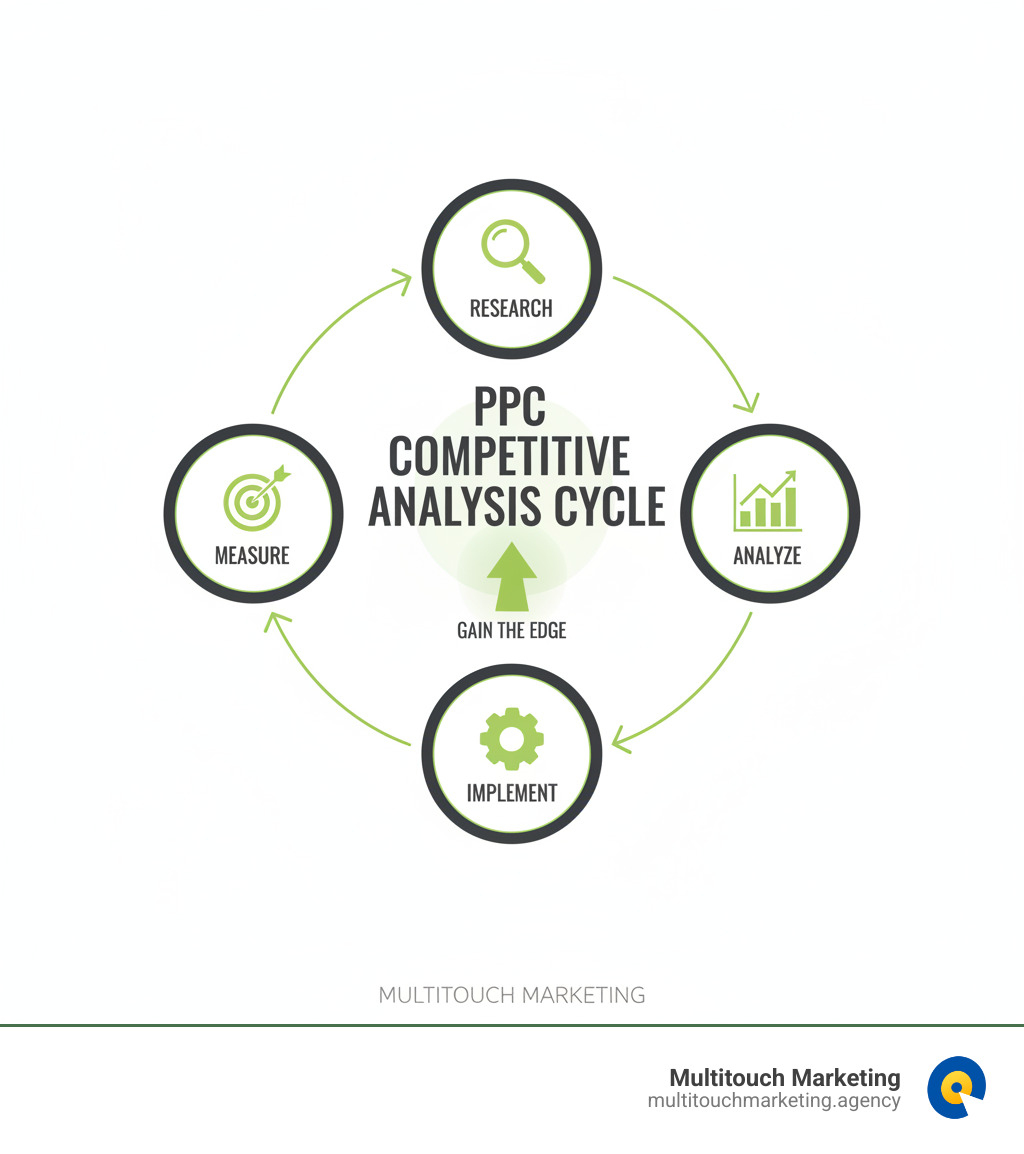
Understanding the Battlefield: Why PPC Competitive Analysis Matters
PPC advertising is a powerhouse for traffic and leads, with PPC ads boosting brand visibility by up to 80%. But in busy markets like Raleigh, Durham, or Chapel Hill, NC, you need a strategic advantage. That’s where PPC competitive analysis comes in. For more on the benefits of paid ads, see our guide: Why PPC Advertising Is Beneficial In Business.
What It Is and Why It’s Crucial
PPC competitive analysis is the systematic evaluation of your rivals’ paid search strategies, ad performance, and market tactics. The goal is to uncover their strengths, weaknesses, and missed opportunities. It’s not about copying, but about adapting insights to improve your own campaigns. This analysis is vital for success:
- Avoid Budget Waste: Learn from competitors’ successes and failures to skip costly trial-and-error and make every dollar work harder.
- Refine Your Strategy: Adjust benchmarks, find better keywords, and craft more compelling messages that resonate with your audience.
- Stay Ahead of Trends: Keep up with new keywords, emerging competitors, and shifts in strategy to keep your campaigns fresh and effective.
- Set Realistic Benchmarks: Knowing competitor performance helps set attainable goals. With 65% of high-intent searches resulting in an ad click, understanding industry benchmarks like a 6.19% CTR in retail provides a solid starting point.
Types of PPC Market Players
In PPC, “competitors” aren’t just the business next door. We monitor several types of players:
- Direct Competitors: Offer the same products/services to the same audience (e.g., another Raleigh plumber).
- Indirect Competitors: Meet the same underlying need with a different product (e.g., a home warranty service vs. an HVAC repair company).
- Local Advertisers: Crucial for local businesses, as 92% of searchers pick businesses on the first page of local results. Our Local Business PPC Management services help you dominate these searches.
- Other Players: Affiliates, resellers, and comparison engines also bid on your keywords, influencing costs and impression share. Understanding this full landscape is key.
Your Step-by-Step Guide to PPC Market Research (Ethically)
Let’s explore the “how.” PPC competitive analysis is about gathering clues to build a stronger strategy, not copying others. We focus on actionable insights for your campaigns in Raleigh, Durham, and Chapel Hill. For more strategic guidance, explore our PPC Campaign Strategies page.

Step 1: Identify Key Players in Your PPC Space
First, know who you’re up against. Your top PPC competitors aren’t always your traditional business rivals. Start by performing Google searches for your services in your local area. The businesses consistently in the top paid spots are your real PPC competitors. Pay attention to anyone bidding on your brand name. Google Ads’ Auction Insights tool provides direct data on who is in the same ad auctions, revealing your true rivals without guesswork. Don’t forget to also ask your customers who else they considered for real-world insights.
Step 2: Decode Market Keyword Strategies
Keywords are the foundation of PPC. Understanding competitor keywords gives you a massive advantage. We use keyword gap analysis to find terms they bid on that you don’t, revealing new opportunities. Analyzing their PPC Keyword Match Types shows how they target audiences. We also check if they focus on broad terms or high-intent, long-tail keywords like “emergency plumber in Durham open now.” Since 68% of online searches begin with keywords, this is critical. Equally important is identifying keywords they avoid, which can be added to your negative keyword list to save budget.
Step 3: Analyze Ad Copy, Creative, and Offers
Next, understand how competitors present themselves. Analyzing their ad copy reveals what messages resonate with your shared audience. We’re looking for inspiration, not a blueprint to copy.

We identify their Unique Selling Propositions (USPs), examine their Calls-to-Action (CTAs) for clarity and urgency, and note any emotional triggers or promotions. We also check their use of ad extensions (sitelinks, callouts) which boost visibility. For display ads, we analyze visuals and tone. We can also leverage AI Tools For PPC to spot trends and generate new creative ideas.
Step 4: Evaluate the Landing Page Experience
The ad gets the click, but the landing page gets the conversion. A great ad leading to a poor landing page wastes money. We check for message matching between the ad and the page to prevent high bounce rates. We also evaluate the overall User Experience (UX), including mobile optimization and page speed. A conversion-focused design with clear CTAs is crucial; aligned CTAs convert 202% better. We also look for social proof like reviews and testimonials, as around 87% of people use Google to find reviews. Finally, we identify and remove any barriers to conversion, such as confusing navigation or long forms. As Unbounce highlights a company, reducing friction is critical.
Gearing Up: Essential Tools and Key Metrics for Your Analysis
Effective PPC competitive analysis relies on quality data and the right tools to make informed decisions. For ongoing performance improvements, consider a regular PPC Campaign Optimization review.
Essential Tools for Your Arsenal
We focus on tools that provide accurate, actionable insights for our clients in Raleigh and beyond.
- Built-in Platform Tools: These are invaluable as they provide data from the source. The free Google Ads Auction Insights tool is a cornerstone, showing how you fare against others in the same auctions with metrics like impression share and overlap rate.
- Ad Transparency Libraries: These offer a public window into active ads. The Facebook Ad Library lets you see any advertiser’s current ads across Meta’s platforms, revealing their creative and messaging strategies.
- Third-Party Intelligence Platforms: These aggregate competitive data, offering insights into keywords, ad copy, and estimated spend. While the data is an estimate, it’s valuable for spotting broad market trends. For a deep dive, we offer a thorough Pay Per Click Audit.
Key Metrics to Track in Your PPC Market Analysis
Certain metrics are especially revealing about your competitive position.
- Impression Share: The percentage of impressions your ads received versus what they could have received. A competitor’s low share can signal an opportunity.
- Overlap Rate: How often your ad and a competitor’s ad show up in the same auction. A high rate indicates a direct rival.
- Top-of-Page Rate: How often an ad appears at the top of the search results, revealing who is winning the visibility battle.
- Outranking Share: How often your ad ranked higher than a competitor’s, directly measuring performance.
- Click-Through Rate (CTR): We compare our CTRs to industry benchmarks (e.g., retail at 6.19%) to set realistic goals.
- Estimated Ad Spend: Gives a sense of a competitor’s investment and priorities.
- Cost Per Acquisition (CPA): Helps benchmark efficiency and identify where competition is driving up costs.
- Quality Score (Inferred): While not directly visible for competitors, we can infer it by analyzing their ad relevance and landing page experience.
From Insights to Action: Best Practices and Common Pitfalls
Gathering data is only half the journey; the magic is turning insights into action. Our goal is to help you achieve continuous improvement and sustainable growth. For more, see our Advanced PPC Techniques guide.
Best Practices for Ongoing PPC Market Analysis
PPC competitive analysis should be a continuous process, not a one-time project. To stay on top in fast-moving markets like North Carolina, we recommend a consistent approach:
- Establish a Monitoring Rhythm: Use a tiered approach: quick daily checks for major shifts, weekly optimizations for tactical adjustments, and deeper monthly or quarterly strategic reviews to plan for the long term.
- Focus on Actionable Insights: Filter out the noise and zero in on data that directly helps your campaigns. Ask, “How does this help us win?”
- Integrate and Test: Weave insights into all aspects of campaign management, from keyword research to landing page optimization. Use competitive data as educated hypotheses to A/B test and continuously refine your strategy.
Common Pitfalls to Avoid
While powerful, competitive analysis has a few traps. We help clients steer clear of these common mistakes:
- Don’t Just Copy Blindly: Learn from competitors, but never copy them. Their strategy is for their brand, audience, and budget. Use their tactics for inspiration, not as a blueprint.
- Avoid “Analysis Paralysis”: The goal is to gain insights and act, not to analyze forever. Focus on key metrics that lead to action.
- Don’t Over-Rely on Estimates: Third-party tool data is useful for spotting trends but should be treated as a guide, not gospel.
- Never Forget Your Own Goals: Competitive analysis should inform your strategy, not dictate it. Your unique business goals must always come first.
Using Insights to Inform Budget and Bidding
Competitive analysis is key for making smart financial decisions.
- Smart Budget Allocation: Understanding competitor spend helps set a competitive budget. This informs your Google Ads Budget Management and helps us seize opportunities when a rival eases spending.
- Optimizing Bidding Strategies: Insights on impression share and top-of-page rates directly shape your Keyword Bid Strategies PPC Campaign. If a competitor consistently outranks you, we can adjust bids or improve ad relevance to compete more effectively.
Frequently Asked Questions about PPC Competitive Analysis
Here are answers to some of the most common questions about PPC competitive analysis.
How often should I conduct a PPC market analysis?
The ideal frequency depends on your industry, budget, and competition. However, we recommend a three-tier approach:
- Daily Checks (5-10 min): Quick glances to catch major shifts or competitor spikes.
- Weekly Optimizations (30-45 min): Tactical adjustments to bids, copy, and targeting based on recent trends.
- Monthly/Quarterly Reviews (2-3 hours): Deeper dives to identify broad trends, find new opportunities, and make long-term strategic decisions.
How accurate are the ad spend estimates from market analysis tools?
Ad spend estimates from third-party tools are just that—estimates. They use data modeling and algorithms to make educated guesses. While they are not exact figures, they provide valuable directional insights and help identify trends, like a competitor increasing or decreasing their budget. We use them as a compass to gauge competitive intensity, not as a GPS for exact figures, and always prioritize direct data from platforms like Google Ads when available.
What is the most important element to analyze in a competitor’s campaign?
While a holistic view is always key, the most revealing area is often the alignment between their keywords, ad copy, and landing page offer. When these three elements are perfectly aligned, it signals a strong, well-thought-out strategy that is likely driving conversions. Analyzing this seamless flow from search to conversion can reveal the core of their strategy and highlight opportunities for you to offer something even better.
Conclusion
Mastering PPC competitive analysis, from decoding keywords to evaluating landing pages, gives you a significant strategic advantage. It’s not about keeping up with competitors; it’s about understanding their playbook so you can write a winning one of your own.
This continuous process of learning and adapting leads to smarter, data-driven decisions and a much-improved ROI. By understanding your rivals’ moves, you can craft a PPC strategy that is effective, efficient, and profitable for your business in Raleigh, Durham, Chapel Hill, NC, or beyond.
The competitive landscape doesn’t have to be intimidating. The experts at Multitouch Marketing are here to help you steer it, turning valuable insights into tangible action. Let us help you open up your full potential by Mastering your complete digital marketing strategy.