
Why Paid Search Marketing Matters for Your Business Growth
Paid search marketing is a digital advertising strategy where businesses pay search engines like Google and Bing to display their ads at the top of search results. When someone searches for products or services you offer, your ad can appear above organic results, driving high-intent traffic to your website. The best part? You only pay when someone clicks your ad (a model known as Pay-Per-Click or PPC).
This strategy offers immediate visibility to customers who are actively looking for solutions. While organic SEO takes time to build, paid search can place you at the top of the page today. With Google handling over 3.5 billion searches daily, the opportunity is immense. Paid search ads typically convert visitors at a higher rate than organic results or other forms of digital advertising.
What makes paid search so powerful is its ability to reach people at the exact moment of intent. Someone searching “emergency plumber near me” or “best running shoes for flat feet” isn’t just browsing—they’re ready to act. Your ad meets them right where they are.
The challenge lies in navigating the complexities of bidding, quality scores, and budget optimization. Without expertise, it’s easy to spend money with little to show for it.
That’s where strategic management makes all the difference. I’m Milton Brown, and since 2008, I’ve managed paid search marketing campaigns with spends from $20,000 to $5 million. I’ve learned what works—and what doesn’t—when turning ad spend into measurable business growth.
What is Paid Search and Why Is It Essential?
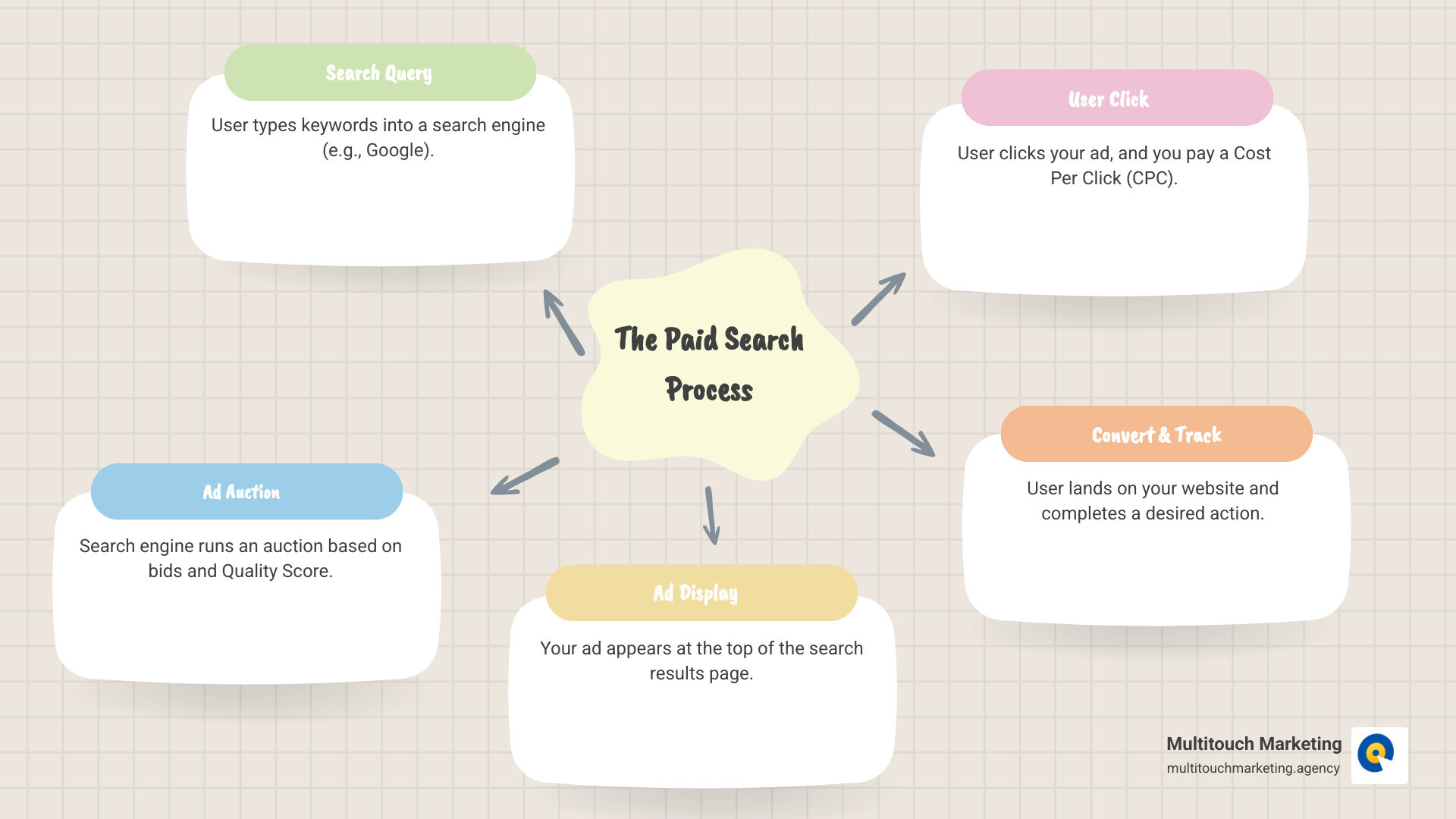
Picture this: someone in your area types “emergency plumber near me” into Google. Within milliseconds, they see several businesses listed at the very top of the page. That’s paid search marketing in action.
At its core, paid search (often called Pay-Per-Click or PPC) is simple: you pay to have your business appear prominently when people search for specific keywords related to your offerings. You only pay when someone clicks your ad. This matters because you’re reaching people at the exact moment they need what you sell. These are high-intent audiences ready to take action.
This creates something traditional advertising can’t match: immediate results. A well-structured paid search marketing campaign can start driving qualified traffic to your website within hours. It’s like flipping a switch to get in front of potential customers today.
Even when people don’t click, you’re building brand awareness. Consistently appearing at the top of search results builds recognition and trust. Paid ads also convert at a higher rate than many other forms of digital advertising because you’re reaching people who are actively searching for solutions.
Best of all, you have complete control and transparency. You decide how much to spend, which keywords to target, and what your ads say. Every click and conversion is tracked, providing clear data on what’s working. For businesses serious about growth, we’ve written extensively about Focusing on PPC Marketing and how it drives measurable results.
Paid Search and Organic Search: How They Work Together
Paid and organic search aren’t competitors; they’re partners. Paid search provides immediate visibility while you build a long-term organic presence. It puts you at the top of the page today.
| Feature | Paid Search (PPC) | Organic Search (SEO) |
|---|---|---|
| Cost Model | Pay-per-click (you pay for each click) | Free clicks (you invest in content/optimization) |
| Placement | Top of SERP, labeled “Ad” or “Sponsored” | Below paid ads, based on relevance and authority |
| Speed of Results | Immediate | Can take months to see significant results |
| Control | High control over ad copy, targeting, and budget | Limited control over ranking, based on algorithms |
| Visibility | Guaranteed placement (if bid wins) | Earned placement (requires ongoing effort) |
| Data & Insights | Rich, granular data on ad performance and user behavior | Data on overall site traffic and user engagement |
Data from your paid search marketing campaigns can boost your entire digital strategy. You get instant feedback on which keywords convert and which ad messages resonate. For example, if paid search shows “eco-friendly yoga mats” converts better than “green yoga mats,” you’ve learned crucial information about your customers’ language that you can apply across all marketing channels.
Paid search also acts as a safety net, allowing you to claim the top spot for competitive keywords where you don’t rank organically. A combined approach creates a comprehensive presence that captures customers at every stage of their journey.
The Primary Benefits of a Paid Search Strategy
A solid paid search marketing strategy delivers game-changing advantages for your business.
- Targeted Audience Reach: Pinpoint who sees your ads based on keywords, location, device, time of day, and demographics. An HVAC company in Durham, NC, can target homeowners searching for “AC repair” on a weekday morning. That’s precision traditional advertising can’t offer.
- Valuable Data Insights: Campaigns generate a wealth of information about customer behavior. You learn which keywords, ads, and landing pages drive action, allowing you to make decisions based on real data, not guesswork.
- Control Over Budget: Set a daily budget you’re comfortable with—whether it’s $20 or $2,000—and never spend more. You can pause underperforming campaigns or scale up successful ones, keeping you in the driver’s seat. This is especially valuable for small businesses, as we explore in Does PPC Work for Small Businesses?.
- Measurable ROI: Track every dollar spent and see exactly what it generated in clicks, leads, and sales. Brands see a strong return on ad spend, with many businesses earning $2-$8 for every $1 invested in Google Ads. This makes paid search an investment in a system that delivers scalable results.
The Engine Room: How Ad Rankings Are Determined
Here’s a surprise about paid search marketing: the highest bidder doesn’t always win the top spot. If that were the case, only businesses with the deepest pockets would succeed.
Instead, search engines like Google use a sophisticated auction system that balances an advertiser’s bid with the quality and relevance of their ad. This allows smart marketers to outperform competitors with bigger budgets. We explore this strategic advantage in How to Increase Your ROI Through Scientific SEM.
Every time someone searches, a lightning-fast auction determines which ads appear and in what order based on Ad Rank. Think of Ad Rank as your ad’s overall score. It’s calculated using several factors, including your bid, ad quality, the context of the search (like location and device), and the expected impact of ad extensions.
This system ensures Google shows users helpful ads, which keeps users clicking and advertisers paying. By rewarding relevance, the system keeps everyone happy.

The Role of Bidding
When setting up a paid search marketing campaign, you establish a maximum bid—the most you’re willing to pay for a click. However, you rarely pay that full amount. The auction system means you typically pay just enough (usually one cent more) to beat the Ad Rank of the advertiser below you.
This is where strategy shines. Because Ad Rank considers both bid and quality, you could have a lower bid than a competitor but rank higher due to a better Quality Score. It’s not about who has the biggest budget; it’s about who uses their budget most intelligently.
Bidding strategies range from manual bidding, which offers complete control, to automated bidding, which uses machine learning to optimize for goals like maximizing conversions. These automated strategies analyze signals like device, location, and time of day to adjust bids in real-time for every auction. Choosing the right strategy depends on your business goals, and we break down the options in our guide to Keyword Bid Strategies PPC Campaign.
Understanding Quality Score
If bidding is what you’re willing to pay, Quality Score is about what you deserve to pay. This 1-to-10 metric is Google’s assessment of your ad’s relevance and usefulness, and it has a massive impact on your paid search marketing success.
A high Quality Score leads to lower costs and better ad positions. A low score means you’ll pay more for worse positions, or your ads may not show at all. Improving Quality Score can dramatically cut costs while improving ad rank.
Quality Score has three core components:
- Expected Click-Through Rate (CTR): Google’s prediction of how likely users are to click your ad. This is based on the historical performance of your ad for a specific keyword.
- Ad Relevance: How closely your ad’s message matches the user’s search query. Specificity is key; an ad for “PPC management Raleigh NC” is more relevant to that search than a generic “digital marketing services” ad.
- Landing Page Experience: What happens after the click. Your page must be relevant to the ad, load quickly, and be easy to steer, especially on mobile devices.
The beauty of Quality Score is that it levels the playing field, allowing a small business with a well-crafted campaign to outperform a larger competitor. Improving it involves writing relevant ad copy and ensuring your landing pages are fast and user-friendly. Google provides detailed guidance on how to improve your Quality Score. Understanding how Ad Rank, bidding, and Quality Score interact is key to spending smarter, not just spending more.
Building a Winning Paid Search Marketing Campaign
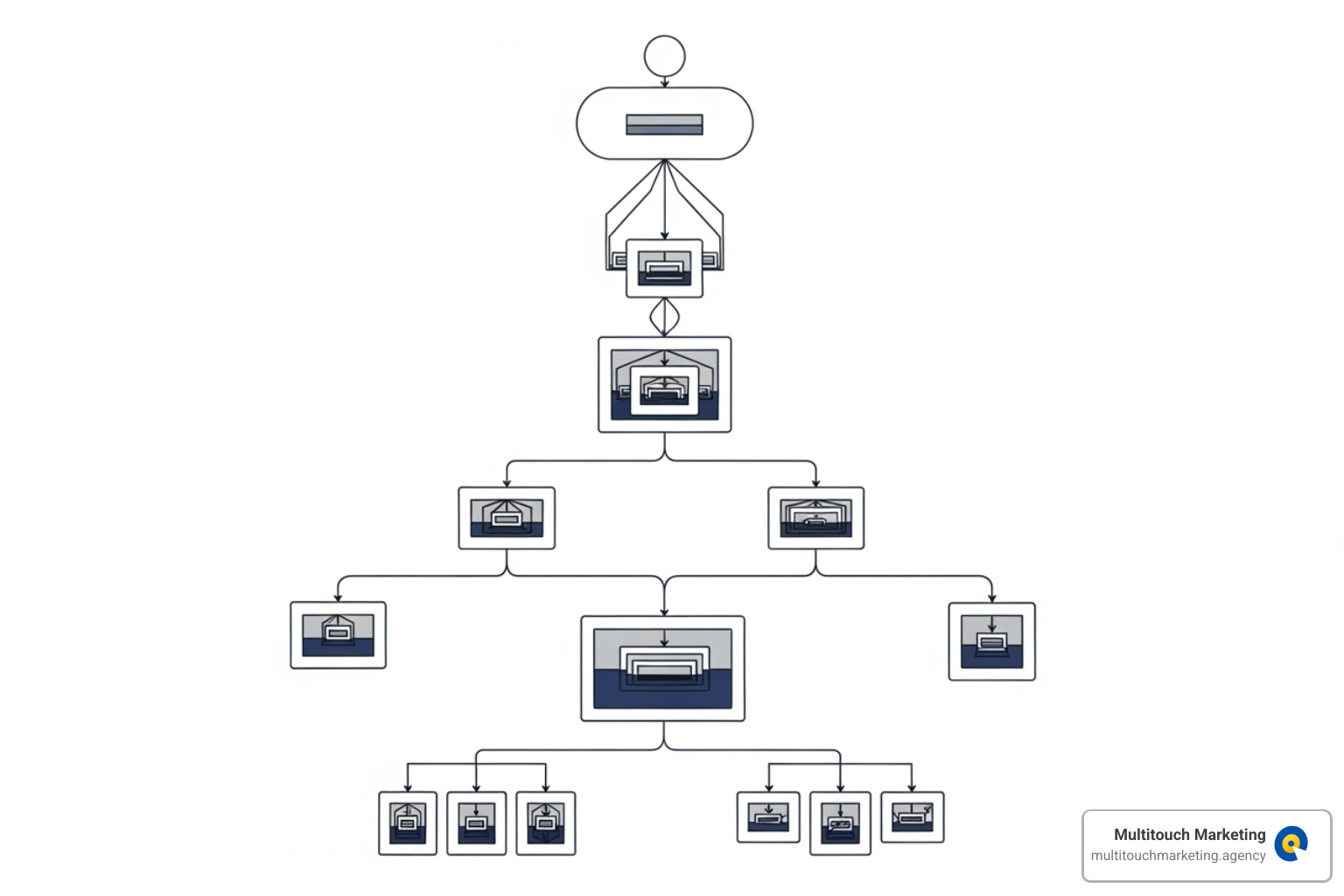
A successful paid search marketing campaign is built with strategic architecture, not guesswork. Campaigns follow a logical hierarchy: Account > Campaign > Ad Group > Keywords & Ads. This organization allows for precise targeting, efficient management, and better results.
For example, a plumbing business in Durham, NC, wouldn’t use one generic campaign. They might create separate campaigns for “Emergency Plumbing” and “Water Heater Installation.” Within the emergency campaign, they’d have focused ad groups like “Burst Pipe Repair” and “Clogged Drain Solutions.” Each ad group contains highly specific keywords and ads custom to that problem. This ensures that a user searching for an emergency sees an ad that speaks directly to their crisis.
This level of organization is what separates campaigns that drain budgets from those that drive results. It improves relevance, boosts Quality Score, lowers costs, and increases conversions. To get started, our guide on How to Set Up a Google Ad Campaign walks you through the process.
The Foundation: A Robust Keyword Strategy
Keywords are the bridge between a customer’s search and your solution. A strong strategy goes beyond guessing, requiring research and an understanding of user intent.
We start with keyword research using tools like the Google Keyword Planner to find relevant terms with sufficient search volume. Understanding user intent is critical. A search for “how to fix a leaky faucet” (informational) is different from “emergency plumber Raleigh NC” (transactional). Our strategy must align with the customer’s stage in their journey.
We use keyword match types to control ad visibility:
- Exact Match:
[plumber Raleigh]shows for identical searches or close variants. - Phrase Match:
"plumber Raleigh"shows for searches including the phrase, like “best plumber Raleigh.” - Broad Match: Casts the widest net, showing for related searches, but requires careful management.
Negative keywords are just as important. These are terms you tell Google not to show your ads for. A professional plumber would add “free” and “DIY” as negative keywords to avoid paying for clicks from users who will never convert. Our guide on PPC Negative Keyword Strategy explores this essential technique.
Crafting Compelling Ads and High-Converting Landing Pages
Great keywords need great ads and landing pages to convert interest into action. Your ad copy is where you turn browsers into buyers.
- Headlines & Descriptions: We craft benefit-driven headlines that include target keywords and a clear value proposition. Descriptions expand on the offer, highlighting what makes you different and solving the customer’s problem.
- Call-to-Action (CTA): A clear instruction like “Get a Free Quote” or “Shop Now” is essential for turning interest into clicks.
- Ad Extensions: These extra pieces of information—like sitelinks, callouts, and location extensions—make your ad more prominent and useful, often boosting your Quality Score. Learn the fundamentals in Google’s guide on What is a text ad?.
Many campaigns fail at the landing page. The page must be a seamless continuation of the ad’s promise. If your ad says “24/7 Emergency Plumber Raleigh,” the landing page must immediately confirm that service. A fast-loading, mobile-friendly, and easy-to-steer page with a clear CTA is non-negotiable. This smooth journey is what turns clicks into customers.
Exploring Different Types of Paid Search Ads
While text ads are the foundation of paid search marketing, various formats serve different goals.
- Text Ads: The classic ads at the top and bottom of search results. Versatile and effective for nearly any business.
- Shopping Ads: Ideal for e-commerce, displaying product images, prices, and reviews directly in search results.
- Local Service Ads: Designed for service providers (e.g., plumbers in Durham, NC), featuring a “Google Guaranteed” badge and a pay-per-lead model.
- Dynamic Search Ads (DSAs): Google automatically generates headlines based on your website content, saving time for businesses with large inventories.
- Responsive Search Ads (RSAs): You provide multiple headlines and descriptions, and Google’s AI mixes and matches them to create the most effective ad variations.
- Call-Only Ads: Designed to drive phone calls directly from a mobile search ad.
- Remarketing Ads: Show ads to users who have previously visited your website, re-engaging interested prospects. We can even Set Up Dynamic Remarketing Google Ads to show users the exact products they viewed.
A comprehensive strategy often mixes these formats to reach customers effectively.
Smart Budgeting and Measuring Success
Anyone can spend money on paid search marketing, but turning that spend into profit requires skill. Success depends on smart budgeting and careful measurement, changing ad spend from an expense into an investment.
The foundation is conversion tracking. We must define and track what a “win” looks like—a sale, a form submission, or a phone call. This is the difference between guessing and knowing. From there, we monitor Key Performance Indicators (KPIs) that tell the story of our campaigns, revealing what’s working and what needs optimization. To keep things on track, we regularly use our Google Ads Account Audit Checklist.
How to Effectively Manage Your Paid Search Marketing Budget
Managing a paid search marketing budget is about strategic allocation and data-driven adjustments. We start by setting a realistic daily budget for each campaign to control spending. Pacing is also key; we want ads to show consistently throughout the day, not burn through the budget by noon.
We continuously adjust bids at the keyword level, increasing bids for high-converting keywords and lowering them for underperformers. This granular control ensures every dollar works as hard as possible. Businesses typically make an average of $2 for every $1 spent with Google Ads, making a well-managed budget a powerful investment. Our guide on PPC Campaign Budgeting for Small Businesses breaks down how to maximize limited funds.
Measuring the ROI of Your Paid Search Marketing
Clicks are nice, but revenue is what matters. Measuring the ROI of your paid search marketing is critical to understanding true performance.
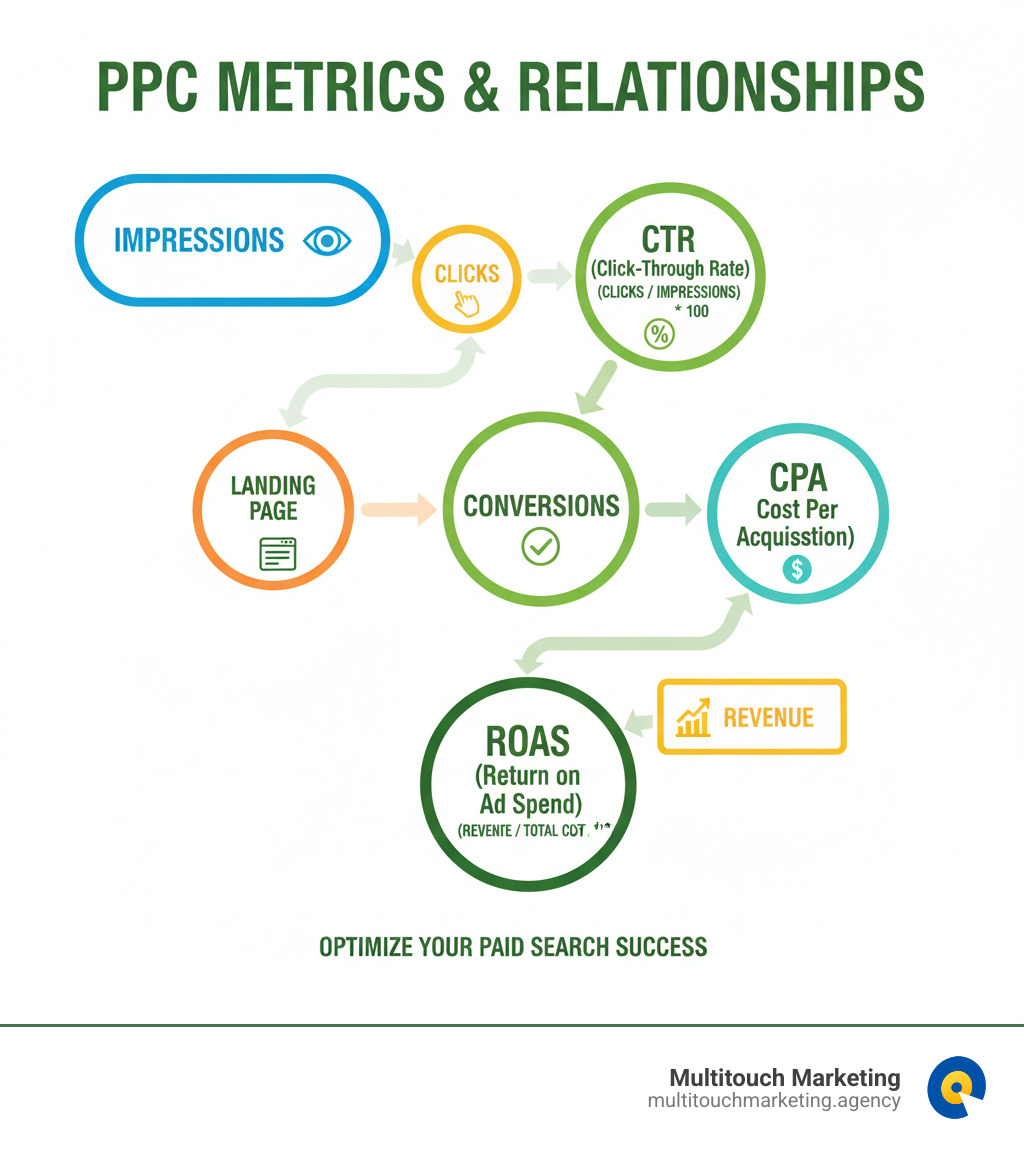
- Return on Ad Spend (ROAS): This tells you how much revenue you generate for every ad dollar spent. A 5:1 ROAS means $5 in revenue for every $1 spent.
- Cost Per Acquisition (CPA): This shows what you’re paying to acquire a single customer or lead. It helps determine profitability.
- Conversion Rate: This is the percentage of ad clicks that result in a desired action (like a sale or lead). It’s a key indicator of campaign effectiveness.
- Click-Through Rate (CTR): This measures how many people who see your ad click on it. A strong CTR indicates your ad is relevant and compelling, which also boosts your Quality Score.
- Customer Lifetime Value (CLV): Understanding the total revenue a customer generates over time helps determine how much you can afford to spend on acquisition. You can learn more about why customer lifetime value is important.
By tracking these metrics with Google Ads and analytics platforms, we get a complete picture of performance. This data-driven approach is what separates profitable campaigns from expensive experiments.
Conclusion
We’ve explored paid search marketing, from the basics of ad auctions to building high-converting campaigns. We’ve seen how this powerful tool puts your business in front of customers at the exact moment they’re searching for what you offer, whether you’re serving clients in Raleigh NC, Durham NC, or beyond.
It all comes down to this: paid search marketing is a strategic investment that delivers immediate visibility, precise control, and measurable results. Unlike traditional advertising, paid search provides clear data on who clicked, what they searched for, and what actions they took. This transparency allows for smart, data-driven decisions that continuously improve performance.
The flexibility of paid search is its greatest strength. You control the budget, target your ideal audience, and can adjust your strategy in real-time. When a potential customer in your area searches for your services, you can be right there at the top of the results.
However, getting it right requires expertise. Managing bids, optimizing Quality Scores, and analyzing performance data is a full-time job. A poorly managed campaign can burn through a budget with little to show for it, while a strategic campaign can deliver transformative growth.
That’s where we come in. At Multitouch Marketing, we’ve been managing paid search marketing campaigns since 2008. We know how to make every click count toward your business goals.
Ready to stop guessing and start growing? Get your free, no-obligation PPC audit today! We’ll show you exactly where your opportunities lie and how to turn your ad spend into real, measurable business growth.