
Why Online Advertising PPC is Your Fast Track to Visibility
Online advertising PPC (Pay-Per-Click) is a digital marketing model where you pay a fee each time someone clicks your ad. Instead of waiting for organic traffic, you can buy visits to your website and appear at the top of search results almost instantly.
Quick Answer: What You Need to Know About PPC
- What it is: An advertising model where you only pay when someone clicks your ad.
- Where it appears: Search engines (Google, Bing), social media (Facebook, LinkedIn), and other websites.
- Why it matters: 79% of brands say PPC is a massive driver for their business.
- Main benefit: Immediate visibility and measurable results.
- Key platforms: Google Ads, Microsoft Advertising, Facebook Ads.
The digital marketing landscape has shifted. Businesses can’t afford to wait months for SEO results when competitors are at the top of search results right now. More than 7 million advertisers spent $10.01 billion on PPC ads in 2017, and that number has only grown.
However, PPC isn’t just about spending money on ads. Statistics show that less than 25% of PPC ads produce conversions, meaning many businesses waste money on clicks that don’t become customers.
This guide cuts through the complexity. You’ll learn how PPC works, how to set up campaigns that generate revenue, and how to optimize your ads to lower costs while increasing results.
I’m Milton Brown, and I’ve been managing Online advertising PPC campaigns since 2008 for businesses of all sizes, handling budgets from $20,000 to $5 million. I’ve seen what works—and what doesn’t.
The Core Concepts: What is PPC and How Does It Work?
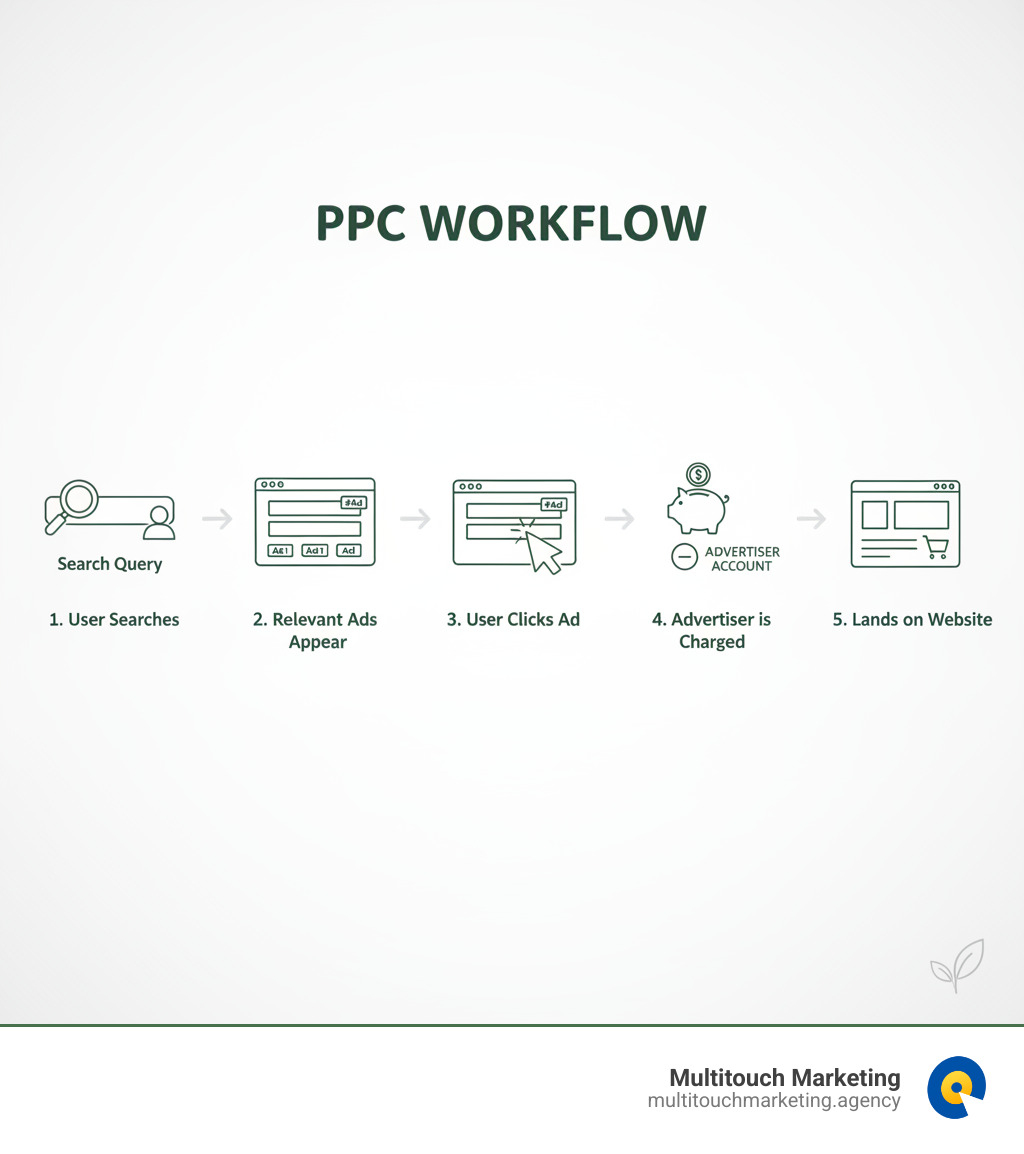
Pay-Per-Click is an internet advertising model where you only pay when someone clicks your ad. Instead of hoping people find your website organically, you’re buying targeted visits from people already interested in what you offer. You’re not paying for impressions or views, only for engagement.
How Does PPC Work? The Ad Auction
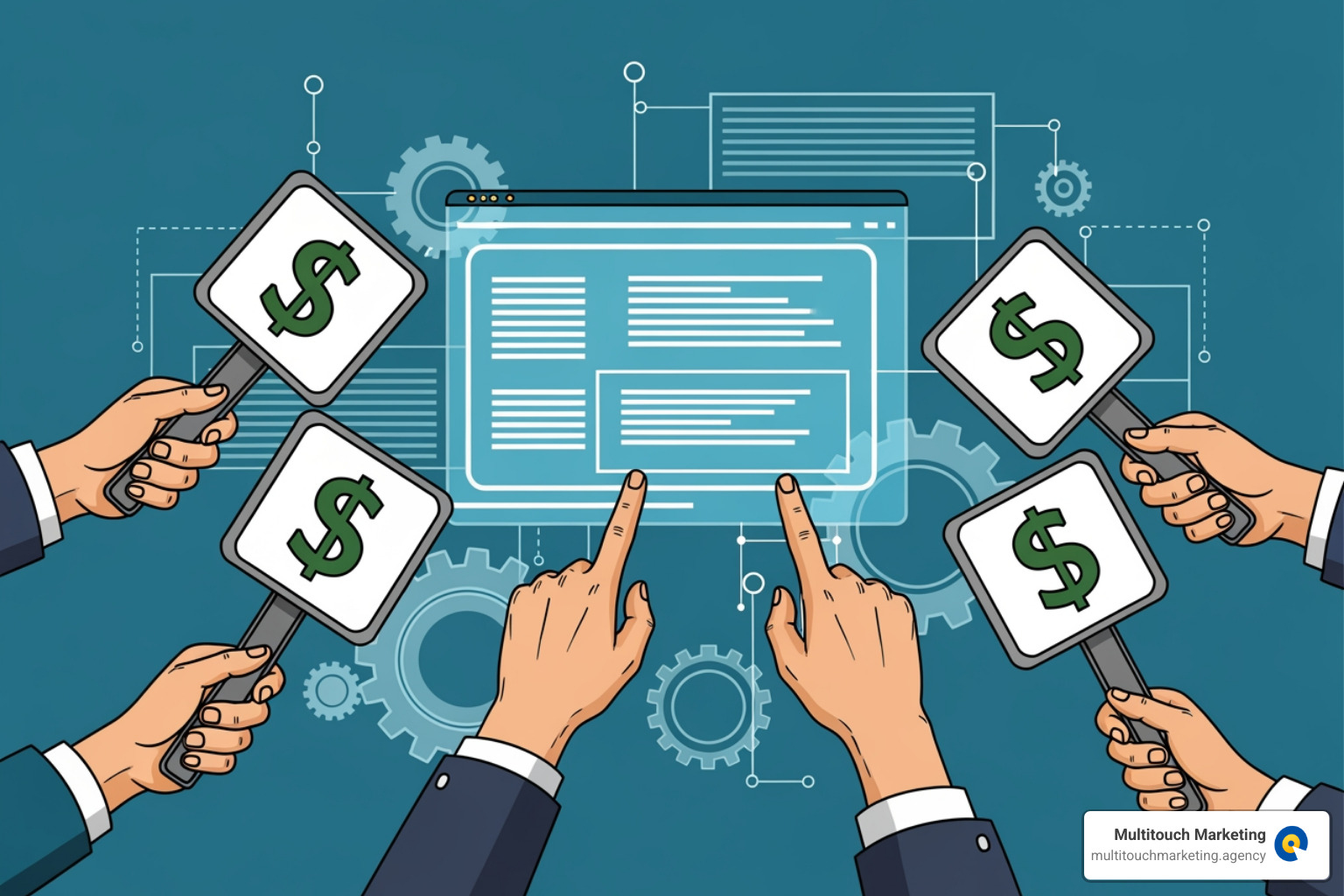
Every time someone searches on Google or Bing, an auction happens in milliseconds. When you run a PPC campaign, you bid on keywords relevant to your business (e.g., “leather messenger bag”). The platform’s algorithm evaluates all advertisers bidding on that keyword.
The system considers two main factors: your bid (how much you’ll pay per click) and your ad’s quality and relevance. This process determines which ads appear and in what order. If your ad wins and is clicked, you pay your bid amount or less, depending on the competition.
PPC vs. CPC: What’s the Difference?
Though often used interchangeably, they are different. PPC (Pay-Per-Click) is the advertising model. CPC (Cost Per Click) is the metric that measures how much each click costs. As Google Ads explains, CPC is the actual dollar amount you pay. Your CPC can vary widely by industry, keywords, and competition.
Common Platforms for Online Advertising PPC
- Google Ads: The largest PPC system, offering access to Google Search, YouTube, and millions of websites on the Google Display Network. Our Google Ads Campaign Management Services help businesses steer this powerful platform.
- Microsoft Advertising: Covers search engines like Bing and Yahoo. It captures about a third of US desktop searches and often has lower competition and CPCs.
- Social Media Networks: Platforms like Facebook, Instagram, and LinkedIn allow you to target users based on demographics, interests, and behaviors, rather than active searches.
Types of PPC Ads
Understanding different ad formats is crucial for a versatile online advertising PPC strategy.
- Search Ads: These are the text-based ads at the top of Google or Bing results. They capture people at the exact moment they’re searching. Text ads are a form of marketing communication designed to match queries with relevant offers.
- Display Ads: These are visual banners you see on news sites and blogs. They are great for building brand awareness, reaching over 90% of online users.
- Social Media Ads: These ads appear in user feeds on platforms like Facebook and Instagram. They excel at targeting specific audiences. Learn more from our guide on Social Media Ad Formats.
- Remarketing Ads: These ads target people who have already visited your website but didn’t convert. They are incredibly powerful for reaching warm leads. We can help you set up dynamic remarketing in Google Ads to bring prospects back.
- Google Shopping Ads: Essential for e-commerce, these product listings show images, prices, and store names directly in search results, creating a shortcut to purchase.
Building Your First Campaign: A Step-by-Step Guide
Launching a successful Online advertising PPC campaign requires a strategic process, not random spending.

Setting Your Campaign Goals and Budget
First, answer: What are we trying to achieve? Goals could be brand awareness, lead generation, or direct sales and conversions. Once you have a goal, you can set a budget. PPC offers excellent control with daily or monthly spending limits. While many businesses allocate $15,000-$20,000 per month, you can start smaller and scale. Our guide on PPC Campaign Budgeting for Small Businesses breaks this down. Finally, choose a platform based on where your audience spends their time (e.g., LinkedIn for B2B, Instagram for local consumer brands).
The Foundation: Keyword Research and Selection
Keywords connect what someone searches for with the ad you show them. Getting this right is critical.
- Importance of Keywords: They tell ad platforms when to show your ads, connecting you with customers at the moment of need.
- Keyword Research Tools: Use tools like Google Keyword Planner to find search volumes, competition levels, and estimated costs.
- Search Intent: Understand the user’s goal. Someone searching “how to fix a leaky faucet” (informational) is different from someone searching “emergency plumber Durham NC” (transactional). Focus on transactional keywords for better conversion rates.
- Match Types: Control when your ads appear. Broad match is wide, phrase match is more specific, and exact match is highly targeted. Our guide on PPC Keyword Match Types explains when to use each.
- Negative Keywords: These prevent your ads from showing for irrelevant searches, saving money. For example, a luxury car dealer would add “cheap” as a negative keyword. Our PPC Negative Keyword Strategy guide shows how to build an effective list.
The Engine: Quality Score and Ad Rank
In the Google Ads auction, the highest bidder doesn’t always win. Google prioritizes relevant, helpful ads.
Quality Score is Google’s 1-10 grade for your ad’s quality and relevance. A higher score lowers your costs and improves your ad position. It’s based on three components: Expected Click-Through Rate (CTR), Ad Relevance, and Landing Page Experience.
The impact on CPC is significant. Google rewards high Quality Scores with a discount, allowing you to outrank higher bidders. Improving your score is an ongoing mission of refining keywords, ad copy, and landing pages. Google offers guidance on how to improve your quality score.
The Ad Rank formula is Maximum Bid × Quality Score. This means improving your Quality Score has the same effect as increasing your bid—but without the extra cost.
Why Choose PPC? Benefits, Drawbacks, and Strategic Comparisons
Why do so many businesses invest in Online advertising PPC? Because when done right, it delivers results other channels can’t match in the same timeframe.
Main Benefits of Using PPC Advertising
The primary appeal of PPC is speed. You can launch a campaign and get qualified visitors to your website within hours. This immediacy is powerful.
What makes PPC truly valuable is its measurability. Every click, impression, and conversion is tracked, allowing you to calculate ROI with precision and make data-driven decisions. You also have remarkable control over your campaigns, from daily spend and keywords to audience targeting by location, device, and time of day.
This targeting capability means you reach people actively searching for what you offer. That’s why customers are 50% more likely to purchase something after clicking a paid ad. Even without a click, seeing your ad can improve brand awareness by 80%. The data is clear: 79% of brands say PPC is a massive driver for their business. For more details, explore Why PPC Advertising is Beneficial in Business.
Advantages and Disadvantages of Online Advertising PPC
PPC has both strengths and weaknesses. The main advantages are immediate traffic, granular targeting, easy A/B testing, and its ability to complement other marketing channels like SEO.
However, there are challenges. PPC can be expensive, especially in competitive industries. It requires ongoing management to adapt to changing markets and competitor strategies. Click fraud from bots is also a concern, though platforms like Google have systems to filter it out. Research on click fraud shows it’s a significant issue. Finally, some users experience ad blindness, though 57.5% of users don’t recognize paid ads when they see them.
PPC vs. Other Digital Marketing Strategies
It’s rarely a question of “PPC or SEO?” but rather how they work together.
| Feature | PPC (Pay-Per-Click) | SEO (Search Engine Optimization) |
|---|---|---|
| Speed | Immediate traffic, fast results | Takes weeks to months for significant ranking |
| Cost | Pay per click; direct cost for each visitor | “Free” traffic, but requires investment in content |
| Control | High control over ad copy, targeting, budget | Less direct control; relies on algorithms |
| Longevity | Stops when budget runs out | Long-term asset; rankings can persist |
For a visual comparison, see this SEO vs PPC – Time for a Fight! [Infographic].
- Use PPC for: Quick results, product launches, testing new offers, and capturing high-intent keywords.
- Prioritize SEO for: Building long-term authority, content-driven strategies, and when working with a limited ad budget.
Paid search (Google Ads) is intent-based, meeting existing demand. Paid social (Facebook, Instagram) is interest-based, creating new demand by targeting users based on their profiles. A comprehensive strategy uses PPC for immediate results while SEO builds long-term assets.
Mastering Your Online Advertising PPC: Optimization and Performance Tracking
The truth about Online advertising PPC is that launching a campaign is just the start. The real work is in the ongoing optimization that turns ad spend into profit. Small, strategic adjustments can dramatically improve results, doubling conversion rates or cutting costs in half.
Our team specializes in PPC Campaign Optimization and implementing Advanced PPC Techniques to ensure your advertising dollars work as hard as possible.

Key Metrics to Track for Your Online Advertising PPC Campaign
- Impressions: How often your ad is shown.
- Click-Through Rate (CTR): Clicks divided by impressions; shows ad relevance.
- Cost Per Click (CPC): The amount you pay for each click.
- Conversion Rate: The percentage of clicks that result in a desired action (e.g., a sale or lead).
- Cost Per Acquisition (CPA): How much you spend to get one conversion.
- Return on Ad Spend (ROAS): Revenue from ads divided by ad cost; the ultimate profitability metric.
- Quality Score: Google’s 1-10 rating of your ad’s quality and relevance, affecting ad position and CPC.
How to Decrease Your Cost Per Click (CPC) and Improve Results
Lowering CPC while improving results is about smart optimization, not magic.
- Improve Quality Score: This is the most powerful lever. High scores are rewarded with lower costs and better ad positions.
- Refine Keyword Targeting: Use more specific phrase and exact match keywords. Build a robust negative keyword list to avoid wasted spend on irrelevant clicks. Our PPC Negative Keyword Strategy guide can help.
- Optimize Ad Copy: Write compelling headlines and descriptions that match search intent to improve CTR and Quality Score.
- Improve Landing Pages: A fast, relevant, and trustworthy landing page is critical for conversions. Walmart found that a 1-second improvement in load time increased conversions by 2%.
- Adjust Bidding Strategy: Use manual bidding for precise control or automated strategies that leverage machine learning to optimize for conversions. Learn more about Keyword Bid Strategies for PPC Campaigns.
- A/B Testing: Continuously test ad headlines, calls-to-action, and landing pages to find what resonates with your audience. Test one element at a time for clear results.
Online advertising PPC optimization never ends. The campaigns that thrive are the ones that constantly evolve and improve.
Frequently Asked Questions about PPC Advertising
Here are answers to common questions about Online advertising PPC from businesses in the Raleigh, Durham, and Chapel Hill areas.
How much does PPC cost?
There’s no single answer. The cost of Online advertising PPC depends on your industry, keyword competition, and location. A click for a “car accident attorney” in Raleigh might cost over $50, while a click for “custom birthday cakes Durham” could be just a few dollars. The average CPC across industries is around $2.59, but this is just a benchmark. The key benefit of PPC is budget control; you set daily spending limits and maximum bids to manage costs. For more on this, see our guide on PPC Management for Small Business.
How long does it take to see results from PPC?
PPC is fast. You can start seeing traffic within hours of launching a campaign, unlike SEO, which can take months. However, there’s a difference between immediate traffic and meaningful results. Achieving an optimized ROI and a low Cost Per Acquisition (CPA) typically takes several weeks or months of continuous testing and data-driven refinement. The initial period is a learning phase for the campaign.
Can I do PPC myself or should I hire an agency?
This depends on your time, resources, and goals. DIY PPC is possible for basic campaigns if you have the time to learn, manage, and stay current with platform changes. However, managing PPC effectively is complex, and many DIY efforts waste money on poorly optimized campaigns.
An expert PPC management company brings specialized knowledge, advanced tools, and strategic oversight to maximize your budget and avoid costly mistakes. This is especially valuable in competitive local markets like Raleigh and Durham. The cost of an agency is often offset by the savings from avoiding wasted ad spend and the increased returns from professionally managed campaigns. If you’re unsure about your current performance, consider our PPC Audit Services to identify opportunities for improvement.
Conclusion: Turn Clicks into Customers
Online advertising PPC is a powerful way to connect with customers at the exact moment they are searching for a solution. Unlike traditional advertising, it offers precision, control, and immediate, measurable results.
Success in PPC requires a strategic approach to keywords, bidding, and continuous optimization. It’s not about setting and forgetting; it’s about making smart, data-driven decisions to consistently improve performance. The businesses that thrive with PPC treat it as an ongoing process of testing and refinement.
For businesses in competitive markets like Raleigh, Durham, and Chapel Hill, strategic PPC management is the key to standing out. At Multitouch Marketing, we help businesses steer the complexities of PPC, turning clicks into customers and avoiding the costly mistakes that drain budgets. Our expertise ensures your ad spend is an investment in growth.
Ready to transform your advertising strategy and drive real results? Explore our Google Ads Campaign Management Services to get started, or reach out to discuss how PPC can work for your specific business goals.