
Is Your PPC Account Actually Working for You?
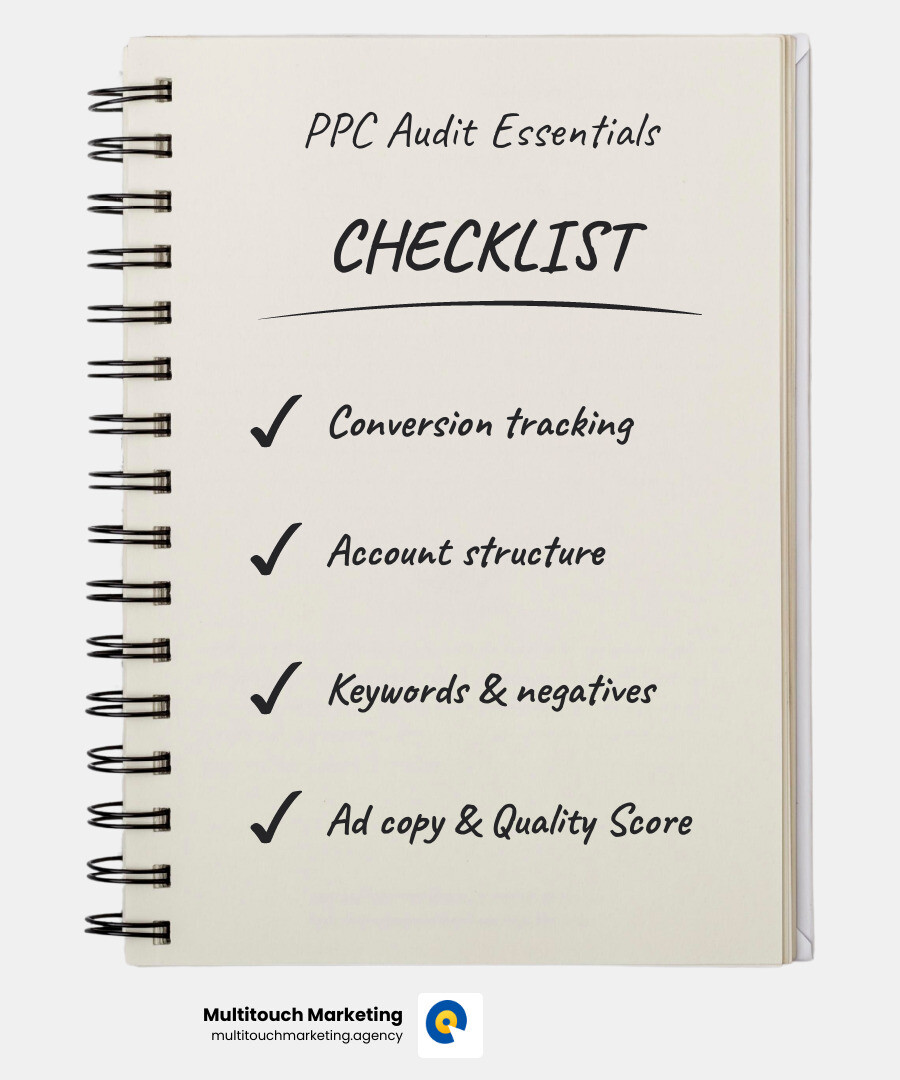
A PPC account audit checklist is a structured review of your Google Ads account that checks for wasted spend, tracking errors, structural problems, and missed optimization opportunities. Here’s a quick overview of what a complete audit covers:
- Conversion tracking – Are your tags firing correctly and measuring the right actions?
- Account and campaign structure – Are campaigns organized logically by product, service, or intent?
- Keywords and search terms – Are you targeting the right queries and blocking the wrong ones?
- Negative keywords – Are irrelevant searches eating your budget?
- Ad copy and assets – Are your RSAs strong, and are all extensions in place?
- Landing pages – Do they match your ads and load fast?
- Bids and budgets – Is your strategy aligned with your actual business goals?
- Performance Max campaigns – Are asset groups strong and brand searches protected?
- Quality Score – Are your keywords, ads, and landing pages working together?
- Wasted spend and lost impression share – Where is money leaking, and what traffic are you missing?
Most accounts leak between 10% and 30% of their ad spend through tracking gaps, loose keyword targeting, and poor structure. The good news? A thorough audit can surface those leaks fast and show you exactly where to fix them first.
Running PPC without regular audits is a bit like driving with your eyes closed. You might be moving, but you have no idea if you’re heading in the right direction.
I’m Milton Brown, a paid media specialist with experience since 2008 managing accounts from $20,000 to $5 million across ecommerce, healthcare, higher education, and nonprofits – and a PPC account audit checklist is the first thing I reach for when diagnosing underperforming campaigns. In this guide, I’ll walk you through every layer of a professional audit so you can stop guessing and start improving results with confidence.
Simple guide to PPC account audit checklist:
The Foundation: Conversion Tracking and Signal Integrity
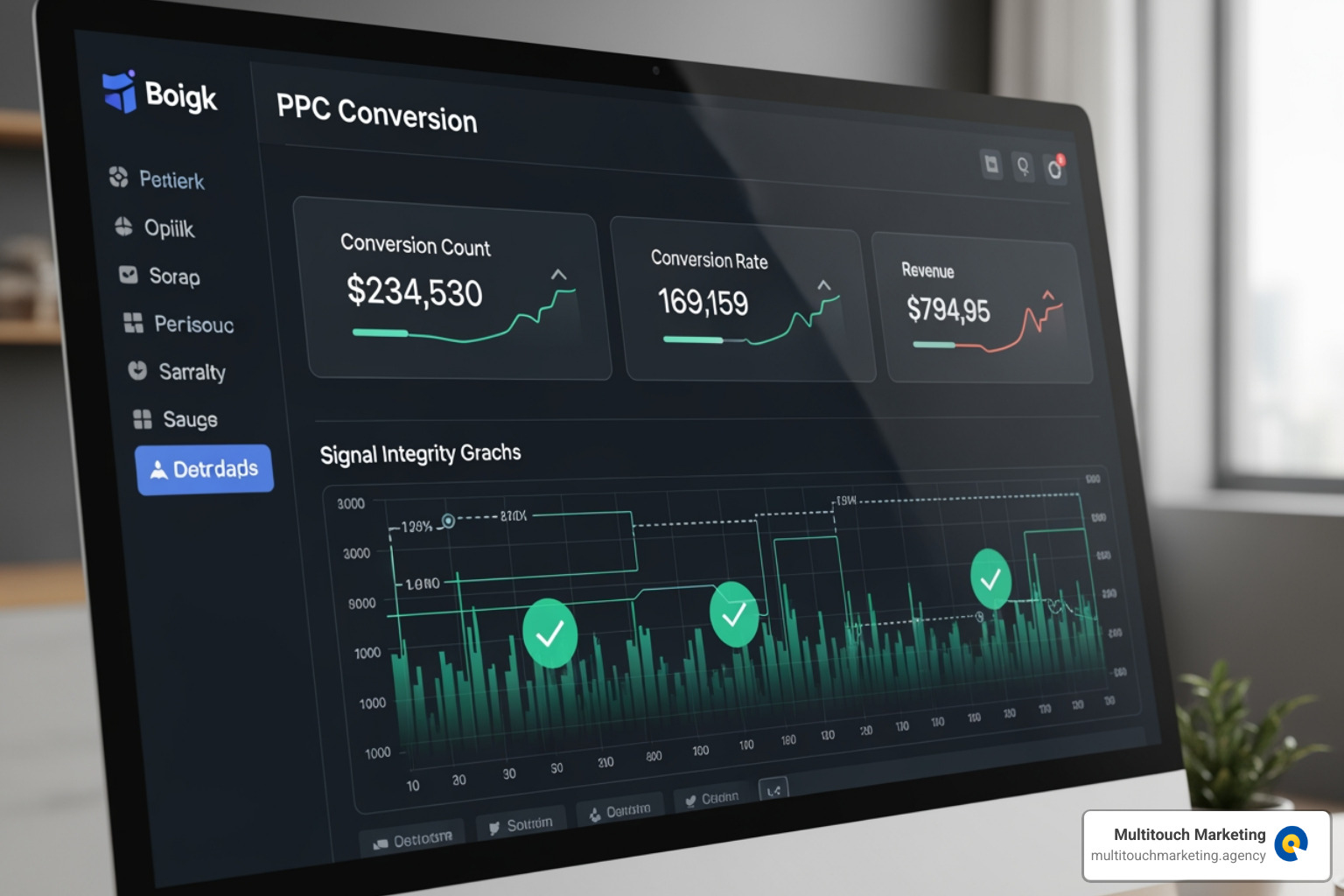
Before we look at keywords or ad copy, we have to talk about “signals.” In the modern era of AI-driven PPC, your bidding algorithms are only as smart as the data you feed them. If your tracking is broken, you are essentially asking a world-class athlete to run a race while wearing a blindfold.
The first step in any Pay Per Click Audit is verifying signal integrity. This starts with Google Analytics 4 (GA4) integration. Many accounts are still coasting on old Universal Analytics settings or haven’t properly linked their GA4 audiences to Google Ads. We also need to look at Enhanced conversions, which use hashed first-party data to recover “lost” conversions in a privacy-safe way.
One of the biggest mistakes we see in a PPC account audit checklist is a lack of distinction between Primary and Secondary goals. If you tell Google to optimize for “Page Views” (a secondary micro-conversion) with the same intensity as “Completed Purchase” (a primary goal), your Smart Bidding will chase cheap traffic that doesn’t buy anything.
| Feature | Basic Health Check | Full PPC Account Audit |
|---|---|---|
| Conversion Tracking | Is the tag “green”? | Are values accurate? Is deduplication working? |
| Structure | Are campaigns running? | Is the hierarchy built for Smart Bidding signals? |
| Keywords | Are there negative keywords? | Are there conflicts between negatives and active terms? |
| Bidding | Is a strategy selected? | Is the strategy aligned with the current conversion volume? |
| Assets | Are sitelinks present? | Are assets tailored to specific ad group themes? |
Proper UET and conversion tracking ensures that every dollar spent is accounted for. Without this, you’re just guessing.
Verifying Conversion Accuracy in Your PPC Account Audit Checklist
To verify accuracy, we use tools like Google Tag Assistant to watch the “firing” of tags in real-time. We also look for deduplication issues. For example, if a user refreshes a “Thank You” page, does it count as two sales? If so, your ROAS is a lie.
For B2B companies in Raleigh or Durham, lead quality is often more important than lead quantity. This is where Offline Conversion Imports (OCI) come into play. By feeding data from your CRM back into Google Ads, you can tell the system, “This lead turned into a $10,000 contract, but that one was just a spam bot.” This allows the AI to find more of the former and less of the latter.
Structural Optimization and Campaign Settings
A messy account structure is the silent killer of ROI. We often see accounts that have grown “organically” over years, resulting in a tangled web of overlapping ad group themes. In our Google Ads Account Audit Checklist, we look for a logical hierarchy that mirrors your website or business lines.
Key settings to check include:
- Location Targeting: Are you targeting “Presence” (people actually in your area) or “Interest” (people searching about your area)? For a local business in Chapel Hill, targeting “Interest” might accidentally waste money on people in California looking for “Durham NC history.”
- Device Bid Adjustments: If your website’s mobile conversion rate is 50% lower than desktop, are you still paying the same amount for mobile clicks?
- Budget Sufficiency: As a rule of thumb, campaigns should have budgets for at least 10 clicks per day to give the algorithm enough data to learn.
ad rank factors aren’t just about who bids the most. It’s a combination of your bid, your Quality Score, and the expected impact of your ad assets. Even a small structural change can lead to a 300% increase in conversions from A/B testing by simply putting the right ad in front of the right person.
Auditing Ad Assets and RSAs for Maximum Impact
Ad assets (formerly extensions) like Sitelinks, Callouts, and Structured Snippets are not “optional extras.” They are essential components that increase your ad’s real estate on the SERP and improve your Click-Through Rate (CTR).
When auditing ad extensions setup, ensure you have at least four active sitelinks and four callouts per campaign. For Responsive Search Ads (RSAs), check your “Ad Strength.” Are you using all 15 headlines and 4 descriptions?
A common debate in the PPC account audit checklist world is “pinning.” Google wants you to let the AI decide which headline goes where. However, for highly regulated industries or strict brand guidelines, you might need to pin Headline 1. Just know that pinning too much can hurt your ad strength and reach. Use ad relevance diagnostics to see if your headlines actually match the keywords in your ad group.
Mastering Keywords, Negatives, and AI-Driven Search
The Search Terms Report is the most valuable tool in your arsenal. It shows you what people actually typed before clicking your ad. If you’re bidding on “PPC services” but appearing for “PPC definition,” you are wasting money on students instead of customers.
Data shows that 70% of searches involve longtail phrases. If your keyword list is only 10 broad terms, you’re missing the nuances of how people search. However, as Google pushes more toward Broad Match and Smart Bidding, the “defensive” side of your account—your negative keyword lists—becomes critical.
In our PPC Audit Services, we look for:
- Duplicate Keywords: Are two campaigns competing for the same search term?
- Negative Conflicts: Did you accidentally block a keyword you are actively bidding on?
- Broad Match Runaway: Is Broad Match bringing in irrelevant “junk” traffic because your Smart Bidding doesn’t have enough conversion data to be picky?
With 80% of buyers using GenAI tools, search behavior is changing. People are asking longer, more conversational questions. Your audit should ensure you’re using audience targeting and remarketing segments to bid more aggressively on people who have already visited your site or match your ideal customer profile.
Refining Your PPC Account Audit Checklist for Performance Max
Performance Max (PMax) is Google’s newest “black box” campaign type. It serves ads across Search, YouTube, Display, and Maps. Because it’s so automated, auditing it requires a different lens.
- Asset Groups: Are you providing high-quality video and images, or is Google “auto-generating” ugly videos for you?
- Audience Signals: Are you giving the AI a head start by uploading your customer email lists?
- Brand Exclusions: Is PMax “stealing” credit by showing ads to people who were already searching for your brand name?
- Final URL Expansion: Is the AI sending people to your “Privacy Policy” page instead of your “Services” page?
According to IAB’s 2025 Outlook on consumer behavior, cross-channel measurement and proving incrementality are top challenges. A PMax audit must prove that the campaign is finding new customers, not just cannibalizing your existing Search campaigns.
The Essential PPC Account Audit Checklist
How often should you run this? We recommend a “hygiene check” monthly and a deep-dive PPC account audit checklist every quarter. If you haven’t done one in six months, you are almost certainly leaving money on the table. You can even start with a Free PPC Audit to get a baseline.
When we look at performance, we focus on the three Quality Score components:
- Expected CTR: Do people actually want to click your ad?
- Ad Relevance: Does the ad copy match the search intent?
- Landing Page Experience: Is the page fast, mobile-friendly, and relevant?
Improving your Quality Score from a 5 to an 8 can effectively cut your CPC in half. This is the fastest way to stop wasted spend. We also look for “Lost Impression Share (Budget).” If you have a high-performing campaign that is “Limited by Budget,” you are literally turning away customers who want to give you money.
With Search and Retail Media forecasted at $357B in 2025, the competition is only getting fiercer. Use an Impact-Effort Matrix to prioritize your findings. A “Quick Win” might be adding five negative keywords that save $500 a month. A “Major Initiative” might be rebuilding your entire landing page flow.
Don’t forget to look outside your own account. Use tools like Spyfu for competitor keywords to see what your rivals in Raleigh are bidding on. Are they using a specific offer that you aren’t? Finally, compare your results to Ecommerce ROAS benchmarks or industry-specific data to see if your 3x ROAS is actually “good” for your niche.
Frequently Asked Questions about PPC Audits
How often should you conduct a PPC audit?
For most businesses in the Raleigh-Durham area, a comprehensive audit should be done every 3 to 6 months. However, if you are spending more than $10,000 a month, a monthly “health check” is necessary to catch budget leaks or tracking breaks before they become expensive disasters.
What are the most common PPC audit mistakes to avoid?
The biggest mistake is auditing in a vacuum. You can’t just look at CTR and CPC; you have to look at lead quality and backend sales. Another common error is ignoring “Auto-apply” settings. Google often automatically opts you into broad match or new assets that might not align with your brand voice or budget goals.
What should a PPC audit deliverable include?
A professional audit shouldn’t just be a list of problems. It should include:
- An Executive Summary of the biggest opportunities.
- A Prioritized Action Plan (the “Fix-First” roadmap).
- Technical Verification of all tracking codes.
- Competitor Benchmarking to show where you stand in the market.
Conclusion
A PPC account audit checklist isn’t just a chore—it’s a roadmap to higher profitability. By systematically reviewing your signals, structure, keywords, and creative, you move from “paying for clicks” to “buying customers.”
Whether you’re managing things in-house or looking for expert PPC Campaign Management, the goal remains the same: maximum impact for every dollar spent. If you’re ready to see what’s really happening under the hood of your account, you can start a Free Adalysis trial for automated insights or download a Paid Search account audit checklist here to begin your manual review.
At Multitouch Marketing, we live for these details. We’ve helped businesses across North Carolina turn “okay” campaigns into “powerhouse” revenue drivers. Don’t let another month of wasted spend slip by—audit your account today and start winning.