

Why Your Website Needs a Dedicated Manager
Companies that manage websites provide comprehensive services that keep your online presence secure, fast, and optimized for conversions. These agencies handle everything from technical maintenance and security monitoring to performance optimization and strategic oversight, allowing you to focus on running your business.
Top website management services typically include:
- Technical Maintenance – Software updates, bug fixes, and compatibility checks
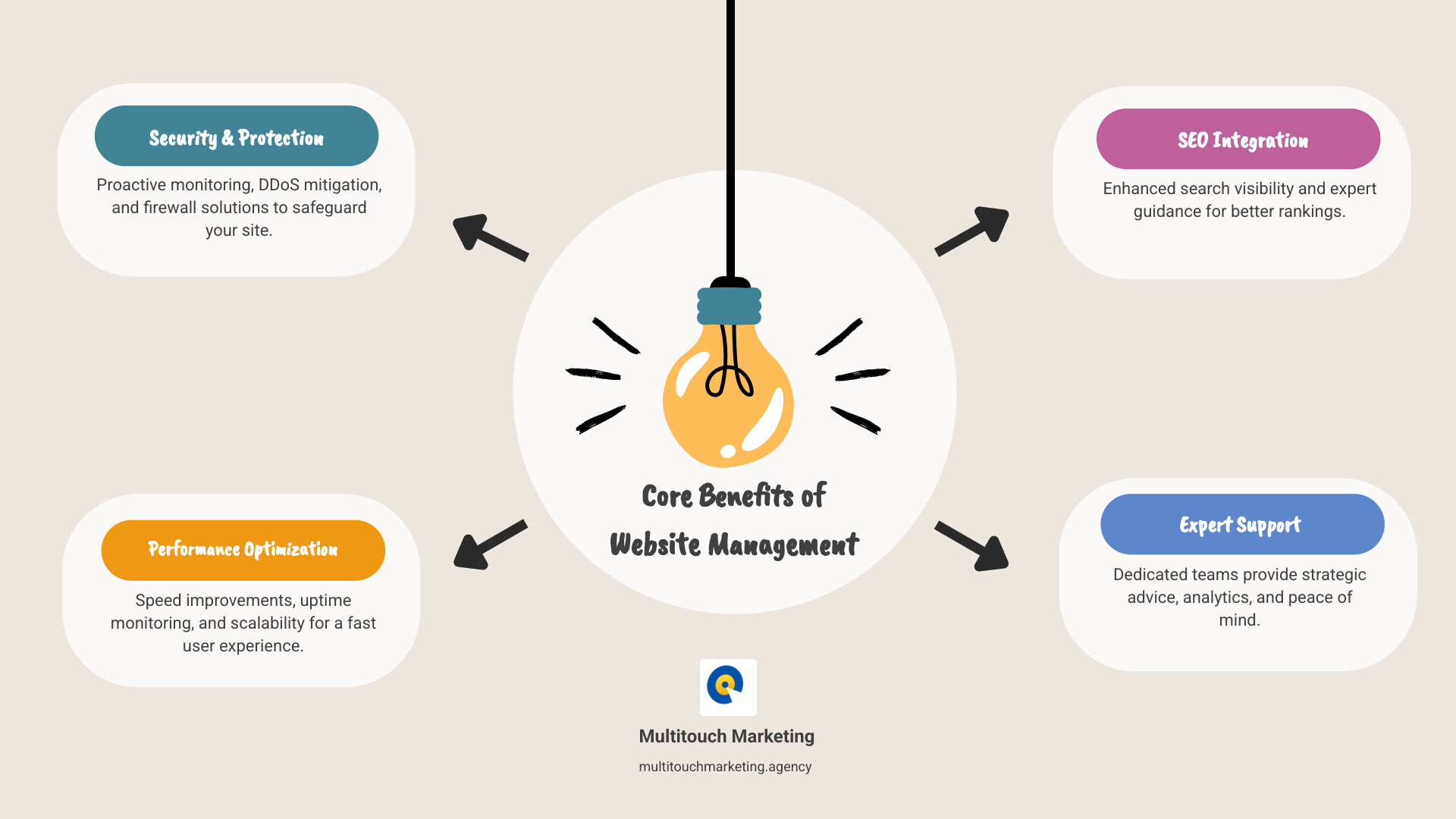
- Security Protection – DDoS mitigation, firewall management, and threat monitoring
- Performance Optimization – Speed improvements, uptime monitoring, and scalability
- Content Management – Regular updates, backups, and responsive design maintenance
- Strategic Support – Analytics reporting, SEO optimization, and expert guidance
Your website is your digital storefront. It creates first impressions, shapes user experiences, and directly impacts business growth. But here’s the problem: without proper management, websites deteriorate quickly.
The research shows that a single day of website downtime can cost businesses between $2,000 and $9,500. If that downtime extends to 72 hours without a dedicated management team, you’re looking at losses between $6,000 and $28,500. That’s not including the damage to your reputation or the customers who never come back.
Most small business owners face a tough choice. Managing a website in-house requires technical expertise you might not have on staff. Hiring freelancers can be unpredictable. Professional website management services offer a middle ground—predictable costs, expert teams, and peace of mind.
The typical investment? Between $500 and $2,000 per year for comprehensive management services. Compare that to the cost of downtime, and the math becomes simple.
I’m Milton Brown, and since 2008 I’ve helped businesses optimize their digital presence by integrating website management with data-driven marketing strategies. Working with companies that manage websites has shown me how proper technical oversight amplifies marketing ROI and protects business continuity.
Find more about companies that manage websites:
What Do Website Management Services Include?
When we talk about website management services, we’re not just referring to basic hosting or occasional updates. We’re talking about a holistic approach to maintaining, optimizing, and enhancing your website’s user experience and functionality. Think of it as having a dedicated team of digital guardians ensuring your online home is always welcoming, safe, and performing at its peak.
At its core, a website management company takes on the daily, weekly, and monthly tasks that keep your site running smoothly. This includes crucial technical maintenance like applying software updates, fixing bugs that might crop up, and ensuring compatibility across different browsers and devices. They’re also responsible for robust security monitoring, which involves everything from proactive threat detection to managing firewalls and mitigating Distributed Denial of Service (DDoS) attacks.
Performance optimization is another critical piece of the puzzle. This means constantly working to improve your site’s loading speed, ensuring high uptime, and making sure your website can scale to handle increased traffic without breaking a sweat. Beyond the technical backend, these services often encompass content updates, keeping your site’s information current and engaging. Regular website backups are also standard, providing a safety net in case of any unforeseen issues, allowing for quick recovery.
Many companies that manage websites also offer strategic oversight. This involves analyzing your website’s performance data, providing detailed analytics reports, and offering actionable insights to improve your online presence. Furthermore, they integrate essential services like SEO Optimization Tips to help your site rank higher in search results, and ensure your design is responsive, adapting seamlessly to any screen size. For more details on maintaining your site’s health, explore our services on Website Maintenance and Support. We also dig into the importance of adaptable design in our guide to Responsive Web Design.
The Four Pillars of Comprehensive Website Management
To truly understand the breadth of what companies that manage websites offer, it’s helpful to break it down into four fundamental elements:
- Website Maintenance: This is the ongoing care and upkeep. It includes regular software updates for your Content Management System (CMS) like WordPress, plugins, and themes. It also covers patching security vulnerabilities, fixing broken links, and ensuring all functionalities work as intended. Think of it as changing the oil and rotating the tires on your digital vehicle.
- Website Development: Beyond just fixing things, this pillar involves improving and expanding your website. This could mean adding new features, integrating third-party tools, optimizing existing code, or even developing custom solutions to meet evolving business needs. It’s about keeping your website modern and competitive.
- Governance: This element focuses on the strategic direction and policies for your website. It involves defining content guidelines, ensuring legal compliance (like privacy policies and accessibility standards), managing user roles and permissions, and generally overseeing the quality and consistency of your online presence.
- Infrastructure: This refers to the underlying technology that powers your website. It includes secure hosting solutions, server management, database optimization, and ensuring a robust and scalable environment for your site. It’s the foundation upon which everything else is built.
These four elements are crucial for effectively managing a website and ensuring its long-term success. For a deeper dive into what these services entail, check out our article on Website Maintenance Services Includes.
How Management Services Ensure Security and Performance
In today’s digital landscape, a website is constantly under threat from cyberattacks and the relentless demand for speed and reliability. This is where professional website management truly shines. Companies that manage websites implement sophisticated measures to safeguard your online assets and ensure peak performance.
Security: Our approach to security is multifaceted. We deploy enterprise-grade protection, which includes proactive monitoring to detect and neutralize threats before they can cause harm. Advanced DDoS mitigation techniques are used to prevent your site from being overwhelmed by malicious traffic. Managed Web Application Firewalls (WAF) act as a shield, filtering out harmful requests. We also focus on secure data handling and managed SSL certificates to encrypt data transmissions, ensuring compliance with industry standards and protecting sensitive user information. Regular security audits are conducted to identify and address any potential vulnerabilities. This comprehensive strategy provides a robust defense against changing cyber threats. For more insights on keeping your site safe, refer to our Website Maintenance Best Practices.
Performance: A slow website is a frustrating website, leading to high bounce rates and lost conversions. We prioritize end-to-end performance optimizations to deliver lightning-fast load times, reliability, and scalability. This includes optimizing both front-end (what users see) and back-end (server-side) elements. Techniques like caching, image optimization, and code minification are standard. We ensure your website can handle traffic surges without a hitch, providing consistent speed and an optimal user experience. Our teams also provide uptime guarantees, ensuring your site is accessible to your audience when they need it most. This focus on performance not only pleases your visitors but also positively impacts your search engine rankings.

Agency vs. In-House vs. Freelancer: Which Is Right for You?
When it comes to managing your website, businesses in Raleigh, Durham, Chapel Hill, and across North Carolina generally have three main options: handling it in-house, hiring a freelancer, or partnering with companies that manage websites (agencies). Each path has its own set of advantages and disadvantages, and the best choice depends heavily on your specific needs, resources, and long-term goals.
In-House Management: This means assigning website management tasks to an existing employee or hiring a dedicated staff member.
- Pros: Complete control, deep understanding of your business, immediate availability for urgent tasks.
- Cons: High salary costs, difficulty finding diverse skill sets (design, development, security, SEO), risk of knowledge gaps if an employee leaves, potential for tunnel vision.
Freelancer: Hiring an independent contractor for specific tasks or ongoing support.
- Pros: Often more affordable than an agency, flexibility, access to specialized skills on a project-by-project basis.
- Cons: Reliability can vary, limited availability if they have multiple clients, may not offer comprehensive services (e.g., a developer might not be an SEO expert), communication can be less structured, potential for unpredictable costs if every edit is quoted separately.
Website Management Agency: Partnering with a dedicated company that offers a full suite of services.
- Pros: Access to a diverse team of experts (designers, developers, copywriters, SEO specialists, security experts), predictable subscription or retainer costs, comprehensive service packages, structured communication and project management, higher reliability and scalability, up-to-date with industry trends and technologies.
- Cons: Can be more expensive than a single freelancer, less direct control than an in-house team (though a good agency provides transparency and collaboration).
Here’s a quick comparison to help you weigh your options:
| Feature | In-House Management | Freelancer | Website Management Agency |
|---|---|---|---|
| Cost | High (salary, benefits, training, tools) | Variable (hourly, project-based) | Predictable (monthly retainer, subscription) |
| Expertise | Limited to individual’s skills | Specialized (but usually not comprehensive) | Diverse team of specialists |
| Availability | Dependent on employee’s working hours | Varies by freelancer’s workload | Dedicated support teams, often 24/7 for critical issues |
| Scalability | Difficult to scale quickly | Limited by individual’s capacity | Highly scalable with team resources |
| Scope of Services | Narrow, often focused on specific tasks | Project-specific, can be fragmented | Comprehensive, integrated suite of services |
For many growing businesses in North Carolina, partnering with companies that manage websites offers the best balance of expertise, reliability, and cost-effectiveness, freeing up internal resources to focus on core business operations.
How to Choose the Right Website Management Partner
Selecting the right website management agency is a crucial decision that can significantly impact your business’s online success. With so many options available, especially in a vibrant market like North Carolina, approach this process strategically. We’ve seen how a good partnership can transform a business’s digital presence.

Here’s our guide to finding your ideal website management partner:
-
Identify Your Specific Needs and Goals: Before you even start looking, clearly define what you need your website to achieve and what challenges you’re currently facing. Do you need better security, faster loading times, content updates, SEO improvements, or a complete redesign? How involved do you want to be in the process? Listing your desired services, setting a realistic budget, and outlining your expectations will narrow down your search considerably. This initial self-assessment is vital for any business in Raleigh, Durham, or Chapel Hill looking to optimize their digital strategy.
-
Research Potential Agencies: Look for companies that manage websites with a strong reputation and a history of success. Start with local recommendations and online searches. Explore their websites to understand their services, values, and team structure. Pay attention to their communication style and how they present themselves.
-
Review Their Portfolio and Industry Experience: Does the agency have experience working with businesses similar to yours? While industry-specific experience is a plus, a diverse portfolio can also indicate adaptability and a broad skill set. Reviewing their past projects will give you insight into the quality of their work and their ability to deliver results. For example, if you’re a local contractor, you might look for an agency with experience in Contractor Website Design Agency.
-
Understand Their Pricing Models: Website management costs can vary widely. Most reputable agencies don’t have a one-size-fits-all price due to project variability. They’ll typically require a conversation to provide a custom quote. Compare these quotes, ensuring you understand what’s included in each package and if there are any hidden fees. The typical cost for these services falls within the range of $500 to $2,000 per year, but this can fluctuate based on the extent of services needed.
-
Read Reviews and Testimonials: Client testimonials offer invaluable insight into how an agency treats its clients and the results they deliver. Look for reviews on independent platforms. A 4.9/5 rating based on over 550 third-party reviews, for instance, speaks volumes about a company’s reliability and client satisfaction. Reviews provide a well-rounded view of what to expect, covering both strengths and areas for improvement.
By following these steps, you’ll be well-equipped to find a website management partner that aligns with your business objectives and helps you achieve sustainable online growth.
What to Expect from a Website Management Company
Once you’ve chosen a website management company, what can you realistically expect from this partnership? A professional agency goes beyond mere technical tasks; they become an extension of your team, dedicated to your website’s ongoing success.
Firstly, you should expect a dedicated project manager. This individual will be your primary point of contact, ensuring clear communication, coordinating tasks, and keeping your projects on track. They act as a bridge between your business goals and the technical execution, making sure everyone is on the same page.
Regular reporting is another key expectation. A good agency will provide consistent updates on your website’s performance, security status, and completed maintenance tasks. These reports should be clear, actionable, and explain what has been done and why, including insights from site analytics.
You’ll also benefit from technical support, available through various channels like email, phone, or a dedicated client portal. This ensures that any issues, from minor glitches to critical outages, are addressed promptly and efficiently. Many agencies offer different tiers of support, with varying response times and availability.
Finally, a truly valuable website management partner provides strategic recommendations. They don’t just fix problems; they identify opportunities for improvement. This could involve suggesting improvements to user experience, optimizing content, or recommending new features to align with your business goals. For instance, if you’re considering a significant overhaul, they can guide you through the Goals for a Website Redesign. They’re invested in your long-term success, helping your website evolve with your business.
Comparing Costs: Professional Management vs. In-House
The decision to outsource website management often boils down to a cost-benefit analysis. While the idea of managing your website in-house might seem to save money, a closer look at the numbers often reveals the opposite.
Professional Website Management Costs: On average, the cost for comprehensive website management services typically falls within the range of $500 to $2,000 per year. This investment covers a broad spectrum of services, from security and performance to content updates and strategic advice, provided by a team of specialists. This predictable, subscription-based pricing model allows businesses to budget effectively without unexpected expenses.
The Cost of Website Downtime: This is where the true value of professional management becomes starkly clear. As we mentioned, a single day of website downtime can cost a business anywhere from $2,000 to $9,500. If your website experiences a prolonged outage, say 72 hours, without a dedicated management team to quickly resolve the issue, the estimated cost could skyrocket to $6,000 to $28,500. These figures don’t even account for the intangible costs like damaged brand reputation, lost customer trust, and the resources diverted to crisis management. When you consider that proactive website management significantly reduces the likelihood and duration of downtime, the annual investment starts to look very reasonable.
In-House Salary Costs: To replicate the services of a professional website management company in-house, you would need to hire multiple specialists: a web developer, a security expert, an SEO specialist, and potentially a content manager. The combined annual salaries for such a team would far exceed the $500-$2,000 annual cost of outsourcing. This doesn’t even include the costs of benefits, training, software licenses, and the time spent managing these employees.
When you calculate the potential ROI, the decision becomes clear. Investing in professional website management is not just an expense; it’s a strategic investment that protects your revenue, improves your online presence, and frees up your valuable time to focus on what you do best: running your business.
The Strategic Impact of Professional Website Management
A well-managed website is more than just an online brochure; it’s a powerful engine driving your digital marketing strategy and overall business growth. Professional website management, particularly from companies that manage websites that integrate with broader marketing efforts, has a profound strategic impact.
One of the most significant impacts is boosting digital marketing ROI. For businesses across North Carolina, from Raleigh to Chapel Hill, our expertise in PPC (Pay-Per-Click) advertising has shown us that a high-performing website is critical for campaign success. Less than 25% of PPC ads produce conversions, often because the landing page experience is subpar. A managed website ensures that your landing pages are optimized for speed, user experience, and conversion, directly improving the efficacy of your PPC campaigns and generating more leads and sales. We’ve seen clients achieve significant boosts, sometimes between 30% to 50%, on existing, underperforming PPC campaigns simply by optimizing the website experience.
Professional website management also plays a crucial role in SEO success. A secure, fast, and regularly updated website is favored by search engines. When we talk about How SEO Pushes Business Growth, we’re referring to the symbiotic relationship between technical website health and search engine visibility. Managed services ensure your site adheres to best practices for indexing, uses machine-readable schema, and maintains clean server-side code, all contributing to better rankings.
Furthermore, these services are essential for future-proofing your digital presence by leveraging technology and industry trends. Companies that manage websites are constantly adapting to new advancements. This includes integrating AI for improved user experiences or task automation, ensuring mobile-first design for the majority of internet users, and staying current with evolving web standards. For instance, platforms are now designed for automatic IndexNow support and the new LLMs.txt for improved findy, ensuring your site remains findable and relevant in an AI-driven world. This proactive approach ensures your website remains competitive and effective, regardless of how the digital landscape changes.
By entrusting your website to experts, you’re not just getting maintenance; you’re gaining a strategic partner that helps your website contribute meaningfully to your bottom line.
Frequently Asked Questions about Website Management
We often hear similar questions from businesses in Raleigh, Durham, and Chapel Hill when they consider partnering with companies that manage websites. Let’s address some of the most common ones.
How do I identify my business’s specific website needs?
Identifying your business’s specific website needs is the crucial first step before engaging any website management service. We recommend a systematic approach:
- Start with a Website Audit: This is like a health check for your site. It reveals technical issues, performance bottlenecks, security vulnerabilities, and SEO opportunities. Many agencies, including us, offer a Free SEO Audit to help you get started.
- Define Business Goals: What do you want your website to achieve? Is it lead generation, e-commerce sales, brand awareness, or customer support? Your website’s purpose should dictate its features and management priorities.
- Analyze User Feedback and Behavior: Look at your website analytics. Where do users drop off? What content is most popular? What complaints do you hear from customers about your site? This data provides invaluable insights into areas needing improvement.
- Review Competitor Websites: See what your competitors are doing well and where they fall short. This can inspire new ideas and highlight essential features you might be missing.
- Assess Internal Resources: Determine what tasks your team can realistically handle in-house versus what requires external expertise.
By clearly understanding your current website’s state and your business objectives, you can articulate your needs to potential website management partners more effectively.
What are the differences between various service packages?
Just like choosing a car, website management service packages come with various options and tiers. The key differences typically revolve around the scope of services, the amount of dedicated support, and the proactive versus reactive nature of the management.
- Tiered Plans: Most companies that manage websites offer tiered packages (e.g., Basic, Standard, Premium, Enterprise). Lower tiers might cover essential maintenance, security, and backups, while higher tiers add more advanced features like extensive content updates, strategic SEO optimization, application development, and dedicated project management.
- Included Hours: Packages often specify a certain number of monthly hours for tasks like content updates, graphic design support, or minor development. For example, some agencies offer flexible packages ranging from 10-80 hours of support monthly.
- Support Levels: The level of support can vary significantly. Basic plans might offer email support with a standard response time, while premium plans could include phone support, priority turnaround times, and even 24/7 emergency assistance.
- Proactive vs. Reactive Services: Higher-tier packages often include more proactive services, such as monthly innovation sessions, regular performance monitoring with strategic recommendations, and ongoing Search Engine Optimization efforts rather than just fixing issues as they arise.
- Add-on Services: Many agencies allow you to customize packages with add-on services like advanced analytics reporting, PPC campaign management, or specific application development.
When comparing packages, match the inclusions with your identified needs and budget, ensuring you’re paying for services that genuinely add value to your business.
Can a management company work on my existing website?
Absolutely! In fact, working with existing websites is a cornerstone of what many companies that manage websites do. You don’t necessarily need a brand new website to benefit from professional management.
The process typically begins with an initial site audit. This allows the management company to thoroughly assess your current website’s condition, identify its technical stack (e.g., WordPress, Drupal, Squarespace), pinpoint any existing issues, and understand its overall structure.
Most agencies are proficient with popular Content Management Systems (CMS) like WordPress, which powers over 1.5 million sites globally through managed services. If your site is built on a less common platform, it’s worth confirming the agency’s compatibility and experience.
In some cases, if your existing website is outdated, insecure, or built on a highly problematic platform, the management company might recommend a migration. This involves moving your website to a more stable, secure, or scalable platform. Many services specialize in “stress-free migrations,” providing tools and dedicated teams to ensure a smooth transition with minimal downtime.
Whether it’s ongoing Website Maintenance, performance optimization, or security improvements, a professional website management company can integrate seamlessly with your current online presence to improve its health and effectiveness.
Conclusion: Partner with an Expert for Sustainable Growth
In today’s digital world, your website is an invaluable asset—too important to neglect. As we’ve explored, partnering with professional companies that manage websites offers a wealth of benefits, from safeguarding your online presence against costly downtime to strategically enhancing its performance and marketing impact. This isn’t just about technical fixes; it’s about making a strategic investment in your business’s sustainable growth.
By entrusting your website management to experts, you gain invaluable peace of mind. You free up your internal resources to focus on your core business operations, innovate, and serve your customers. You benefit from a dedicated team of specialists—from security engineers to SEO strategists—all working to ensure your website is secure, fast, and effective.
At Multitouch Marketing, we understand the critical interplay between expert web management and data-driven digital marketing. Our approach integrates robust website management with our proven expertise in PPC and SEO strategies, ensuring your website is not only technically sound but also a powerful engine for lead generation and revenue growth. For businesses in Raleigh, Durham, Chapel Hill, and throughout North Carolina, we are dedicated to maximizing your online results.
Don’t let your website become a liability. Let us help you transform it into a powerful asset.
Contact us to learn more about our Website Management Services