
Why Automated PPC Bidding Matters for Your Business
Automated PPC bidding is changing how businesses manage paid search campaigns. Instead of manual adjustments, it uses AI and machine learning to set optimal bids in real-time based on your campaign goals.
What is Automated PPC Bidding?
- AI-powered bid management that adjusts bids automatically based on the likelihood of achieving your goals
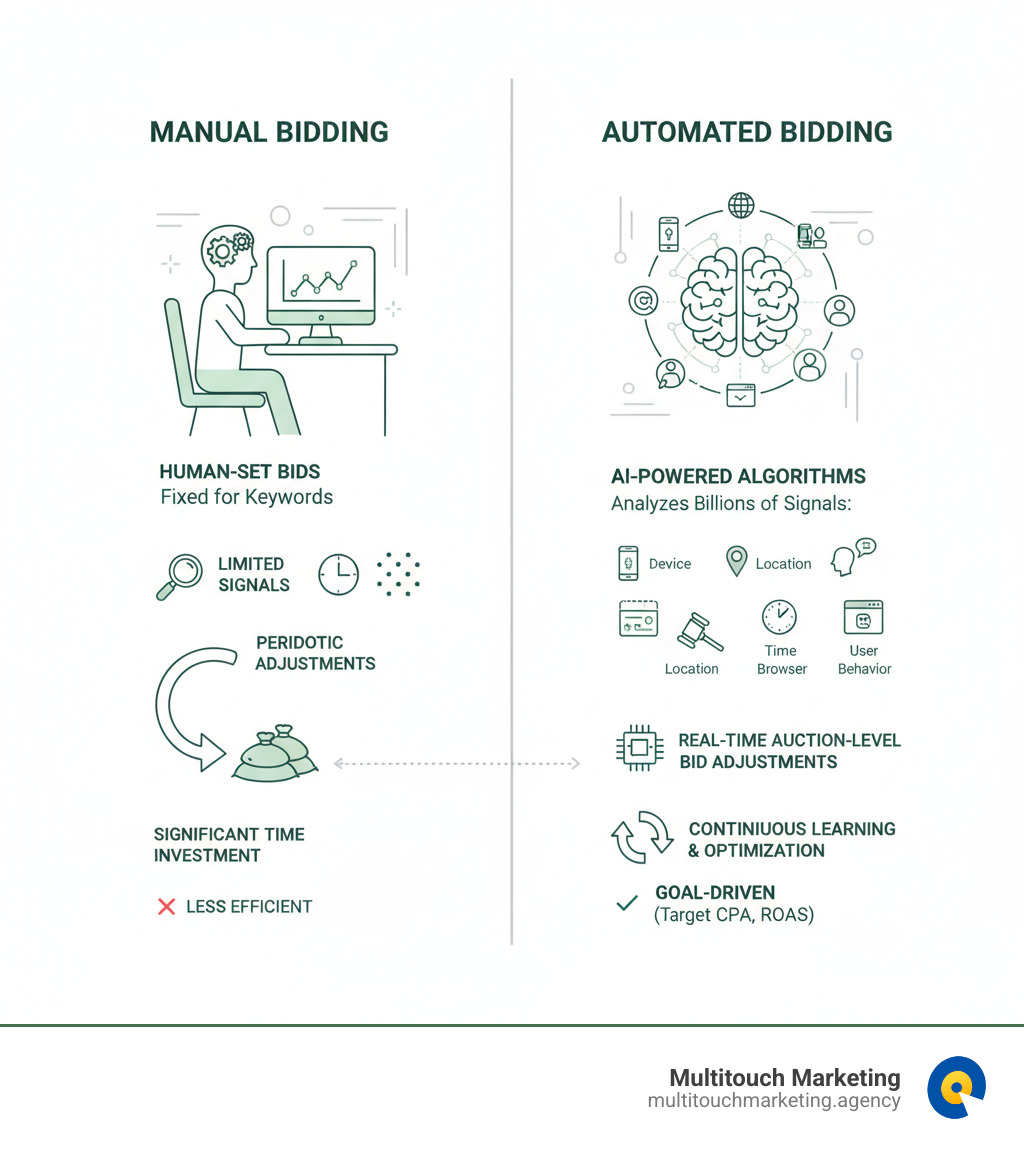
- Real-time optimization that considers signals like device, location, time of day, and user behavior
- Goal-oriented strategies including Target CPA, Target ROAS, Maximize Conversions, and Maximize Clicks
- Learning phase of 7-14 days where the system analyzes data and optimizes performance
- Continuous improvement as algorithms adapt to changing market conditions
The shift to automation is widespread, with over 80% of Google advertisers now using it. This reflects a simple reality: the complexity of modern PPC has outpaced manual management. With countless variables in each auction, automated systems can process data and react in ways humans can’t match.
But automation isn’t a magic button. As one expert notes, “automated bidding isn’t a magic switch; getting it right optimizes budget and performance, but getting it wrong leads to overspending without results. Success requires accurate conversion tracking, sufficient historical data, clear goals, and human oversight.
I’m Milton Brown, and I’ve managed PPC campaigns since 2008 with budgets from $20,000 to $5 million. I’ve seen Automated PPC bidding evolve into a sophisticated system that, when implemented correctly, dramatically improves performance and frees up time for strategic work. Let me show you how to use it effectively.
The Engine of Modern PPC: How Automated Bidding Works
Imagine manually managing a PPC campaign with thousands of keywords. The right bid changes constantly based on whether someone is searching from their phone in downtown Raleigh or a laptop in Chapel Hill, and whether it’s Tuesday morning or Saturday night. Your competitors are also adjusting their bids, constantly shifting the landscape.
It’s exhausting, which is why Automated PPC bidding is a game-changer. AI steps in to handle the heavy lifting.

Here’s how it works: Automated PPC bidding uses machine learning to analyze massive amounts of real-time data during each ad auction. It considers signals like device, location, time, and past user behavior. The system processes these signals to set the optimal bid for that specific moment and search. It’s like having a super-smart assistant who can make thousands of calculations in an instant. If you’re curious about how we harness AI, check out our insights on AI in Google Ads.
Manual vs. Automated Bidding: The Core Differences
The difference is like driving a stick shift versus a car with cruise control and lane assist.
With manual bidding, you set your own maximum cost-per-click for each keyword, giving you complete control. This appeals to advertisers who want to manage every detail. However, this control is incredibly time-intensive. For large campaigns, it’s nearly impossible to keep up, and you’re always playing catch-up with old data.
Automated bidding flips this approach. Instead of setting individual bids, you tell the system your campaign goals, like more conversions or a specific return on ad spend. The algorithm is always goal-oriented, learning, and making real-time adjustments. The efficiency gain is enormous, as it handles tasks in seconds that would take you hours.
The Role of Machine Learning and Data Signals
Machine learning is the engine that powers Automated PPC bidding, learning from millions of experiences simultaneously. For example, if the algorithm notices that mobile users in Durham searching at night convert at a high rate, it automatically increases bids for those auctions.
This learning isn’t instant. When you launch a new automated strategy, expect a learning phase of 7 to 14 days. During this time, the system gathers data and performance might fluctuate. It’s crucial to be patient and avoid making frequent changes, as this can reset the learning process.
The entire system depends on accurate conversion tracking. Without precise data on what happens after a click, the algorithm is flying blind. It needs to know which clicks led to conversions to identify patterns and optimize. This is where predictive analytics becomes powerful, using historical data to forecast future behavior. For a technical look, Google’s guide to Smart Bidding offers excellent details.
What is Smart Bidding?
Smart Bidding is a subset of automated bidding focused specifically on conversions and conversion value. It’s Google’s most advanced AI approach.
Smart Bidding strategies are conversion-focused by design. Target CPA aims for conversions at a specific cost, while Target ROAS maximizes revenue for a target return. Maximize Conversions gets the most conversions possible within your budget, and Maximize Conversion Value prioritizes total revenue.
What makes Smart Bidding special is its use of auction-time bidding. For every search, the system sets a unique bid based on contextual signals like device, browser, location, and time. It evaluates billions of signal combinations to predict the likelihood of a conversion, meaning even low-volume keywords benefit from insights gathered across your entire account. We dive deeper into these approaches in our guide to Advanced PPC Techniques.
Choosing Your Strategy: A Guide to Automated Bidding Types
Selecting the right Automated PPC bidding strategy is about matching the tool to your specific goals. Whether you’re focused on generating leads, maximizing e-commerce revenue, or simply getting your brand in front of more people, your answer determines which strategy will serve you best.
Here are the main options, organized by what they’re designed to achieve.
| Strategy | Primary Goal | Best Use Case | Key Metric |
|---|---|---|---|
| Target CPA | Get conversions at specific cost | Lead generation with clear value per lead | Cost per conversion |
| Target ROAS | Maximize revenue efficiency | E-commerce with varying product values | Return on ad spend percentage |
| Maximize Conversions | Get most conversions possible | Flexible budget, volume-focused campaigns | Total conversions |
| Maximize Conversion Value | Get highest total revenue | E-commerce prioritizing revenue over volume | Total conversion value |
| Maximize Clicks | Drive maximum traffic | Brand awareness, content promotion | Click volume |
| Target Impression Share | Control ad visibility | Brand dominance, competitor outranking | Impression share percentage |
For more context on building comprehensive campaign strategies, explore our More info about PPC Campaign Strategies.
Strategies Focused on Conversions and Value
These conversion-focused strategies use machine learning to identify and bid on opportunities most likely to drive real revenue.
Target CPA (Cost-Per-Action) is your go-to when you know what you’re willing to pay for a conversion. If a new lead is worth $50 to your Raleigh business, Target CPA works to get you leads around that average cost. For this to work, you need sufficient historical data (Google recommends at least 15 conversions in the past 30 days).
Target ROAS (Return on Ad Spend) considers the value of each conversion. This is powerful for e-commerce businesses where products have different prices. It bids more aggressively for searches likely to result in higher-value purchases. Advertisers who switch from Target CPA to Target ROAS often see an average of 14% more conversion value at a similar return.
Maximize Conversions is the straightforward option for getting as many conversions as possible within your budget. It works well when you’re more concerned with volume than cost-efficiency, such as during seasonal pushes.
Maximize Conversion Value is similar but prioritizes the total dollar value of conversions. This strategy is ideal for e-commerce businesses that want to maximize bottom-line results.
All four of these strategies are part of Google’s Smart Bidding, leveraging machine learning to drive measurable outcomes.
Strategies Focused on Clicks and Visibility
Not every campaign is about immediate conversions. Sometimes you need to build brand awareness or drive traffic to content.
Maximize Clicks gets you the most clicks possible within your budget. It’s useful for content marketing or gathering initial data, but be aware that more traffic doesn’t automatically mean more qualified leads. It’s best used as part of a broader funnel strategy.
Target Impression Share is your visibility powerhouse. This strategy lets you control how often your ads appear on the search results page. You can aim for the absolute top position or simply to appear on the page. It’s effective for brand awareness in competitive markets like Durham or Chapel Hill. It can also be used to strategically outrank a specific competitor, an investment that can pay off in brand perception and market share.
Understanding these approaches helps us build campaigns that align with your business objectives. For more detailed guidance, check out our insights on More info about Keyword Bid Strategies PPC Campaign.
Implementing and Optimizing Automated PPC Bidding
Automated PPC bidding is powerful, but it’s far from a “set-it-and-forget-it” solution. Successful implementation requires a thoughtful approach, blending machine learning with strategic human oversight.

The Essentials of Successful Automated PPC Bidding
Before you start, lay the groundwork for success with these best practices.
- Set Clear Campaign Goals: You must define what success looks like. Your goals—clicks, conversions, or ROAS—directly dictate which strategy to use.
- Ensure Accurate Conversion Tracking: This is the most critical factor. The algorithms learn from your conversion data. If it’s faulty, the system will optimize based on bad information, wasting ad spend. For assistance, refer to guides like Set up Google Ads conversion tracking or our own More info about how to Set Up a Google Ad Campaign.
- Sufficient Data Volume: Conversion-focused strategies need enough historical data to learn patterns. If your campaign is new or has few conversions, some strategies may struggle.
- Realistic Targets: When setting a Target CPA or Target ROAS, be realistic. Overly aggressive targets can limit your ad impressions and volume. Start with targets that align with your historical performance.
Monitoring and Adjusting Your Strategies
Automated PPC bidding requires continuous monitoring and strategic adjustments.
- Regular Performance Reviews: Don’t “set it and forget it.” Review campaign performance weekly to look for trends and opportunities the automation might have missed.
- Analyze Bid Strategy Reports: Use the detailed bid strategy reports in platforms like Google Ads to see how the strategy is performing against your goals.
- Adjust Budgets and Targets: Be prepared to adjust budgets and targets (CPA, ROAS) as market conditions and business objectives change.
- Understand Performance Fluctuations: Performance may fluctuate during the 1-2 week learning phase. This is normal, so patience is key.
- Validate with Analytics: Use analytics tools to validate that the conversions being driven are genuinely valuable before scaling investments.
Common Mistakes in Automated PPC Bidding and How to Avoid Them
Here are common pitfalls to avoid when implementing Automated PPC bidding:
- Frequent Strategy Changes: Constantly switching strategies or making manual changes during the learning phase resets the algorithm. Let each strategy run for at least two weeks before making major adjustments.
- Ignoring the Learning Phase: New strategies need 7–14 days to learn. Don’t panic and pull the plug too early; give the system time to gather data and stabilize.
- Poor Conversion Data: Inaccurate conversion data leads to bad automation decisions and wasted ad spend. Treat clean data as a non-negotiable priority.
- Unrealistic Goals: Setting a Target CPA that’s too low or a Target ROAS that’s too high can choke your campaign. Start with realistic targets based on historical performance.
- Neglecting Ad Creative and Landing Pages: Automated bidding optimizes bids, but it can’t fix a bad ad or a poor landing page. Ensure your creative and user experience are also optimized.
- Excessive Reliance on Automation: While automation saves time, it doesn’t replace human expertise. Maintain strategic oversight, monitor performance, and be ready to make informed adjustments.
By being mindful of these mistakes, you can set your automated strategies up for success. For a comprehensive review of your current efforts, consider a Pay-Per-Click Audit.
Frequently Asked Questions about Automated Bidding
We get a lot of questions about Automated PPC bidding. It’s a powerful tool that can feel a bit mysterious at first. Let’s clear up some common questions we hear from businesses in Raleigh, Durham, and Chapel Hill.
What is an automated bidding strategy?
An automated bidding strategy is like having a smart assistant for your PPC campaigns. Instead of manually setting bids for every keyword, you tell Google Ads your goal (e.g., more conversions, better ROAS, more clicks). Automated PPC bidding then uses AI to adjust your bids in real-time, considering hundreds of signals like device, location, and time of day. The system constantly learns and adapts to get you the best possible results for your objective.
When is automated bidding the most effective choice?
Automated PPC bidding shines when you have clear campaign goals. The algorithms need to know what “success” looks like for your business. It’s also most effective when you have sufficient historical data, as strategies like Target CPA and Target ROAS need past conversion information to make smart predictions. Most importantly, you need accurate conversion tracking. Without it, the system optimizes based on faulty data, which wastes your budget.
Finally, automation is ideal when you want to save time and leverage real-time optimization. It handles complex, high-volume bid adjustments far more efficiently than a human can, freeing you up to focus on strategy.
How long does it take for automated bidding to optimize?
Automated PPC bidding isn’t instant. The system goes through a “learning phase” that typically takes one to two weeks. During this time, performance may fluctuate, which is normal. Google’s algorithms need about 7–14 days to gather enough data to recognize patterns. The worst thing you can do is make frequent changes during this period, as it resets the learning process. Patience is key. Once the system stabilizes, you’ll start seeing the real benefits of automation.
Conclusion: Balancing Automation with Human Expertise
Automated PPC bidding is incredibly powerful, but it’s not magic. It’s a sophisticated tool that, when wielded correctly, can transform your advertising results. But like any tool, it works best in skilled hands.

Think of automated bidding as a brilliant assistant that handles the tedious work of constant bid adjustments, freeing you to focus on strategy. For businesses in Raleigh, Durham, and Chapel Hill, this technology offers a significant advantage.
But that assistant still needs direction. Algorithms can’t write compelling ad copy, understand market nuances, or make judgment calls based on business priorities. The most successful PPC campaigns combine the best of both worlds: machine learning handles the computational heavy lifting, while a human marketer provides strategic vision.
This is where we come in at Multitouch Marketing. We don’t just set up automated bidding and walk away. We actively guide these systems, monitoring performance and making strategic adjustments to ensure your budget works as hard as possible. We know that Automated PPC bidding is most effective with a knowledgeable team providing ongoing oversight.
The need for human expertise, creativity, and strategic thinking only becomes more valuable as technology advances. Someone needs to ask the right questions and make decisions that align with your unique business goals.
Ready to harness the power of automation with a team that knows how to guide it effectively? We’re here to help you achieve results that move your business forward. While you’re exploring our PPC services, Learn more about our social media marketing services to see our comprehensive approach to digital marketing.